
Follow Up on Recent Issues on China Law & Policy

By , July 28, 2010

A worn out Senate Majority Leader, Harry Reid

The past week has provided closure to two issues China Law & Policy has been following  for the past few months.  Last week, Senate majority leader Harry Reid announced that the Democrats would not be moving forward on the climate change bill that had been sitting in the Senate for the past year.  Although the bill had the potential to completely reorganize the U.S.’ energy policy, the Democrats were unlikely to get the votes necessary to pass the bill and opted not to try.

The death of the climate change bill raises serious questions about the U.S.’ ability to compete with China on green technology.   The Chinese government has made major and obvious commitments to green technology, attracting capital from around the world.  Without a coherent energy policy, don’t expect investors to seek out green technology opportunities in the U.S.  Until the U.S. has a more coherent policy, anticipate the continued flow of capital to China.

As if the failure of climate change legislation was not enough, the Senate announced yesterday that it would not take up the DISCLOSE Act, the House of Representatives’ response to the Supreme Court’s decision in Citizens United v. FEC, a decision that expanded corporations’ speech rights in U.S. elections.  As China Law & Policy wrote soon after the decision, Chinese companies, some of which have ties to the Chinese government, could use the loophole of their U.S. subsidiaries to donate to U.S. campaigns. China Law & Policy testified before Congress in May on the legislation – the DISCLOSE Act – as it was being considered by the House of Representatives.  Looks like we won’t be testifying before the Senate anytime soon.

Gees, did Harry Reid just have the worst week ever?

Just for Fun: Tips for Travelers – Avoiding Stress in Beijing

By , July 26, 2010

Visiting Beijing anytime soon?  Or merely just thinking about it?  As anyone can tell you who has ever been, in a city of  close to 20 million people on a land mass roughly the size of New York City, it is a stressful place.  So it is important to know how to remain calm and relaxed in a city that is anything but.  Susan Fishman Orlins, one of the first Americans to live in Beijing after the U.S. normalized relations in 1979, and a notorieous worrywart, offers her suggestions on how to avoid the stress of Beijing and live the imperial lifestyle while there.  Didn’t Puyi ride a bike too? 

What worries me most in Beijing is the air quality. When I view this smoggy city-as though through gauze or an organdy curtain soiled with age-I’m pleased with my choice to get around on a two-wheeler rather than sit in traffic jams, contributing to the pollution. You can rent a bike at any of several subway stations and drop it off at any other subway rental area. Be aware that, traffic-wise, the bigger you are, the more you have right of way. At intersections, cars turn from all four directions, seemingly at once, without slowing down. As for a helmet, don’t leave home without one!…Read More of Susan’s Travel Tips Here.

More of Susan’s worries, and writings on China, can be found at her blog –  Confessions of a Worrywart: Meditations on All that Could Go Wrong.  After reading one or two posts,  you will find yourself happily worrying too.

When the Murder Victim Turns Up Alive – Will Justice Be Served?

By , July 21, 2010

Zhao Zuohai, freed after 11 years in jail for a murder that never happened

May 2, 2010 was the day that Zhao Zuohai got his life back.  It was also the day that China was forced to re-examine its criminal justice system and deal with the very real fact that many innocent people in China are in jail.

In 1999, after being tortured for 33 days, including being handcuffed to a chair, beaten with sticks and denied eating and sleeping for long periods of time, Zhao Zuohai, a poor farmer from a village in Henan Province, confessed to killing a fellow villager who had gone missing.  Although only a behead body was found, its identity not 100% certain, Zhao was convicted of murder.  But after Zhao served 10 years of his 29-year sentence, the “murder victim” turned up alive, returning to his village to obtain his social security benefits.  On May 10, 2010, a court threw out Zhao’s conviction and Zhao returned to his village.

Zhao’s wrongful conviction led to a very open critique of the Chinese criminal justice system and produced changes.  At least on paper.  A month after Zhao was freed, China passed its first rules to exclude during a trial any confessions obtained through torture.  While the regulations had been a work in progress for at least the past year, Zhao’s case likely sped up their issuance.  Then, on Friday, the Supreme People’s Procuratorate  took action, upgrading its compensation scheme for wrongful conviction from 111.99 yuan (approximately $16.50) to 125.43 yuan (approximately $18.50) for every day of a person’s sentence.

Although the recent police investigation into the circumstances surrounding Zhao’s detention has been surprisingly candid, with the public release last week of the police’s investigation (in the form of a “prosecution recommendation proposal” as required by Article 129 of China’s Criminal Procedure Law (CPL)), actual repercussions for the perpetrators remain to be seen.  While five police officers have been charged with “forcing a confession,” all remain free out on China’s equivalent of bail.  Unlike in the U.S., bail is notoriously uncommon in China, where suspects remain in custody up until trial.  The example of Australian national Stern Hu is typical – denied bail even though he posed little to no flight risk.

The decision to release a suspect on bail is usually made by a high official in the police or the prosecutor’s office.  And if the recent case of Xu Zhiyong is any guide, bail means that the case will likely never go to trial.  While it creates a legal limbo for the suspect, the suspect remains free, which beats sitting in a Chinese prison.

The fact that the five police officers responsible for the torture of Zhao Zuohai are on bail means that a trial against them is unlikely.  Additionally, a recent article by Shen Bin, a Shanghai lawyer, questions if a case can even be brought against the police (English translation courtesy of the Dui Hua Foundation).  Article 87 of the Criminal Law (CL) sets a statute of limitation for criminal prosecutions; for crimes that receive a sentence of five years or less, the statute of limitations is five years. In this case, the maximum sentence the police could receive is three years (CL Article 247), making the statute of limitations for bringing a case five years, which Zhao Zuohai’s case has long surpassed. Article 88 of the CL permits the statute of limitations to be ignored if the victim brought a charge of prosecution and the prosecutor ignored it, but it is unclear if Zhao Zuohai’s complaints of torture soon after his conviction are sufficient to rise to the level of “charge of prosecution.”

Zhao Zuohai’s wrongful conviction case confirms a criminal justice system that has a lot of failings.  But it also shows a somewhat more open Chinese government willing to confront some of these issues and a populace seeking to better protect criminal suspects.  However, with the fact that the police who tortured Zhao remain free on bail with little risk of prosecution, China still has a way to go before the danger of wrongful convictions is minimized.

Happy Birthday China Law & Policy!

By , July 18, 2010

Last Thursday marked China Law & Policy‘s first year anniversary, giving us an opportunity to take stock.

When I started this website last summer, a good friend who has his own website told me I should be happy if I get more than 10 hits a day.  And I was.  Things started out slow, but when I was getting a consistent 20 hits a day, I felt good.  But now, a year later, China Law & Policy receives over 1,500 hits a month, with a subscriber list of over 200 people.  In a year, China Law & Policy has published 103 articles, covering a variety of issues, some serious, and some a little less so.  But all with the purpose to offer a different perspective on China and to better inform the U.S. public about issues pertaining to China.

Interestingly, the two most popular articles both involved criminal justice in China.  The article on British citizen Akmal Shaikh’s execution in China at the end of December received the greatest readership (Death Sentence for British Citizen Upheld; Execution Date Set).  But our April 19 article on the Rio Tinto trial in China (Rio Tinto Trial in China – A Miscalculation about Rule of Law?) and Prof. Vivienne Bath’s critique of the article (A Response to Rio Tinto – A different Opinion from Australia) was also extremely popular with our readership.  Rounding up the top three is from the “Just for Fun” section about Lady Gaga’s popularity in China (Oh My Lady Gaga! A Star is Born in…China).

China Law & Policy has also been very fortunate to attract other talent as well.  Marcy Nicks Moody, a regular contributor, has written a series of hard hitting articles about economic policy and trade issues between the U.S. and China.  Her article on China’s response to the Haiti earthquake (In the Aftermath of Haiti’s Earthquake: Where is China?) offered an interesting perspective on China’s soft power and was picked up by many other websites.  We also have had great articles from trade specialist Adam Bobrow, Chinese lawyer and professor Cao Xinglong, longtime China-watcher Susan Fishman Orlins, Gaga expert and Uigher food enthusiast Thomas Cantwell, and Chinese art expert Taliesin Thomas.

One of the goals of China Law & Policy has been to offer an outlet to a younger set of China-watchers, those who have come of age with a China that has always been a friend and never a foe.  The mainstream press is still largely reserved for an older set of “China experts” – those raised during the Cold War and who had to deal with the baggage of Red China vs. Free China (the Mainland vs. Taiwan), baggage that today’s younger China watchers do not have to carry.

In the next year, China Law & Policy would like to increase the number of guest bloggers and further diversify the opinions offered on the website.  We would also like to have more articles from Chinese scholars.  Prof. Guo Zhiyuan’s interview on mental illness and the Chinese criminal justice system remains our most popular interview.

Finally, China Law & Policy would like to thank all of those who have been supporters of the website.  From the beginning, there have been many that have constantly encouraged, provided article ideas and new ways of thinking of issues; this support has truly been invaluable.  Thank you.

But we still want to hear from you. Have ideas about what China Law & Policy should do in the next year?  Have topics that you think China Law & Policy should cover?  Or just general comments?  Please use the comment section to let us know.  Thank you for your continued support!

Just for Fun: Oh My Lady Gaga! A Star is Born in…China

Lady Gaga from the Pokerface Video

Originally Posted on The Huffington Post

In just over two years since her debut of “The Fame,” Lady Gaga has come to dominate the airwaves, profoundly impacting pop culture throughout the world.  With her sold-out concerts in New York City this week, China Law & Policy asks the question that everyone wants to know the answer to: yeah, you might be famous in the U.S, but are you big in China?

Mao Zedong once said “the revolution is not a dinner party.”  In China right now, it’s a dance party and Lady Gaga is the DJ.  In malls throughout the country – from cosmopolitan Beijing to the smaller city of Zhengzhou –  the addictive beats of Lady Gaga’s  electro-pop boom incessantly.   And China’s youth adores her, at least the ones I talked to.  They might not understand all the words to her songs but they get her message – “different”, “unique”, “rebellious” – all adjectives used to describe her by the students I interviewed.

Chinese pop star, Da Zhangwei, copies Lady Gaga's Muppets outfit

Lady Gaga’s videos and music are just as popular in China as they are in the U.S.  And as in the U.S., her fashion has sparked imitation across China.  Because it is bizarre, Lady Gaga’s style is copied by Chinese pop stars in a sort of homage to her (click here for a side-by-side comparison montage).  Average people want to achieve her style as well.  On China’s nationally syndicated talent show “Ni Zui You Cai” (“You’re the Most Talented”), dance performances to her music are common (check out this number to “Poker Face”) and when judges on the show compare a singer or dancer to Lady Gaga, the audience explodes in a raucous of cheers, excited just to hear her name.

In fact, Lady Gaga is so popular right now that her name is barely ever translated into Chinese characters, much to the chagrin of Chinese officials (if it is translated, it is usually translated as 雷帝嘎嘎 (“Lei Di Ga Ga”), meaning “Thunder Emperor Gaga”).  Even for Michael Jackson and Madonna, their names are almost always translated into Chinese characters.  But for Lady Gaga, her English name is not only brazenly used by the Chinese youth but has become a part of Chinese slang; nowadays, Chinese young people no longer use the phrase “Oh My God” to express surprise or amazement; instead internet chat rooms and regular conversations are filled with “OMLG!” – “Oh My Lady Gaga!”

I get why Lady Gaga is popular in China.  She’s so deliciously “plasticy” – her music and her fashion – and plasticy is big in China.  The drama that she brings is also attractive to a culture where “melodrama” does not carry a negative connotation. Her music videos like “Paparazzi” and “Telephone,” with their overly emotional acting and vindicated female characters, are more like a Chinese soap opera than anything you would see in America.

But there has to be something more than just the plastic melodrama.  If that is all it took, Lindsay Lohan or Paris Hilton would be huge in China (they are not).  So what is it about Lady Gaga that she appears to be the biggest star in China right now?  I’m no expert on pop culture, so I sat down and discussed the issue with my friend and self-proclaimed Gaga expert, Tom Cantwell.  “She’s popular in China because she is accessible” says Tom.   Her music is simple-lyric dance music with addictively catchy beats behind the simple words (“bang bang, we’re beautiful and dirty rich” with a beat supporting each word).  That’s the appeal of dance  music – its simplicity – and also what makes it universally loved. Think about it, there is a reason why Wham!, the British dance duo, was the first Western music group to perform in China back in 1985 and why someone like Jay-Z, with his more intricate melodies that are purposely off the beat, is not widely popular outside of a small hip-hop fan-base on the Mainland.

Tom went on to say, “Yes, her music is accessible but so is her fashion.”  Accessible?  She wears no pants half of

Gaga fan with cans in her hair await the Today's Show Free Lady Gaga Concert, July 8, 2010

the time and muppets the other half.  “Of course.”  As Tom explained, someone like Beyonce, who is beautiful and dresses in the highest of fashion, is absurdly inaccessible for the average person in both the U.S. and China.  But Lady Gaga creates outfits, making her fashion style achievable with some imagination.  “I can just imagine a Chinese girl in some factory town, inspired by Lady Gaga, putting tin cans on her head” Tom said.

That sentiment was echoed in my conversations with the Chinese young people I spoke to.  While everyone mentioned Lady Gaga’s music, what they really stressed was her fashion.  Although each mentioned that Chinese culture was still too traditional for Lady Gaga’s fashion to be widely copied in China, there was a tinge of envy in their voices, one young man even commenting that he looked to others to have the “courage” to copy her style.  And that’s what is most interesting about this Lady Gaga phenomenon in China; for all the talk in the West about the Chinese youth not being taught to be “free thinkers,” their love for Lady Gaga demonstrates that they do have an independent streak in them.  One that appreciates and respects differences and the absurd.  And just good, fun dance music.

Slip Slidin’ Away: Google in China

Google's Chief Legal Officer, David Drummond

Google's Chief Legal Officer, David Drummond

Originally Posted on The Huffington Post

The long, publicly drawn-out saga of Google in China continues.  And at this juncture, one wonders why.  On Monday, Google’s Chief Legal Officer, David Drummond, posted a blog entry to share with the world Google’s new troubles in China.  Drummond announced that in order to acquiesce to Chinese officials’ demands and guarantee that the Chinese government renew Google’s Internet Content Provider (ICP) license, Google would change certain aspect of its Chinese website, Google.cn.  This certainly is a different Google than the one just six months ago that had its guns blazing.

Back in January, after Google’s servers were hacked by an attack likely originating in China, Google announced that it would no longer censor its results on its Chinese search engine, Google.cn.  While the two issues – hacking and censorship – seem to have little to no relation to each other, Google successfully played up its moral stance against China’s internet censorship in the West and became the darling of the Western press for maintaining its motto of “don’t be evil.”  A few questioned Google’s sincerity (see here) and wondered if Google would have taken such a moral stance if its withdrawal from the largest internet market in the world had a greater impact on its profits.  In general however, Google was heralded as upholding freedom of speech and human rights.

But Google’s pull-out from China did not mean that it shut down its Google.cn site.  Instead, in order to conform with Chinese law and also with Google’s promise not to censor search results, Google redirected all traffic from Google.cn to Google.com.hk, a website locate in Hong Kong and thus not subject to the censorship rules of the Mainland.  Visitors to Google.cn would be automatically redirected to Google.com.hk.  But this doesn’t mean that a search on Google.com.hk, when conducted from the Mainland, is free from censorship.  The results from such a search are in fact censored – it’s just that Google itself is no longer doing the censoring; instead, China’s internet technology does the censoring (for an explanation of the different types of internet censoring in China see here).

Now though, Google’s make-shift solution has raised the ire of the Chinese government and Google fears that its ICP license is at stake.  Under the Telecommunications Regulations of the People’s Republic of China (PRC), every website that operates inside the borders of China, must obtain an ICP license.  Thus, Google.cn, which is housed within China’s borders, needs an ICP license; but Google.com, the U.S.-based search engine which is accessible on the Mainland, does not need an ICP license since it is housed within the U.S.  If the Chinese government does not renew Google.cn’s license, then the site will be shut down and will no longer exist.

What the Chinese government doesn’t like, at least according to Google, is the automatic redirection of traffic from Google.cn to Google.com.hk.  So to appease the Chinese regulators, Google has changed it so that there is no longer an automatic redirection; instead, Google has added a line on Google.cn stating in Chinese that the site has been moved to Google.com.hk and the if the user clicks anywhere on the page, he or she will be redirected to Google.com.hk.  So instead of an automatic redirection, it now takes a simple click.  According to Google, it needs Google.cn so that Mainland users will know that they can access a Chinese-language search language at Google.com.hk (Mainland users can in fact access Google.com, the U.S.-based search engine, but its interface is in English, not Chinese).

But will this change make a difference?  While technically there is a distinction between an automatic redirection to the Hong Kong-based site and a quick click of the mouse on the Google.cn website to get there, in reality it is more of a distinction without a difference.  Will the Chinese government find this distinction acceptable and renew Google’s license?  Or will it reject Google’s license renewal application?
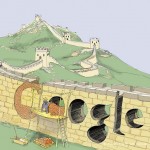
If the Chinese government does reject Google’s ICP license renewal application where does this leave Mainland internet users?  Basically in the same place that they are in now, causing one to ask Google, what’s the big deal?  Contrary to popular belief, Chinese internet users have access to Google.com, the U.S.-based site, as well as direct access to Google.com.hk.  A search by a Mainland user on either of these sites will produce the same Chinese government-censored results.  If the Chinese government rejects Google’s application, the only difference will be that Google.cn, the Mainland-based site, will be shut down and will no longer exist.  So unless a Mainland internet user knows to go to Google.com or Google.com.hk, he or she will likely turn to the Chinese-based search engine, Baidu.com.  Since the start of “the troubles” between Google and the Chinese government in January, Baidu has increased its market share of internet users, from 58.4% to 64% of the market.  Google’s market share in China, with the automatic redirection to Google.com.hk, has decreased from 35% to 30% (see Rebecca MacKinnon, June 30, 2010 Congressional Testimony, p. 7).

Although Google’s loss of the search engine market share in China was likely inevitable since Baidu benefits from its close and special relationship with the Chinese government, it’s still important for Google to maintain its Google.cn website in China and have some sort of a toe-hold in the country for future development especially.  Currently only around a third of China’s population are internet users, causing internet companies to salivate at the potential profits in China.  Other Google applications, like Gmail and Google Earth (Google’s mapping tool), could also bring in huge amounts of revenue.  Google Earth is particularly promising since China has begun to make efforts to provide its population with accurate online maps.  In fact, this past June, Google applied for approval as one of China’s officially-licensed internet mapping companies.  But as of July 1, such approval does not look likely.  The Chinese State Bureau of Surveying and Mapping just issued a list of mapping companies it deems of “high quality,” a prerequisite for approval.  Google is not listed.

Google potentially has a lot to lose, at least profit-wise, by continuing to take a hard-line against the Chinese government, and that might explain its current change in demeanor and willingness to acquiesce to the Chinese government.  But Google’s attention to its business interest should not come as a shock; in fact, that’s likely what caused it to pull-out of China in the first place. A   corporation’s raison d’être is to maximize profits for its shareholders.  Regardless of what Google might say — that its goal is to “not do evil” — it is ultimately responsible, under law, to its shareholders.  And that’s the way it should be.  Society should not rely on corporations to act as stand-ins for its values.  It is the role of governments, individuals and non-governmental organizations (NGOs) to advocate on behalf of human rights and society’s moral values.  Corporations are not there to police themselves; others must do it for them.  Individuals and NGOs have the ability to shine the media spotlight on corporations’ morally-offensive behavior, calling for boycotts and effectively raising the economic cost of conducting undesirable business practices.

Governments can and should pass laws that are economically punitive to corporations that conduct morally-offensive
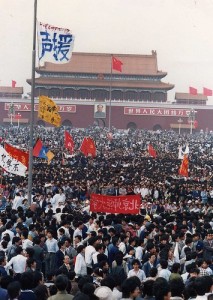
Tiananmen Square Protests, Spring 1989 - before the Government Crackdown

activities, making such actions too high of an economic cost to that company.  In fact, in terms of internet and technology, the U.S. already has such regulations.  Known as the Tiananmen Sanctions, and passed after the 1989 Tiananmen Square protests, Congress can deny export licenses to those U.S. companies that sell “crime control and detection instruments and equipment” to China (Congressional Research Service, “China: Economic Sanctions,” p. 2).  But these sanctions are never used.  U.S. companies like Cisco, Oracle and Motorola have provided Chinese state security forces with the technology necessary to police the internet.  Aside from a few articles in the U.S. press, these transactions have received little to no censure.

China’s internet censorship should not be condoned.  But Google is not the champion of our moral values, nor should it be asked to be.  The responsibility lies with us, through our elected officials and through our own actions.  But so far it appears that society is more willing to hide behind the mask of Google’s actions, seeing its pull-out from China as some moral victory instead of a business dispute.  This is unfair to Google, detrimental to the Chinese people and undermines the values which we hold dear.

Panorama Theme by Themocracy