How China Beat the U.S. and Became the New Green Tech Giant

By , August 31, 2010

China marches on to be the global green tech leader

Originally Posted on Foreign Policy Digest

China no longer needs to worry about the U.S. as a serious green technology competitor because the U.S. just left the race. After a year-long impasse, Senate majority leader Harry Reid confirmed on July 22, 2010 that the Democrats would not be able to secure enough votes to pass the American Clean Energy and Security Act and, thus, would abandon any further efforts to do so.

But, in today’s globalized economy, rising powers like China are willing and readily able to capitalize on America’s missed opportunities. The climate change bill would have provided a coherent U.S. energy policy, directed investment to green technology and created much-needed American jobs. Instead, those investment and job opportunities will likely go to China. With China’s rapid expansion into the clean technology sector, the U.S. is being left behind and leaving many to wonder–will it ever be able to catch up?

BACKGROUND

Although the U.S. debate on climate change dwells on the prevention of environmental damage, the Chinese government focuses on the economics of climate change, emphasizing the direct link between clean technology and China’s energy security and economic competitiveness. Former Center for American Progress senior policy analyst Julian Wong explained in a recent testimony before the U.S.-China Economic and Security Review Commission that China’s emphasis on the economic upside of clean technology has imbued its energy policy with a greater sense of urgency, allowing the country to surpass the U.S. in many renewable energy industries.

With over 4,000 miles of track laid domestically, China is the leader in high-speed rail.  It has pledged $300 billion to bring high-speed rail to many parts of the country and is exporting its expertise to Turkey, Venezuela, Saudi Arabia and potentially, even California. Notoriously stingy at funding its rail system, the U.S., on the other hand, has pledged a relatively paltry $8 billion and has only one high-speed rail line. Instead of developing cleaner rail technology, the U.S. continues to develop carbon-intensive modes of transportation, investing in highways and air transit.

China has also become a global leader in the renewable energy sector. As the leading manufacturer of solar panels, China exports most of its solar panels overseas. As for wind, China installed the largest number of wind turbines in the world in 2009, expanding its wind capacity by 13 GW. By contrast, the U.S. only expanded its capacity by 10 GW in 2009. But, China’s prowess in renewables should not come as a surprise. In 2009, China invested $34.6 billion in green technology, making it the leader in renewable energy funding; the U.S. came in second, investing $18.6 billion.

Some critics argue that the Chinese government has an unfair advantage because an authoritarian system can funnel money easily to industries it wants to promote. The largest commercial banks in China are state-owned and–at the insistence of the central government–have provided ample low-interest loans to green technology companies. The U.S. market economy, on the other hand, cannot require American banks to give out favorable loans. Furthermore, China has used protectionist policies, like its “indigenous innovation” policy, to promote home-grown companies at the expense of foreign ones.

ANALYSIS

While some of these arguments are reasonable and should be addressed in trade talks with the Chinese, their importance in explaining the U.S.’ second-fiddle status is exaggerated. The criticisms serve only to obscure the real issue behind the U.S.’ downfall in the green technology sector – the lack of a coherent national energy policy. In the U.S., the climate change debate too often ignores the important role of government in promoting emerging industries within the capitalist framework and cooperating with the private sector. Silicon Valley, for example, flourished because of government support and its close ties to government, particularly the defense agencies. To attribute China’s competitive edge to its planned economy is to suggest that capitalism and free markets are what hinder the U.S. ability to be a viable competitor in the global green technology market. But, American history shows that government support bolsters innovation.

Capital will flow to where there is some level of certainty in investment. Venture capitalists are sinking their dollars into China’s green technology because the Chinese government has a crystal-clear policy, which it has backed by huge investments in renewable energy–sure signs of a government’s sincere commitment to promoting green tech. These investors are also receiving huge returns on their Chinese investments.  China’s richest person is now believed to be Wang Chuanfu, founder and chairman of BYD, a battery and electric car company in China.

Furthermore, it’s not just Chinese capital that is flowing. This September, Chinese wind turbine manufacturer Mingyang Electric will seek to raise $500 million in an initial public offering in the U.S. If the U.S. wants that capital to remain within its borders, the federal government needs to make an equally strong commitment to renewable energy. Until Congress passes some sort of legislation signaling its commitments to certain industries, capital–even U.S. capital–will continue to flow to China and green technology innovation in the U.S. will remain at a standstill.

In his testimony, Julian Wong raised the crucial point that, although the U.S. still leads China in green technology research and development (R&D), eventually, those R&D dollars will want to move to China, too. By its nature, R&D needs to be geographically close to its manufacturing base, as well as to the end users of its products. In fact, some U.S. companies–including important players like Applied Materials, DuPont, and IBM–have already begun to move their green tech R&D to China.

China has clearly surpassed the U.S. in key green technology industries and has established the economic infrastructure to lead the green technology market. Instead of trying to stay on the offensive, Congress has defensively decried China’s authoritarian government and indigenous innovation policies and aroused fear of China’s threat to American economic dominance. Aside from rhetoric, it is unclear what substantive actions Congress is taking to make the U.S. green technology sector more competitive. If the U.S. followed China’s example in passing green tech-friendly policies, it may be able to catch up. But, by ignoring that possibility and abandoning any hopes of climate change legislation, Congress has, instead, opted out of the green technology race. Unfortunately, the only losers in Congress’ ill-fated decision are the American public and the millions of Americans still out of work.

Just For Fun: Movie Review – Mao’s Last Dancer

By , August 22, 2010

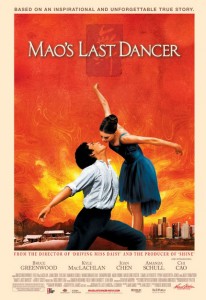
Mao’s Last Dancer tells the true story of ballet dancer Li Cunxin’s defection to the United States in 1981.  The film is fairly average, not particularly well-acted (aside from Bruce Greenwood who plays the complex character of Houston Ballet choreographer Ben Stevenson and does a superb job) and at times way too dramatic.  Joan Chen makes an appearance as a poor Chinese peasant, raising seven sons in the stark mountainous countryside of Shangdong province, and of course, looks as beautiful as ever.

But the movie is not a complete wash out in that it takes a snapshot of a very important time in U.S.-China relations and tells the story of a tense 21-hour period in this new-found relationship.

The film opens in Li’s impoverished home village outside of Qingdao, Shangdong Province.  It is 1972, the height of China’s Cultural Revolution, socialist rhetoric is running high and Li is 11 years old.  When Party officials visit his mud-walled school, Li is selected for a competition in which the winning students will be sent to Beijing to study.  It’s not until the next day, when Li is asked to do various tumbles, twists, and handstands that his family finally realizes he has being selected to attend the Beijing Dance Academy.  The director, Bruce Beresford (Driving Miss Daisy), does a great job of distinguishing the feelings of the two generations – Li’s parents want him to go to Beijing because they know that this will offer their son a better life; Li goes because he feels a sincere sense of obligation to his motherland.  And that is what is great about this movie – in a very nuanced way it shows the sincerity of the young people’s belief in the teachings of the Cultural Revolution.  Li was born on the eve of the Cultural Revolution and his whole life he has been indoctrinated with its teachings and has come to believe them.  No other movie I have seen about the Cultural Revolution has been able to effectively capture this subtle fact.

Fast-forward nine years (note: plot spoiler!) and Li is a star.  At least in China.  He performs twice for Chairman Mao’s wife, Jiang Qing, and when Ben Stevenson arrives as part of the various “good will” cultural tours immediately after China and the U.S. normalized relations, Li is the only dancer he considers talented.  As a result, Stevenson invites Li to study in Houston as an exchange student for six weeks in the summer of 1981.

Kyle MacLachlin in Mao's Last Dancer

Kyle MacLachlan in Mao's Last Dancer

Ensues are various skits about Li adjusting to American life – the usual “look how different America is from China”, “look at the extravagant Americans” scenes.  But eventually Li becomes a star, performing the lead role in one of the Houston Ballet Company’s premier summer events.  Li also begins dating one of the American ballerinas.  Needless to say, Li doesn’t want to go back when his time has come but because the Chinese government fears that Li is getting too soft, does not allow him to extend his visa.

Li speaks to a lawyer (played very well by former Twin Peaks star Kyle MacLachlan) about his options, and (note: plot spoiler!) rushes into a hasty marriage to his American girlfriend.  When he goes to tell the Chinese consulate, he is kidnapped and held in the consulate for 21 hours. With the help of his attorney and the Department of State, Li is eventually freed but informed that he has been stripped of his Chinese citizenship and will not be permitted to ever return to China.

And this is where the movie gets weak.  We are never told what propels Li to choose America over his family.  How was he able to so easily break with the Communist rhetoric that he had learned his whole life (when he first shows up to America, he is constantly wearing his Mao pin)?  Aside from having sex with his girlfriend, we never see Li getting close with anyone in America.  How did he leave his whole family?  Was it just his youth?  There is so much here that the director could have easily used to better explain Li’s choice.  Instead, it seems to be a mechanical decision and on some level plays on the Western bias of “well of course he would want to live in the West.”  It wasn’t until I got home, researched Li Cunxin and read excerpts from his autobiography that I learned that his rejection of the Communist teachings was actually an important part of his decision.

The real Li Cunxin with his wife and two daughters. All live in Australia.

The real Li Cunxin with his wife and two daughters. All live in Australia.

But even in light of that, being reminded of the relationship between China and the U.S. soon after normalization in 1979, is an important thing, especially for younger China watchers.  China did not really enter my orbit until the early 1990s.  And by then, it was a very different China.  Seeing a China just entering its Reform & Opening period, and watching the U.S. and China (note: plot spoiler!) coordinate efforts to reunite Li with his parents at one of his performance (note, melodrama runs high in this scene) reminds us of a time when symbolic good-will gestures between the U.S. and China helped move a relationship forward.  How times have changed.

For the historical value, for some of the nuanced scenes of political indoctrination, Bruce Greenwood’s performance, and for the scenes filmed in China, it is worth watching.  But wait till it comes out on DVD.

Rating: ★★½☆☆

This movie is now available on DVD: Mao’s Last Dancer
 

NYU To Celebrate Prof. Jerome A. Cohen, Founder of the China Law Field – Sept 7 – NYC

By , August 18, 2010

Prof. Jerome A. Cohen

To celebrate Jerry Cohen’s 80th birthday,  NYU’s U.S.-Asia Law Institute will be dedicating its annual Gelatt Dialogue on Tuesday, Sept. 7 to Jerry and the impact that his 50 years of study has had on the study of Chinese law.

A cross-generational event, the evening will feature those who were with Jerry when the field was first born in the early 1960s (Prof. Randle Edwards), those who helped Jerry open law firms in China in the late 1970s, early 1980s (Stephen Orlins, Owen Nee), and those who work with Jerry on his current rule of law projects in China (Daniel Yu, Hyeon-Ju Rho, Alex Wang, Margaret Lewis, Cynthia Estlund).

“Let a Hundred Flowers Bloom: A Roundtable Discussion on China’s Legal System” will analyze China’s progress these past 50 years and look at what the future may potentially hold.  The event is free and open to the public although RSVP is requested.  Details are below or can be found at the US-Asia Law Institute website (http://www.usasialaw.org/?p=3969).  Given the wide experience of the panelists, the event should be interesting and, given that all of the panelists were students of Jerry’s, should be a wonderful homage to his work

Gelatt Dialogue on “Let a Hundred Flowers Bloom: A Roundtable Discussion on China’s Legal System”

Celebrating Prof. Jerome Cohen’s 80th Birthday
Tuesday, Sept. 7
4 pm – 6:30 pm
Reception to Follow
Greenberg Lounge, Vanderbilt Hall
NYU Law School, 40 Washington Square South
RSVP req’d to Jeremy.Daum@nyu.edu (Subject Line: “Gelatt”)

Summer Reprieve

By , August 15, 2010

With the remaining three weeks of summer, China Law & Policy will be hitting the beach, so blogging might be less than regular.  Do not be alarmed.  We anticipate returning to regular blogging post-Labor Day.  There might be a few articles here and there before that – who knows what China-related things might be happening at the beach and China thoughts we might have will sipping mai tais in the sun.  But we will be actively back starting Sept. 7.

Thank you for your continued readership!

Just for Fun: Restaurant Review – Macao Trading Company

By , August 5, 2010

Macau Trading Company - 311 Church Street, NY

***NOTE – On a return back to Macao Trading Co. in October 2011 (just for drinks), no longer on the menu were the to-die-for-lamb-chops. Given that the lamb chops were the best thing listed in the review, it’s questionable if a trip to Macao is worth it. Certainly the ambiance is still there and it would still be a good place for your out-of-town mother-in-law, but the food is only average; edible but average.***

Macau may be a tiny island neighboring Hong Kong, but it has an air larger than life.  The first and last European colony in the Far East (the Portuguese arrived in Macau in 1557, leaving 400-odd years later in 1999), Macau still maintains the romantic feel of its colonial past, where East meets West in the culture, architecture and food.  But with the romantic, there is also the illicit air of Macau’s colonial past.  As the gambling mecca of Asia since the 1850s, organized crime has permeated, controlling Macau’s largest industry – the casinos – and in many ways, its government as well.

But it’s this feel of illegality that makes Macau attractive and the backdrop for some of Hong Kong’s best gangster films.  So when my friend suggested that we have dinner at Macao Trading Company in New York City’s Tribeca, I was excited at the chance to be transported back to the mysterious and dark Macau.

Unfortunately, Macao Trading Company doesn’t exactly live up to its namesake, but not for want of trying.  The bar area of the restaurant could easily be found in the streets of Macau, with strong teak wood elements, Buddha statutes, and iron fans.  But as I sat there, sipping on a glass of Portuguese wine, waiting for my dining companions, I realized that the fault lied more with the customers.  Americans just don’t do colonial sleazy nearly as well as their European counterparts; we are too earnest I suppose.  But in order to help overcome such a deficit, the bar offered a wide selection of drinks, with specialty cocktails starting at $14 each (including a $15 mai tai).  Stick with the Portuguese white house wine.  It was tasty and refreshing on a hot and humid New York City summer night.  As soon as we were seated, we immediately ordered a carafe.

While we were expecting fusion, the menu was largely divided between solidly Portuguese dishes and decidedly

Tortilha do Macao

Chinese ones, with some Chinese dishes oddly of the Sichuan-style rather than Cantonese (which would be the native type of Chinese food in Macau).  We decided to start our adventure with a Portuguese dish – Tortilha do Macao – a lump of crab meat and potato, with a curry dipping sauce.  It was a heavy mix, with a comfort-food type texture but without any of the consoling flavors.  It was too much potato with almost no flavor of the crab and absent the curry dipping sauce, the tortilha do macao would be a dry lump of nothingness.

Meatballs!

The Portuguese meatballs (as opposed to the Chinese meatballs) were equally as heavy but with much more of a taste – a very pronounced meat one.  Mixing ground lamb with ground pork and a juicy mozzarella center, the Portuguese meatballs were hearty but nothing to write home about.

The grilled lamb chops on the other hand were almost divine.  Or at least I thought so.  Initially we hesitated ordering the lamb chops because they were listed on the “small plates” side of the menu,

Lamb chops

and we are three people who like to eat lamb.  But the portion size was good – with more than enough for two servings each.  The on-the-bone lamb chops were perfectly tender with a smokey, barbecue taste.  Flawlessly complementing the lamb was a light and savory garnish of bean sprouts, radish, peppers and mango.  For me, the mix of these flavors is Macau.  My dining companions were a little less impressed, noting that lamb chops are a Cantonese specialty (this I never knew – how many times you go to Hong Kong and see lambs walking around?) and that lamb chops this good could easily be found in Flushing, Queens, at a cheaper price.  While this might be true, any trip to Macao Trading Company is not complete without these lamb chops.

Our next dish was a decidedly Chinese and one of my favorites – Ants Climbing the Tree.  While not an appetizing name, ants climbing the tree is a dish of glass noodles with minced pork and a red chili sauce.  It can be a fulfilling, flavorful dish but Macao Trading Company’s version falls far short of the ideal.  There was no distinction in flavors with the chili sauce overpowering everything else and the noodles too pasty.

Bacalao Fried Rice

Fortunately we ended our meal with a bang, the Bacalao Fried Rice – a very Cantonese dish that one dining companion commented was a dish her aunt would make if she was feeling experimental (note that in traditional Chinese cooking, the key is never to experiment but rather to perfect).  The flavor of the salted cod was perfectly pronounced and the use of jasmine rice was brilliant.  With the lamb chops, the bacalao fried rice was off the charts.

With its Tribeca address and dim lit interior, Macao Trading Company, as one of my dining companions noted, is the perfect place to bring your mother-in-law who is visiting from Cleveland and wants a crazy night out on the town.  But its neither terribly crazy nor terribly good.  At the very least though, the check won’t set you back too much.  With five dishes and a carafe of house wine, the bill came to $114 with tip ($38/each).  Macao Trading Company also picks up after hours, staying open till 3:30 AM.  The heavy food could be good to sop up some alcohol and after a night of partying the lack of flavor in some of the dishes will likely go unnoticed.  But in general, Macao Trading Company is average; if you’re in the neighborhood and want ambiance, give it a shot.  Just know what to order.

Rating: ★★½☆☆

Macao Trading Company
311 Church Street (just south of Canal)
New York,  NY 10013
(212) 431-8750
www.macaonyc.com

Pencils, Staplers & Pens, Oh My! China Submits Government Procurement Bid to WTO Body

By , August 2, 2010

As promised, on July 9, 2010, China submitted its proposal to join the World Trade Organization’s (WTO) Agreement on Government Procurement (GPA).  China’s government procurement market – in which the government purchases supplies and services to keep it running –is larger than the GDP of many small nations, accounting for $500 billion by some estimates, a size that makes many western companies salivate.  But China has no legal obligation to open its government procurement market to global competition.

Needless to say, the inability for foreign companies to access such a huge market has been a sticking point for many foreign governments in its dealings with China.  During May’s Strategic & Economic Dialogue (S&ED), Secretary of State Hillary Clinton raised the government procurement issue often.  By the end of the S&ED, China promised to submit an application to the GPA in July, its first submission since 2007 when China’s application was resoundingly rejected by other GPA member nations for being over-protectionist.  But the U.S. is not the only country with issues concerning government procurement.  German Chancellor Angela Merkel visited China in the beginning of July and market access was number one on her list of discussion topics with the Chinese leadership.  Even the U.S. Congress is threatening action, proposing the adoption of the “China Fair Trade Act of 2010” if China does not open its government procurement market.

So with all that pressure, will China’s 2010 revised offer to join the GPA open its markets to foreign corporations?

Don’t hold your breath.  While China responded to some of the criticism lodged against its 2007 application – it shortened the implementation period from 15 years to 5 and significantly lowered the monetary values of the projects and purchases covered to be more in line with other member states – its 2010 application does little to actually open its government procurement market.

In Annex I of China’s 2010 application, a larger number of central government agencies are covered compared to China’s previous application – 61 to be exact.  But the largest market – namely government procurement on the local level – is completely absent.  Annex II, which is to list those sub-central government agencies covered by the agreement, is left blank.  Additionally, China’s state-owned enterprises (SOEs) are also not covered by the GPA

More high rise aparment buildings in Shanghai

application.  Although a hybrid between a government-run organization and a private corporation, SOEs maintain good ties with the government, especially on the local level.  As Monday’s New York Times pointed out, many SOEs whose businesses are completely unrelated to housing development, such as the Anhui Salt Industry Corporation, have been the biggest players in China’s real estate construction boom.  This is largely due to the SOEs huge amounts of cash and their ability to endless borrow from government-run banks.   But under China’s 2010 GPA application, these SOEs would be allowed to ignore competitive bids from foreign companies.

Although this is a disappointment for foreign corporations looking to crack into China’s government procurement market, China’s current 2010 GPA application is at least honest in admitting to the fact that the central government might have a lot less control over the provinces than many thought.

This is especially true if central policies seek to disrupt the symbiotic relationship that exists between local governments and local SOEs.  As Reuters notes in its report on China’s GPA application, China’s provinces have had a long history of preferential treatment of local provincial industries, even at the expense of Chinese corporations from other provinces.  These local SOEs – like the Anhui Salt Company – employ hundreds if not thousands of local workers, and local SOEs are often more willing to partake in a “I-scratch-your-back-you-scratch-mine” economy.  Take for example the real estate auction mentioned in the New York Times article.  At a government-run public auction, Anhui Salt put in an offer that far surpassed other offers, unnecessarily bidding up the price that it would eventually pay for the land.  But that inflated price goes directly to the coffers of the local government.  And in some provinces, where the government’s balance sheets are more of charade than actual accounting, this extra income is important.  Needless to say, provincial governments are inherently protectionist of its local industries and the system the two have created.

While many believe that the Chinese central government, with it authoritarian rule, can force provincial level governments to act a certain way, China’s 2010 GPA application reflects that there are actually limits.  It also hints that China might be more of a federalist system than originally thought.  Although the U.S. is a member nation of the GPA, because the federal government cannot mandate state government behavior when it comes to government procurement, states have to affirmatively agree to the join the GPA.  In the U.S., only 37 states are signatories to the GPA; the federal government can’t force states to comply with the GPA.  Similarly, China’s 2010 application and the fact that the central government apparently cannot force provinces to sign on to the GPA, raises the question if China is in fact a de facto federalist system.

At any rate, given the absence of SOEs and local governments from China’s GPA application, expect the 2010 offer to be rejected again.  What will be interesting is how loudly the U.S. will object when 13 states have yet to sign on to the GPA.

Panorama Theme by Themocracy