Who Will Be Watched: Margaret K. Lewis on China’s New CPL & Residential Surveillance

By , September 25, 2012

Part 2 of a two part interview series with Margaret K. Lewis.  Click here for Part 1. 

Prof. Margaret K. Lewis

After 16 years and a world of changes, China finally revised its Criminal Procedure Law (“CPL”).  Implementation is set to take place in three months.  So the question remains, is China ready for these changes?  Are the lawyers aware of how these changes will impact their practice?  Will we see a different landscape?

As Margaret K. Lewis, associate professor of law at Seton Hall University and Chinese criminal law expert, explained on Monday, the revised CPL was a compromise between two powerful dueling interests – reformers and the security apparatus.  But who wins out?  In Part 2 of this interview, Prof. Lewis continues to explain some of the major changes, including the inclusion and legalization of the public security’s use of residential surveillance.  Is it better that the rules are finally written down?  Read below to find out.

Click here to listen to Part 2 of this two part interview series with Prof. Margaret K. Lewis, or read below for a transcript of Part 2 of the interview.
Length: 16:02 minutes

********************************************************************************

Will Witnesses Appear in Court?

EL:  Going from confessions, which form the basis of most convictions in China, I want to switch to another aspect of the CPL that I just find really, really confusing which is witness testimony.  Right now, under the current CPL, or just as a general practice, witnesses usually don’t appear in court, is that right? 

ML: That is right.  Although we don’t have an official statistic, I regularly hear that witnesses appear in less than 10% of cases, and even that is likely being generous. The more common practice is to read written statements that witnesses gave to the police or prosecutors. Once when visiting a court in China, the group I was with toured an empty courtroom. It was beautiful: beautiful polished wood, it was gorgeous. The judge giving us the tour pointed out where the defendant would sit and where the lawyers would sit. We asked, “Where does the witness sit?”  There was an awkward pause and then it was said, “Well, a chair would be brought up here for the witness.”  But it was clear that this was not common practice.  Again, hopefully that will change but, to date, witnesses have played a very limited role when it comes to the actual trial process.

Coming soon to a Chinese court near you - Live witness testimony?

EL:   So with the new CPL, in reviewing the added provisions, I have noticed that there are a lot of provisions that talk about witnesses: compensating them for attending a trial and forbidding employers from docking pay or injuring an employee who has to go to court.  I think you find that in Article 63.  But then later on when I was looking through the amended CPL, we see Article 181, which seems to imply that only in rare circumstances will a witness be required to appear and if the court thinks they have to appear.  Do you think based on some of these additions, but yet the retention of Article 181, do you think we will start to see greater in-court witness testimony under the new CPL? 

ML:  As you note, on paper, the revised CPL puts greater emphasis on witnesses appearing in court. But I share your skepticism that these provisions will lead to a marked increase in witness participation.  We need buy-in from the prosecutors, from the judges in particular to welcome this change in the actual courtroom.

Again, a related issue is that lawyers remain restricted both in law and practice.  The scarcity of lawyers who handle criminal cases in China combined with the highly constrained scope of publicly funded representation means that the majority of criminal defendants proceed without any counsel whatsoever. Having witnesses appear is generally of little use to the defendant unless there is competent counsel to examine, or cross-examine, the witness depending on whose witness it is.

EL:  This is all really interesting because I think it shows—the fact that there is a tremendous reliance on confessions and there aren’t witnesses in court—it shows how different the Chinese criminal court system or how a trial is performed in China from the United States.  If you don’t have witnesses and you have confessions, what is really going on in a Chinese criminal trial? What else happens? Or is there anything else that happens?

ML:  I have only seen parts of a few trials in China—my blonde hair and white face doesn’t help—and I know those trials were selected as appropriate for foreign visitors. As a result, I cannot speak much from personal experience.  Instead it is anecdotes and talking to people who have a much more intimate understanding.

But what we do know is that, the further a case progresses, the more likely that a suspect will be found guilty. China’s approximately 99% conviction rate emphasizes the need for early advocacy on behalf of suspects if there is any hope of avoiding criminal liability. The trial itself routinely focuses on whether the defendant merits lenient punishment instead of whether the evidence is sufficient to support a guilty verdict.

I believe in giving criticism where criticism is due. People should realize that here in the U.S. cases seldom go to trial. Most cases are resolved by way of a guilty plea, not a dramatic Law & Order episode in the courtroom. That said, China is still even more dramatic in its conviction rate and how trials have always been of relatively little importance.

The Controversial Provisions on Residential Surveillance

When your home becomes your prison: residential surveillance

EL:  Switching gears let’s go back to what goes on before the trial during the investigation phase.  I think this is perhaps one of the biggest changes to the CPL and most people think for the worse—is the codification of what’s known as “residential surveillance.”  Can you first explain a little bit what is residential surveillance and how the new CPL addresses it?

ML:  The government’s ability to deprive people of liberty prior to conviction or even charging really was a focal point of the debates surrounding the revisions. This deprivation can occur, as you know, through [1]“residential surveillance” [jianshi  ju zhu – 监视居住] though not necessarily at the suspect’s own residence, or [2] through “detention” [juliu – 居留] at what’s known as a detention house or a kanshousuo  [看守所].

Following release of the draft revised CPL last summer, critics quickly pointed to the provision in the law that allowed police to hold suspects under residential surveillance in cases involving crimes of endangering state security, terrorist activity, or serious bribery. Nor would the police have to notify the suspect’s family.

But after [the draft’s release], there was really potent criticism both from people inside China and outside China, the final law was revised and first to limit use to “especially” serious bribery and second to cabin the initially sweeping lack of notice provisions by changing it to “except where notification cannot be processed that there should be notification to the family.”  But critics continue to raise concerns that notice might not include the actual location of the suspect or other crucial information.

With respect to detention, there is a provision that provides that a detainee’s family needs to be notified within twenty-four hours unless again notification cannot be processed or where the detainee is involved in crimes endangering state security or crimes of terrorist activities, and notification may hinder the investigation. What these exceptions to the standard rule of family notification actually mean in practice, this will only be apparent over time.

EL:  Just to follow up and to clarify a little bit, can anyone be placed under residential surveillance for any crime?  How do they distinguish or is it just left totally in the prosecutor and public security bureau’s hands?

ML:  It is limited to certain crimes and types of suspects by law but I can’t verify how it will be used in practice and some of those categories are quite broad. Other [provisions] are more direct saying that for certain categories of people for whom residential surveillance can be used when the conditions for arrest have been satisfied, such as people who are seriously ill or pregnant women…so I’d currently be eligible for residential surveillance.  If you see residential surveillance as an alternative to locking someone up in what could be a very harsh jail-type setting, it comes across as a positive thing.  If you’re pregnant or breast feeding, to have you in a comfortable place, albeit secured and you’re being watched.  But if it becomes a sweeping way to have suspects being held for long extended periods of time, it starts to look a little less rosy.

EL:  When exactly are the police or the prosecutor allowed to put someone under residential surveillance?  Do they have to be arrested?  Or can it be before that, during the interrogation stage?

ML: It can be used both for suspects during the investigation stage or for people who have been formally arrested.  The term “arrest” [daibu – 逮捕] in China often occurs much later than how we colloquially think of arrests in the U.S. People in China can be in custody without being formally arrested.  Bottom line is its scope is quiet broad as far as when it can be invoked in the criminal process.

EL:  We do know there are time limits to detention but is there a time limit under which one can no longer be under residential surveillance or is it not clear at this stage? 

ML: The law provides that the period for residential surveillance shall not exceed six months. Again, only time will tell whether this time limit is followed in practice.  It’s unclear at this point whether there might be some ways to reset the clock, some new charges, how this might be massaged, but the law does at least provide a clear time limit that might give lawyers and families something to work worth.

EL:  When the draft first came out back in 2011, I think the majority of China’s legal academics were rather alarmed by the legalization of residential surveillance.  But there were a few that did argue that in a way it was a positive development, that residential surveillance was happening anyway and now at least there are rules governing the process that must be followed.  What do you think of that argument, do you think there is any validity to that?   

ML:  I agree that there is something to be said for honesty instead of simply codifying an ideal system that has no basis in reality. That said, I personally am worried that the procedural limits on residential surveillance and other liberty-depriving mechanisms will not be strictly enforced; they’ll take the power that the law gives them without the restrictions. As implementation proceeds, a question to watch is whether these new provisions merely expand the tools available to police without providing any concrete safeguards against their unfettered use.

Training on the New CPL

Police training

EL:  I think that brings us to an issue that I think has been floating under the surface during this whole interview which is that at least on paper there seems to be better protect the rights of criminal suspects.  But it seems like a lot of the initiative in protecting criminal suspects has to come from the police and the prosecutor’s offices.  Since the new law was passed in March 2012, do you know if there have been any training for the police and/or the prosecutors to prepare them for January 1, 2013, implementation, when it takes effect?

ML:  As was done after release of the 2010 evidence rules and all sorts of prior declarations, there are reports of course that police, prosecutors, and judges are undergoing various trainings in preparation for the new law taking effect.  Of course we are also waiting for this guidance that should come not only from the Supreme People’s Court but similarly guidance from [1] the Supreme People’s Procuratorate to the prosecutors, and [2] the Ministry of Public Security, to the police, some of which could be public some of which might not.

Even with the new CPL, it is important to emphasize that it does not address the full criminal process. The law spans the life of the case from its initial filing through appeals and execution of punishments. The law does not comprehensively address procedures for the earliest handling of a case by the police prior to involvement by the procuratorate. This entirely police-dominated phase remains the least understood aspect of China’s criminal justice system and, arguably, the most crucial.  So there is still a lot we don’t know and that is important to recognize.

EL:  Right, right.  That is very interesting that you bring that up, that there are no changes with what’s going on with the police and we don’t know. But in that regard, what about with the criminal defense bar.  Has there been any efforts for the criminal defense bar to better learn the new law and to perhaps strategize how to use it to better protect their clients? 

ML:  There are many dedicated, and even fearless, defense lawyers in China who are hard at work to figure out how best to use the new law. As is

Courtesy of the Illustrated Guide to Criminal Law: http://thecriminallawyer.tumblr.com/

the case currently, a lawyer’s good relations with the local authorities handling a case is what’s truly critical when advocating for a client.

I commend anyone who takes on the difficult task of being a defense lawyer in China. The long complaint of the defense bar is that they have the “Three Difficulties”— the difficulty in meeting with clients, the difficulty in getting access to the prosecution’s case files, and the difficulty in carrying out investigation and collecting evidence.  But lawyers have been recently expanding this critique to the “Ten Difficulties”— you take the original three and then we add on the difficulties of obtaining bail, getting witnesses to appear, obtaining a hearing for an appellate trial, pleading innocent, participating in the process of death penalty review, abolishing the criminal law that criminalizes when lawyers specifically encourages witnesses to change their testimony, and also the difficulties in proving that evidence was illegally obtained.

There are so many barriers and perhaps this new law will diminish those barriers, but I think there is a sense of being beleaguered amongst the defense bar right now.

EL:  What’s interesting too is what you mentioned before, that most criminal defendants aren’t actually represented in court or in any part of the proceedings. Has there been anything done to guarantee that those defendants without lawyers, which is probably the majority, know about their rights?  Have there been any public education campaigns? At the very least, does China have any TV shows like Law & Order? I feel like everybody in the United States knows their rights through Law & Order.

ML:  Even more interesting is that people in China watch our TV shows. When I was over there earlier this summer I got a number of questions about whether plot lines on The Good Wife were actually reflecting what happens in courtrooms, and I don’t watch the show so I was at a bit of a loss. But obviously that’s hit the DVD stands as well.

The revised CPL mentions an increased role for legal aid and that raises hopes that the revisions could usher in some meaningful changes, though I am again withholding much in the way of praise until we see changes in practice.

I think the bigger force for change will be weibo and other technologies that can quickly and broadly spread word of cases like Zhao Zuohai’s where there has been a clear miscarriage of justice. That would have been swept under the rug a matter of years ago but, once that was out there in the public sphere and spread like wildfire, there was no way to put that toothpaste back in the tube. So really the most effective push for real change will likely come from large-scale public outcries based on real cases rather than government slogans.

EL:  Right, and that Zuo….what’s his name?

ML:  Zhao Zuohai.

EL:  Zhao Zuohai.  A lot of people think that’s what brought about the 2010 exclusionary rules.

ML:  And there are other cases that continue to come out, and I think that when you put a real face on the injustice it does a lot more than having slogans painted on a bulletin board.

EL:  Well, okay.  There is still a lot to talk about with the new CPL and I think you’re right, a lot of it we won’t really know what happens until it is actually implemented and starts going into use, but I do want to thank you very much Prof. Lewis for sitting down with us today and explaining a lot of the new developments with China’s new Criminal Procedure Law.  Thank you. 

Margaret K. Lewis: What to Expect with China’s New CPL

By , September 23, 2012

Prof. Margaret K. Lewis

Part 1 of a two part interview series with Prof. Margaret K. Lewis

This past March, after almost a year of public comment and almost sixteen years of waiting, China’s National People’s Congress finally revised its Criminal Procedure Law. The revisions were ostensibly designed to bring China more in line with the rest of the world, providing greater rights to criminal suspects and defendants.

But while the law on paper provides some greater protections, the question remains – does it go far enough.  Will it ever go far enough given the immense power of China’s Public Security Bureau.

With the law set to go into effect in three months, on January 1, Prof. Margaret K. Lewis, associate professor of law at Seton Hall University and a noted Chinese criminal law expert, took the time to speak with China Law & Policy and explain many of the law’s new developments and many of its potential problems.  In Part One of this two part series, Prof. Lewis explains the background to China’s Criminal Procedure Law, the different stakeholder who influenced the recent revisions, a confusing new “right” against self-incrimination and the new provisions to limit confessions obtained through torture.  Will they actually work?

Click here to listen to Part 1 of this interview series with Prof. Margaret K. Lewis, or read below for transcript of Part 1.
Length: 14:35 minutes (audio will open in a seperate browser).

******************************************************************************

EL:  Thank you for joining us today Prof. Lewis. 

ML:  My pleasure

Background on China’s Criminal Procedure Law & the Battle Over the Revisions

EL:  Before we delve into the details of China’s new Criminal Procedure Law or

NPC busy at work, passing laws

what is known as the CPL, can you give our listeners some background: what exactly is a criminal procedure law?  Does the United States have anything like that? 

ML: China has both a Criminal Law and a Criminal Procedure Law or CPL that apply to the entire country. This legal system would be more familiar to students of Continental civil-law jurisdictions than to American lawyers. There is not one unified Criminal Law that applies across the U.S. because, in addition to federal criminal law, each state has its own laws.

Now, for criminal procedure, although there are laws, regulations, rules and other types of formal legal documents that shape the criminal process in the United States, we rely heavily on case law to determine what procedures are allowed.  For example, what constitutes an unreasonable search?

Importantly, in China, the Criminal Law and CPL are distinct, standalone laws with the former addressing substantive crimes and defenses—such as what constitutes theft, murder, and other crimes—and the latter addressing the process for investigating, prosecuting, and adjudicating alleged criminal activity. Yet these laws are closely intertwined.

For example, use of the death penalty is first constrained by the substantive offenses for which it is a possible penalty; this now stands at fifty-five, down from sixty-eight in the pre-2011 version of the Criminal Law—not a small number.  If a person is prosecuted for a death-eligible crime, the CPL lays out the procedures that must be followed, including a final review by the Supreme People’s Court (SPC) prior to execution. How China actually uses the death penalty is still largely opaque, with the number of annual death sentences and executions remaining a state secret and estimates really range widely though generally now in the several-thousand range. That said, the trend in recent years has been to constrain the scope through both through substantive and procedural reforms.

Today in China, we have a revised CPL that will go into effect as you said in a few months. The law is written at quite a high degree of abstraction. Rumors have been swirling this summer about a forthcoming interpretation from the Supreme People’s Court that will flesh out the provisions in the law.  This process happened in previous times when we had a new law and is par for the course.  Most important, we need to wait to see how government authorities actually implement the law in practice.

EL:  I feel like for at least the past six years, the Chinese government has been actively talking about revising and amending the Criminal Procedure Law, the CPL. Why did it do it now?  Why 2011, 2012?  

ML:  I would emphasize at least the past six years. It’s been a boy who’s cried wolf or a Congress who’s cried law for a long time.  It’s always difficult to read the tealeaves, but anecdotal reports indicate that there were deep-rooted differences of opinions among various stakeholders in the drafting process.   Generally speaking, the 2013 CPL retains the same structure of the previous law but expands the number of articles from 225 to 290. The revisions themselves reflect tension and compromises between the public security forces and more reform-minded academics and other individuals involved in the drafting process.

For instance, re-education through labor has long been a contentious issue.  This is a police-controlled sanction which is considered administrative, not criminal, and thus does not go through the courts as would a criminal sentence.  Yet the police can send someone away for three years with a possible one-year extension.   Reports circulated for years that China would revise re-education through labor by including it within the CPL or creating some sort of separate court review to comply with provisions in international human rights documents or just abolish it entirely. To date, none of these proposed reforms have prevailed over resistance from the public security forces and they maintain control over the re-education through labor system.

EL:  Just to follow up on that…so basically the two main stakeholders you think are the public security interests and then the academic interests?

ML:  Of course there are also prosecutors, there are courts.  I think the extremes are represented by the most human rights-oriented scholars—of course not all scholars agree on that—and then the real law-and-order police forces.  I think it gets more complicated when you look at prosecutors and judges: their interests can cut both ways.

A New Right Against Self-Incrimination?

EL:  Right, right.  In talking about the generalities, you mentioned the changes or

US' Miranda Rights find their origin in the Constitution's 5th Amendment

some of the lack of changes like re-education through labor.  But I want to focus now on something you have actually written about recently in your article Presuming Innocence, or Corruption, in China, [and] one of the big changes to the new CPL which is basically a right against self-incrimination which we find in Article 50.  Did the previous Criminal Procedure Law not provide such a right to defendants?  Is the right in the 2012 CPL similar to the right to silence that criminal suspects and defendants have in the U.S.?

ML:  The right against self-incrimination in the U.S. has a complex history and its contours are notably different than the new provisions we’re seeing in China’s CPL.

The revised CPL has neither a clear right against self-incrimination nor a clear presumption of innocence. It moves in that direction but stops short.  A way we commonly think of the right against self-incrimination is, as you say, a right to silence, which is included as part of the famous Miranda Rights [in the U.S.].  Anyone who has ever watched any TV knows those by heart.  In China, the 2012 revisions have been lauded for providing that interrogators not force people to incriminate themselves, but this welcome addition fails to provide a clear right to silence, especially when combined with the lingering requirement that suspects must answer questions truthfully. And there’s still an overt emphasis on leniency for confessions, which puts greater pressure on suspects to be forthcoming with information.

EL:  Right, and just to follow up on that.  I noticed that too when I looked at the new CPL, that you have this sort-of right against self-incrimination in Article 50 and then you have what is still left in the new CPL from the old CPL, is this requirement in Article 93 that the suspect answers truthfully and that the interrogator asks questions and they have to talk about their guilt or innocence, and that they answer truthfully.  How do you see those two provisions playing out, or at all? 

ML:  It is difficult to square Article 50 with Article 93. The best I can tell is suspects must answer truthfully, but interrogators are limited in the measures they can take to force people to talk. At base, this tension reflects the horse-trading that went on in the drafting process. We had more reform-minded drafters who wanted a robust right against self-incrimination but there was no way that this was going to get past the public security forces and other more law-and-order factions.

Evidence Obtained through Torture – Will it Really Be Excluded?

EL: That’s really interesting because I think a lot of people think China is just this one-party state and there isn’t these factions and there isn’t horse trading.  And it seems like in your response, you alluded to one of the bigger things that I think a lot of people are applauding which is the adoption of provisions excluding evidence obtained through torture, especially confessions.  Confessions in China are usually the basis of most convictions I believe, but correct me if I am wrong, and there has been a lot of recent stories of murder victims who appear alive and then they have to set the person free.  Can you talk more about these new provisions found primarily in Articles 54 to 58 of the new CPL?

ML:  Confessions still are king in China and certainly the easiest case for a wrongful conviction is when the alleged murder victim returns alive, as seen in the case of Zhao Zuohai.  In that case, the murder “victim” returned to the village alive after his self-confessed “murderer” had spent a decade in prison.  Obviously you don’t need DNA evidence to prove someone’s innocence when someone who is supposedly beheaded now returns to the village intact.

That case brought unprecedented public scrutiny to methods used to extract confessions. It eventually came to light that police had beaten Zhao during the interrogation process. Zhao’s case and other reports of coercion and outright physical torture prompted the release of new evidentiary rules in 2010.  That included, among other provisions, a pre-trial mechanism to challenge the admissibility of illegally obtained confessions.

These new rules have largely been incorporated into the [revised] Criminal

Zho Zuohai with a compensation check for being wrongfully convicted

Procedure Law and this has marked a step towards recognizing the extreme reliance on confessions and the concerns for abuse and mistakes that are inherent in such a one-dimensional method of evidence collection. Again, the new CPL is not yet in effect, but reports of defendants invoking the 2010 rules are few and news of successful challenges limited to at best a handful.

EL:  Just in trying to understand how these new provisions will work, who can actually raise the issue of a confession obtained through torture and what happens once it’s raised?  I think you mentioned a pre-trial mechanism to analyze that.

ML:  The law provides that prosecutors should conduct an investigation on their own volition if they are tipped off that investigators used unlawful methods of evidence collection [Article 55].  But should is different than will. How enthusiastic prosecutors will be using this power is subject to doubt.

Similarly, judges should conduct an investigation if they suspect that investigators used unlawful methods of evidence collection [Article. 56].

Moreover, and most interestingly, the defense may request the court to exclude the evidence gathered by unlawful means. This is a marked change from the prior Criminal Procedure Law. However, as with the 2010 Evidence Rules, it is questionable how receptive courts will be to these applications. Defense counsel is also hampered in its ability to access evidence that would prove illegal means.  And you need to have a defense lawyer who understands these rules to begin with.

There are a number of practical hurdles that stand between what the law says and what we are actually going to see in practice.

What new rights will suspects & defendants have in China's new CPL?

EL:  Another interesting thing, and I don’t know how this works as much in a civil law country, the CPL does not define what is considered torture.  Even in the U.S., there are tactics used in interrogation that while rough, are not legally torture.  Are there any other regulations in China which define torture?  How will the courts go about defining torture?  I know it is a civil law system but will there be any, sort-of, common law definitions emerging for torture?

ML:  First there is an issue of translation. The phrase you often hear in Chinese—xingxun bigong [刑讯逼供] —is often translated as “extracting confessions through torture” but it uses a different word for torture than, for example, in United Nations Convention Against Torture, which is kuxing [酷刑]. Right there, sometimes there is a little bit of questioning what we are dealing with.

To my knowledge, there is no clear definition of torture in Chinese law, but that is true in other jurisdictions as well. I think one concern is that, by giving a clear definition, it can be easier for people to inflict suffering on another person and say, “But, look, what I did is not in the definition of torture.”  Sometimes there is a reason not to have the definition too clearly spelled out.

And as you point out, a related issue is what practices short of physical torture are deemed illegal; for example, coercion, lying to suspects, playing psychological games. When do interrogators cross the line from using creative, acceptable tactics to measures that society really wants to condemn.

Part 2 of the Interview to Follow

Must Read: Bill Bishop’s Analysis on the Anti-Japanese Riots in China

By , September 18, 2012

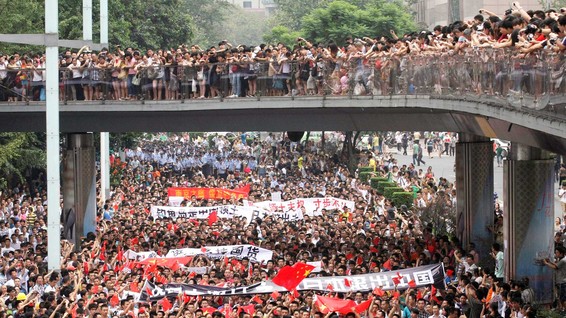
Anti-Japanese Protests in Beijing this Weekend

China Law & Policy has been following the anti-Japanese riots that spread across China this past weekend.  These riots appear to be a somewhat orchestrated response by the Chinese government – through the masses – to their dispute with the Japanese government over the Diaoyu/Senkaku Islands located in the East China Sea.  While this dispute has been ongoing, last week’s purchase of the islands by the Japanese government from the private owner, lead to saber rattling from China and this weekend’s violent protests.

At China Law & Policy, we have yet to blog about this affair, mostly because orchestrated, nationalist protests are difficult to divine.  Who are these protesters?  Just how orchestrated are these events?  Would the majority of Chinese allow their young children be witness to looting and violence and scream words like “kill the Japanese”?  Is this really about a pile of rocks?  There are limitations to our – and for that matter most people’s – ability to truly know what is going on.

The Western media has largely been focused on the violence that has erupted in China around these protests, and the use of the protests as possibly a government tool to hide issues of succession in the Party leadership.

But Bill Bishop, who runs the excellent blog/email newsletter Sinocism (if you are not subscribed to this, you should be), offers a much more nuanced view.  Yes, the protest are violent and yes they are likely orchestrated, but they do not reflect the sentiment of the majority of the Chinese.  Additionally, Bishop inquires as to what Japan was thinking in all of this.  Why would Japan choose to make these islands an issue now during China’s tense party leadership succession?  Bishop also analyzes the perhaps overblown contention that the U.S.’ treaties with Japan would require the U.S. to get involved.

Bishop’s post is a good read and an important fresh perspective.

Glenn Tiffert On China’s Recent Jurisdictional Issues

By , September 9, 2012

Jurisdiction is central in any legal system; it is jurisdiction that gives a court its power to administer justice.  Without proper jurisdiction, a court’s opinion is defective.  Thus, given its importance, all legal systems design specific rules governing when a court has jurisdiction over a case.

But recently in China, how courts have gained jurisdiction in criminal trials has been called into question.  The trial of Gu Kailai, for a murder that took place in Chongqing, was heard in Hefei.  Wang Lijun was police chief of Chongqing, but his crimes are being heard in a Chengdu court.  Has the Chinese legal system ignored all rules concerning what gives a court jurisdiction?  Or are there other rules that apply?

Glenn D. Tiffert, a Ph.D. candidate in History at the University of California, Berkeley with a focus on the legal history of the PRC, explains below that what might look like a random selection of courts actually has a basis in law.  Tiffert also reminds us that there is more than just the Criminal Procedure Law to look at in understanding the Chinese criminal legal system. 

Mixed-Up Confusion?  The Different Ways Chinese Courts Obtain Jurisdiction

By Glenn D. Tiffert

Part 1 of a two part series exploring the jurisdictional issues in recent criminal cases

As the Chinese legal system works its way through the various cases connected to the “Bo Xilai Affair,” it is a good time to review the usually unglamorous procedural rules governing jurisdiction.  The Bo Xilai Affair has brought these jurisdictional rules to the forefront and is generating more than the usual amount of interest among China watchers; even those focused on Chinese law are finding twists worth exploring.

To keep things simple, I will explore jurisdictional issues in the Gu Kailai and Wang Lijun cases alone, although my points could apply more generally to the other defendants connected to Gu, namely her accomplice Zhang Xiaojun, and the four police officers charged with covering up her crime.  This post will look at territorial jurisdiction, in other words, where the trials were held.  A later post will examine why both cases were assigned to intermediate level People’s Courts.

Gu Kailai being led into Hefei Intermediate People's Court

To recap: Gu Kailai was convicted of the intentional homicide of Neil Heywood, a British citizen resident in China, and the crime was alleged to have taken place in Chongqing, Sichuan province, the city her powerful husband, Bo Xilai, presided over as Party Secretary.  However, Gu’s trial took place 800 miles away from the city of Chongqing, in the city of Hefei, Anhui province, a place that had no known connection to the homicide, or to the alleged crimes of the other defendants associated with her.  Observers have suggested various practical or political reasons for why the trial was not held in Chongqing, and why it may have been assigned to Hefei, but those need not concern us here.  We are interested in discovering the legal authority for the assignment of the case to Hefei.

Article 24 of the Criminal Procedure Law of the PRC establishes the general rule that: “A criminal case shall be under the jurisdiction of the People’s Court in the place where the crime was committed.  If it is more appropriate for the case to be tried by the People’s Court in the place where the defendant resides, then that court may have jurisdiction over the case.”   Additionally, the Criminal Procedure Law provides rules for cases in which more than one court could claim jurisdiction, or in which jurisdiction is unclear.  For example, Article 25 states: “When several People’s Courts at the same level have jurisdiction over a case, it shall be tried by the People’s Court that first accepted it. When necessary the case may be transferred for trial to the People’s Court in the principal place where the crime was committed.”  However, in the case of Gu Kailai, none of these basic rules provide a basis for trying her in Hefei.  As a result, we must look elsewhere.

The Chinese legal system provides several routes for transferring jurisdiction over a case from one court to another.  For example, pursuant to the Criminal Procedure Law and the Law on the Organization of the People’s Courts, a lower level court with jurisdiction over a major or complex case can request a higher level court to take over the case.  But because Gu Kailai was charged with a capital crime, we can rule this path out.  Article 20 of the Criminal Procedure Law stipulates that intermediate level courts have jurisdiction of first instance over crimes punishable by life imprisonment or the death penalty and, because this case was actually tried by an intermediate level court, a lower court could not have had jurisdiction over it first.

One jurisdictional route rises above the rest.  Article 26 of the Criminal Procedure Law provides that: “A People’s Court at a higher level may assign a People’s Court at a lower level to try a case over which jurisdiction is unclear and may also instruct a People’s Court at a lower level to transfer the case to another People’s Court for trial.”

Article 26 can be parsed in different ways, with different results attaching.  To resolve the ambiguity, we must do what we do in any legal system, move beyond the four corners of the statute to consult supporting texts and practice, both of which indicate that the Supreme People’s Court (SPC) essentially regards Article 26 as comprising two independent clauses, the second of which matters here.  Hence we get: “A People’s Court at a higher level may… instruct a People’s Court at a lower level to transfer the case to another People’s Court for trial.”

The authoritative SPC Interpretation on Certain Questions Pertaining to the Implementation of the Criminal Procedure Law of the PRC (“the SPC Interpretation”) stipulates two ways that can happen.  First, under Article 18 of the SPC Interpretation, when the President of a lower level court must recuse himself[1] and it would be “unsuitable” for that court to assert its jurisdiction over a case, that court may ask a higher level court to take over jurisdiction.  The higher level court may take jurisdiction or assign it to another court at the same (lower) level as the first court.  Article 19 of the SPC Interpretation requires the higher court to send its decision on jurisdiction – 管辖决定书 (guanxia juedingshu) – to the lower court newly awarded jurisdiction and to other relevant courts.  Second, Article 22 of the SPC Interpretation allows a higher level court on its own initiative to assign jurisdiction over a case from one lower level court to another lower level court “when necessary,” without first requiring a request from below or that the second court be of the same level as the first.

Admittedly, we know few hard facts about the procedural history of the Gu Kailai case, but one nugget stands out.  The Xinhua reporting on the trial indicates that the SPC issued a decision on jurisdiction to the Hefei Intermediate People’s Court, and the Hefei court accepted the case for trial on that basis.  We do not know precisely whether this decision was based on Article 18 or 22 of the SPC Interpretation, as either might reasonably have applied, but the SPC evidently used its inherent power under Article 26 of the Criminal Procedure Law, as expounded in the SPC Interpretation, to transfer Gu’s case to Hefei.  One may furthermore assume that the Supreme People’s Procuratorate issued complementary instructions so that procurators would actually argue the case there, too.

The Supreme People's Court

Assuming that the SPC complied with its own Interpretation of the Criminal Procedure Law, we may infer from its decision on jurisdiction that another court originally accepted the case.  We do not know which court that may have been, but an obvious candidate would have been the Chongqing Intermediate People’s Court.  Under this scenario, three possibilities present: first, the unnamed court claimed jurisdiction over the case without the approval of senior Party and judicial authorities in Beijing, which seems implausible; second, Beijing granted its approval and then changed its mind; and third, acceptance by the unnamed court served, in the interests of formal compliance with procedural requirements, purely as a trigger for transfer to Hefei.  Regardless, as the highest court in the land, once the SPC transferred jurisdiction, the decision was effectively immune from challenge or appeal.

In comparison, the Wang Lijun case is more straightforward.  At least one of Wang’s alleged crimes took place in Chengdu: his purported “defection” in the United States consulate.  Notwithstanding substantive problems matching the facts as we know them to the elements of this crime, Chengdu judicial authorities may properly claim jurisdiction over the case under Article 25 of the Criminal Procedure Law (discussed above), and barring an unlikely protest from their counterparts in Chongqing or any other locale in which Wang is alleged to have committed crimes, the trial will take place in the Chengdu Intermediate People’s Court.  Indeed, given the stakes in trying Wang, one may assume that the SPC, and the political leadership behind it, assents to Chengdu jurisdiction, either tacitly or by assignment.  When the verdict is announced, we may know which.

Historically, reassignments of lower court jurisdiction by higher level courts are not uncommon in the Chinese judicial system, where concerns about local protectionism, judicial independence and varying levels of judicial competence adversely affecting trial outcomes run high.  The 2008 criminal trial of former Shanghai Party Secretary Chen Liangyu in Tianjin is another prominent, recent example.  Cases like those of Chen Liangyu and Gu Kailai shine a spotlight on one of the Chinese judicial system’s underappreciated features.


[1] Article 28 of the Criminal Procedure Law defines the grounds for recusal, including “relations with a party to the case that could affect the impartial handling of the case.”

Just For Fun: Ping’s Seafood – Elmhurst, Queens Restaurant Review

By , September 3, 2012

Ping's in Elmhurst, Queens

I have a friend who, when he visits New York, needs to have dim sum.  Flushing is the usual spot to hit up for dim sum, but this time, we decided to explore a new and up-and-coming Chinese neighborhood in Queens: Elmhurst.  And that is how we found ourselves at Ping’s Seafood, a small, inconspicuous restaurant on the corner of Queens Boulevard and Goldsmith Street that specializes in Hong Kong dim sum.

Elmhurst is considered Queens’ “second” Chinatown, but rest assured, there is nothing second class about Ping’s.  The entry way itself let’s you know that.  Laminated and yellowed restaurant reviews from such renowned newspapers as the Queens Chronicle fill the vestibule; pictures of the chef with the famous and influential of New York, including Mayor Bloomberg informs the visitor: this is not a place to toy with.

But where as other restaurants might ride the tail coats of their prior fame, Ping’s does not sit by idly.  Instead, Ping’s offers some mighty fine dim sum; dim sum that rivals some of the better known restaurants of Flushing

Unlike the jumbo dim sum restaurants of Flushing, Ping’s is relatively small and as a result, quaint. The requisite red velour wallpaper with a massive, gold double happiness symbol fills the back wall of the restaurant but the front wall, covered with windows, allows in a tremendous amount of light (most Flushing dim sum places have few if any windows).  Floor to ceiling tanks of various crustaceans blissfully unaware that their end is near are found throughout the restaurant.  If the name of the restaurant didn’t give you the hint, the tanks sure do: this is a place to order seafood.

Although it was a Thursday afternoon, the restaurant was still half full and a full dim sum was offered.  If ordering unknown dishes from ladies

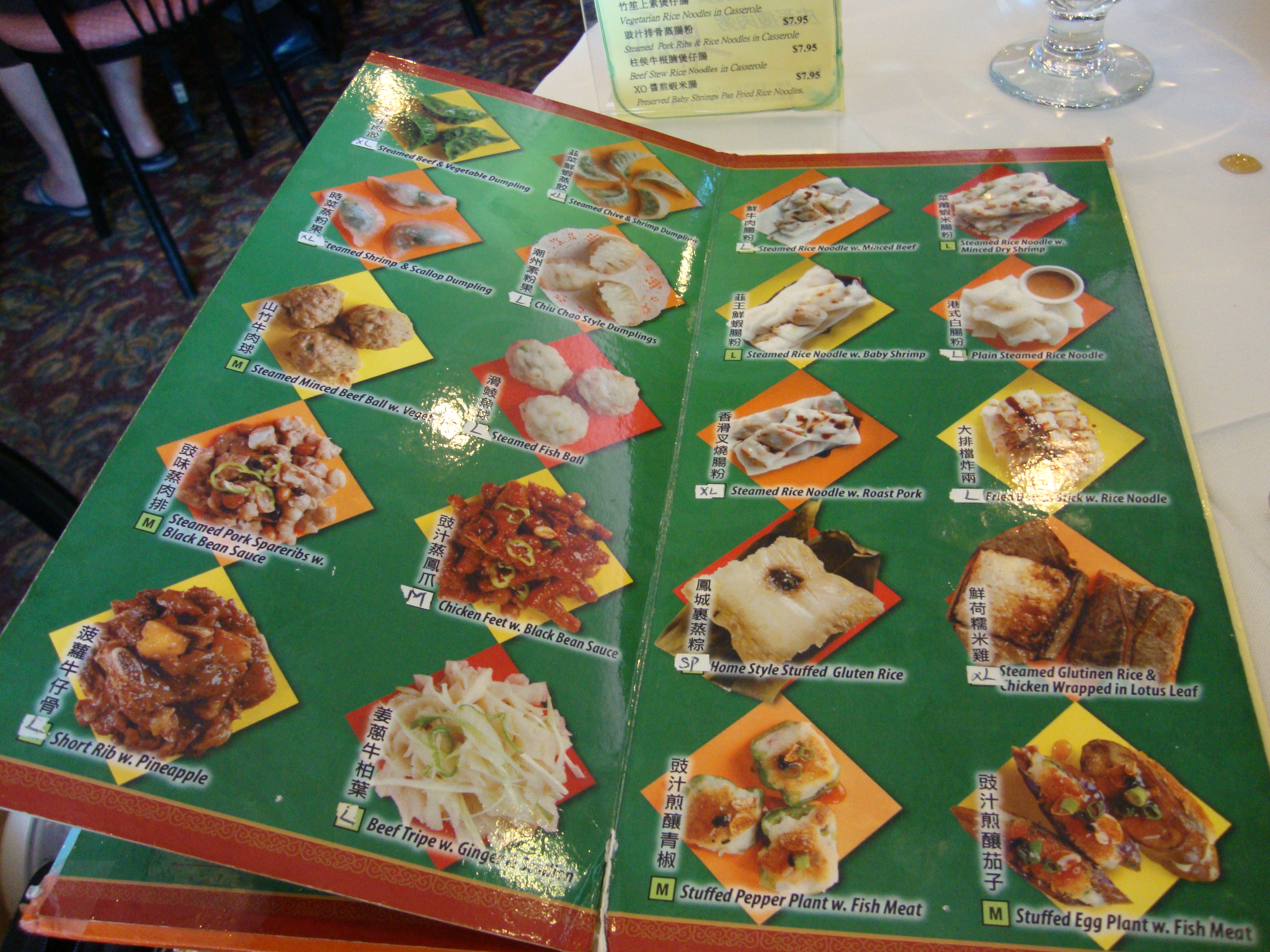
Ping's User Friendly Dim Sum Menu

pushing carts is how you get your thrill, Ping’s provides that, even on a weekday.  But if you have been put off by dim sum because you have no idea what could confront you when you unwrap that lotus leaf, Ping’s provides a radical, alternative way to order dim sum: a cardboard menu with clear pictures and a description in both Chinese and English.  For one of my dining companions, this was the most important aspect of Ping’s for it democratizes dim sum and unwraps the mystery of the gloriousness of the experience.  If I was of lesser moral character, I would have swiped a menu to keep.  Dim sum is pretty much dim sum everywhere and this menu is the dim sum decoder.

But Ping’s greatness does not just lay in its user-friendly accessibility.  The food was also solid: there were some dishes that far exceeded my expectations, a few that disappointed, with most providing a steady and good dim sum experience.  The seafood shumai were pretty amazing; the dumpling was bursting with shrimp flavor and was very fresh.  The same held true of thee steamed rice noodle with baby shrimp: a lot of shrimp-bang for your buck and the rice noodle was perfectly moist.

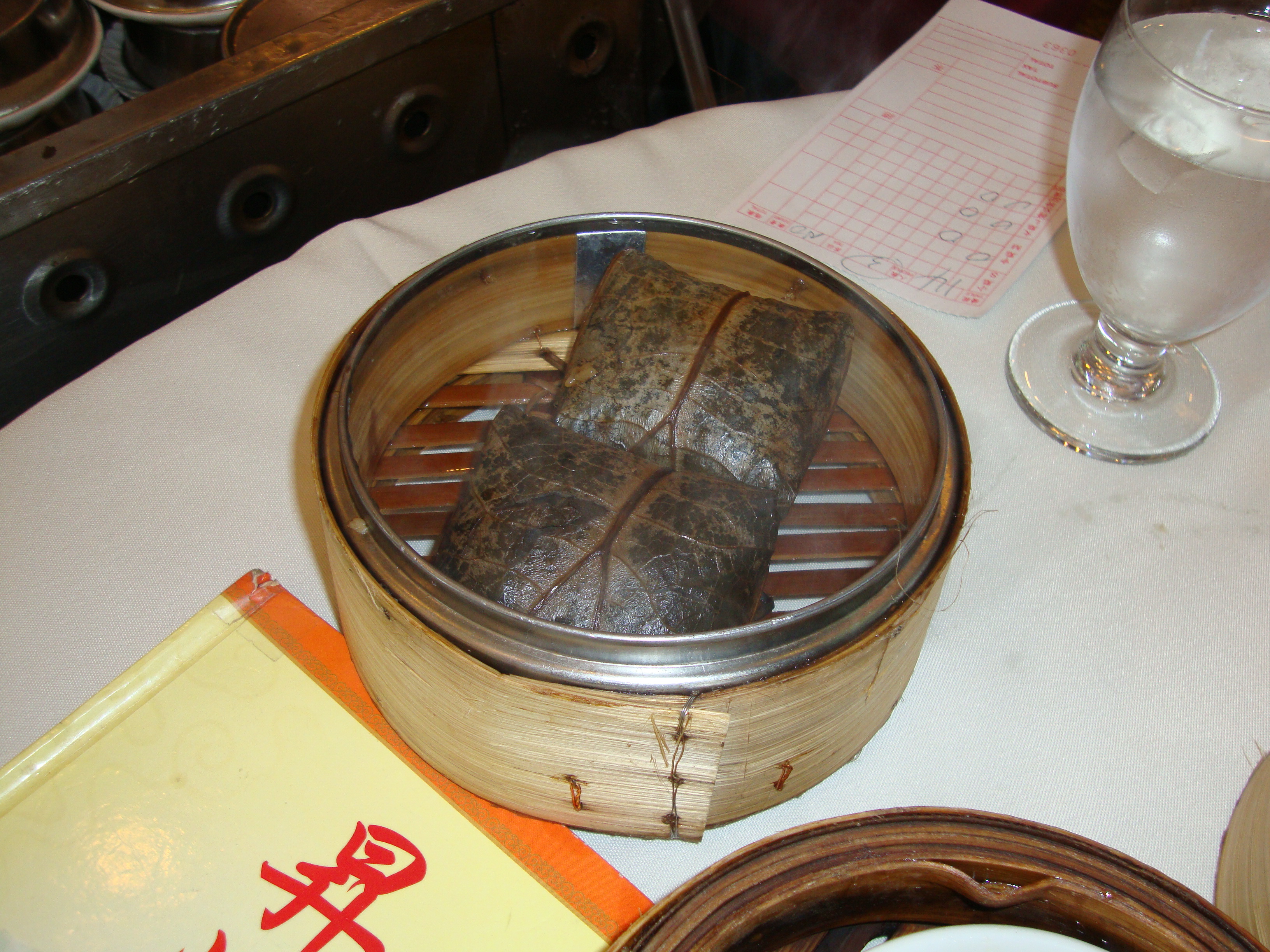
But perhaps the best dish and a dish that should not be missed is the steamed glutinous rice & pork wrapped in lotus leaf.  The rice had a light sweet taste to it and the texture was both sticky and slightly crunchy, making for a fun and delicious experience.  The pork turned out to be crispy sausage with a lot of pork and spice flavor, adding a perfect complement to the sticky rice.  Ping’s Steamed Glutinous Rice is perhaps some of the best in the city.

For me, the barbequed roast pork bun was a bit of a disappointment.  I found the pork too sweet and the bun was a bit too dry.  But one of my dining companions loved that the pork was extra sweet and thought that it was delicious.  I let him finish off the third bun.

We next ordered a series of dumplings – steamed shrimp dumplings, steamed pork shumai and steamed minced beef shumai.  As with all the shrimp dishes at Ping’s, the steamed shrimp dumplings were excellent – the shrimp very fresh and very full.  The texture of the dumpling wrapping was perfectly light and sticky, offering only a hint of an additional flavor and allowing the shrimp to steal the show.

Ping's Decor

As pork is an important meat in the Chinese culture, I expected the pork shumai, like its shrimp brethren, to be good.  But in fact it wasn’t.  The pork shumai was perhaps the biggest disappointment of the day and any trip to Ping’s should NOT include it.  Even my roast pork bun-loving dining companion thought the pork shumai was bad.  But not bad enough that we didn’t finish it.

Ping’s throws down the gauntlet: look out Flushing, Elmhurst is on the rise. Ping’s dim sum is well worth the trip: it’s a nice restaurant with better than average dim sum and the best sticky rice in the city.  It’s also a great experience for a dim sum first-timer.  Given that it is one of the few dim sum restaurants in Elmhurst, expect the weekends to be packed.

Rating: ★★★½☆

Ping’s Seafood
83-02 Queens Boulevard
Elmhurst, NY 11373
(718) 396-1238

http://www.pingsnyc.com/


Panorama Theme by Themocracy