60 Minutes Goes Light on Alibaba

By , September 29, 2014
Jack Ma of Alibaba at the New York Stock Exchange

Jack Ma watching the Alibaba IPO go live at the New York Stock Exchange

With Alibaba’s IPO setting a record-breaking offering price last week, the Chinese e-commerce company’s founder and executive chairman, Jack Ma has become something of a media darling.  That was readily apparent on 60 Minutes this past Sunday, where Lara Logan’s interview failed to press Ma on some of the more apparent issues.  Namely, Alibaba’s relationship with the Chinese government.

To be sure, Ma’s story is impressive, especially in a country where success is often determined by connections.  Ma was a no one.  As a kid, when China began to re-open to the West in 1972, he escorted foreign tourists to practice his English.  But that initiative did not translate into a successful academic record.  Instead, Ma failed the college entrance exam twice, passing it on the third time to attend Hangzhou Teacher’s Institute.  Eventually he graduated, becoming a much loved English teacher and starting his own translation company.

That would be the end of Ma’s story except that in 1995, Ma took a trip to the United States, learning for the first time about the world wide
Jack Ma's early Alibaba team

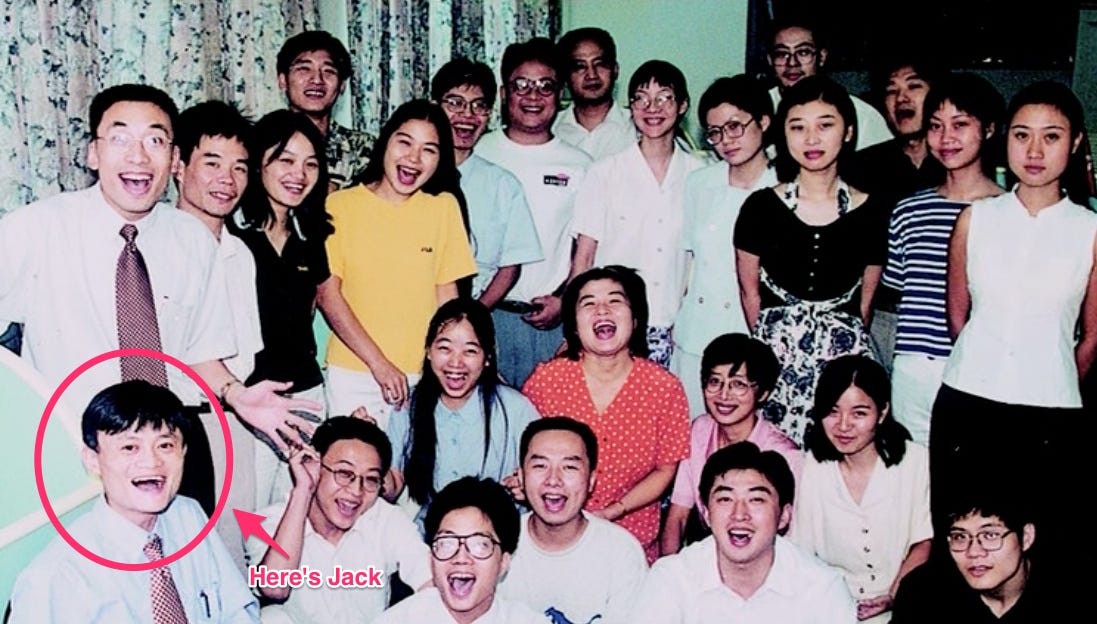
Jack Ma’s early Alibaba team

web.  The trip would change Ma and China.  Upon his return, Ma started China’s first web company, China Pages.  While that company would eventually flounder, in 1999, Ma created China’s first e-commerce website for business to business sales.  That company – Alibaba –  would spawn China’s consumer e-commerce (think ebay) websites Tmall and Taobao.  With an innate understanding of Chinese consumers and what they wanted, by 2005, Taobao would surpass ebay as the dominant consumer e-commerce company in China.  Last year alone, consumers spent over $272 billion on Taobao and Tmall.  Alibaba, and its related consumer websites, have become a force that cannot be ignored by Western companies.

As the 60 Minutes interview revealed, Ma got into the internet when no one in China was yet able to envision its power.  And that is what makes Ma so impressive – his ability to see, before anyone else did, how the internet would reshape commerce .  But for Ma in 2014 to maintain, as he did in the 60 Minutes interview, that even today his company has little dealings with the Chinese government is just preposterous.  According to Ma, “you can love” the Chinese government, but you “do not marry” it.  But this makes no sense in a country where the government can determine the winners and losers.  Unfortunately, Logan didn’t press Ma on this point even though in a voice over, she vaguely acknowledged Alibaba’s government connections.

Alibaba's VIE Structure for its NYSE IPO

Alibaba’s VIE Structure for its NYSE IPO

Alibaba could not succeed in China without the approval of the Chinese government as Alibaba’s own prospectus makes clear (see p. 43 – Risks Related to Doing Business in the PRC).  And it would be strange if Ma wasn’t somehow courting the favor of political elites.  The very corporate structure that Ma used to establish its IPO – a Variable Interest Entity (VIE) – is not particularly legal in China.  As a U.S.-China Economic and Security Review Commission report (“the Report”) points out, VIEs are created by internet companies for the sole purpose of circumventing current Chinese law that caps foreign investment in internet companies.  As the Report makes clear, VIEs are under increasing attack.  In 2013, the Supreme People’s Court – China’s highest court – found a VIE illegal stating that it was being used to clearly circumvent the law.  Other government agencies, including the Ministry of Commerce and the China Securities Regulatory Commission, have questioned the role of VIEs.

But this is China so questionable legal authority for a corporate structure does not necessarily signal its death knell.  The Alibaba VIE will likely not end anytime soon, even with this recent assault on the corporate structure.  But that has more to do with the Chinese political elite’s aligned interest in Alibaba’s success.  And that aligned interest has to do with Jack Ma’s positive relations with at least some in the Chinese government.  But Logan did not ask about this.  Nor did she ask why Alibaba has not come under the purview of China’s Anti-Monopoly Law (AML).  In becoming China’s e-commerce giant, Alibaba has acquired many of its competitors and has broadened its business to include cloud computing, an online payment system, and even financial services such as money market accounts.  But even with all of this, Chinese regulators have been silent regarding Alibaba’s actions vis-a-vis the AML.

Winston Wen, Wen Jiabao's son

Wen Jiabao’s son, co-founder of New Horizon Capital, and Alibaba investor, Winston Wen

In fact, Alibaba’s government connections go deep, a fact that Ma left out of his interview and that Logan chose not to pursue.  As the New York Times reported this past July, in 2012, $7.6 billion in shares was transferred from Yahoo! to some of China’s most well-connected private equity firms: Boyu Capital, co-founded by former President Jiang Zemin‘s grandson; CDB Capital and its Vice-President He Jinlei, son of former Politburo Standing Committee member He Guoqiang; and CITIC Capital, with Jeffrey Zeng, former Vice Premier Zeng Peiyan‘s son, at the helm.  In another transaction, New Horizon Capital, a fund co-founded by former Premier Wen Jiabao‘s son, also bought a significant number of shares in a private placement.

It would be foolish to invest in a company with questionable legal authority that didn’t have strong ties to China’s political elites.  On some level, for Alibaba to maintain its dominant market position, expand into other services, and ultimately succeed, it has to be “married” to the Chinese government.  Why Lara Logan didn’t press Jack Ma on this is anyone’s guess but it was another unfortunate softball interview on 60 Minutes.

What is Going on With China’s Constitution?

By , September 17, 2014

China’s Constitution

Qian Gang over at the China Media Project took a hit for the team earlier this month when he read through the recently-published (and likely dull) volume of Chinese president Xi Jinping’s speeches.  As Qian notes, glaringly absent from “A Primer of Important Speeches by General Secretary Xi Jinping” (“the Primer“) is Xi’s ground-breaking 2012 speech that proclaimed the importance of the Chinese Constitution in ruling China.

Bye, Bye, Bye: A Disappearing Constitution

In December 2012 – with less than a year in power – Xi Jinping (pronounced See Gin-ping) commemorated the 30th anniversary of China’s 1982 Constitution with a speech extolling the virtues of that Constitution. In that speech, Xi explained that it is the Constitution which must be used to constrain the government and the Chinese Communist Part (“CCP” or “the Party”):  “[n]o organization or individual has the privilege to overstep the Constitution and the law.”  Appearing to upend prior leader’s commitment to the Party as paramount to the Constitution, Xi highlighted that “[r]ule of the nation by law means, first and foremost, ruling the nation in accord with the constitution; the crux in governing by laws is to govern in accord with the constitution” (emphasis added).

But the currently-published Primer excludes this speech.  Was this intentional Qian wonders?  As Qian points out in his post, in China, anything this important is intentional.  In a society long trained to be hyper-sensitive to a leader’s speech, back in December 2012, Xi’s speech seemed like a watershed.  An inspiration.  The editors at the Guangdong-based newspaper, Southern Weekend, sure thought so.  Only a few weeks after Xi’s 2012 speech, the editors sought to follow his lead, titling the paper’s 2013 New Year’s editorial “China’s Dream, the Dream of Constitutionalism.”

Either the Southern Weekend editors read the tea leaves wrong or, more likely, not everyone in the CCP leadership supported Xi’s call for constitutionalism.  “China’s Dream, the Dream of Constitutionalism” never saw the light of day.  Instead, Guangdong propaganda officials quickly stepped in, changing the title and watering down the article to one that was effectively a paean to the Party-controlled system of governance.

Hello, Is it Me You’re Looking For? The Constitution Re-emerges

President Xi Jinping of China

Xi Jinping says Hello Again to the Chinese Constiution

With the suppression of the original Southern Weekend New Year’s editorial and the exclusion of Xi’s 2012 speech from the recently-published Primer, constitutionalism would appear to be dead in China, right?  Wrong.  Just last week, in a speech commemorating the 60th anniversary of the founding of the National People’s Congress (“NPC”),  Xi again raised the banner of constitutionalism, stating that the Constitution was China’s most basic document and that ruling the nation must be done in accordance with that Constitution.

Did Xi just not get the hint? Hardly. As Qian Gang, in a new blog post at China Media Project points out, what we are seeing is a rhetorical power play at the highest levels of the CCP.  Xi’s recent pronouncement demonstrates that he wants to continue with this idea that the Constitution is crucial to the CCP’s governance.  But then there are others – others that might have had influence on the final cut of speeches from Xi’s Primer – who are just not that into constitutionalism.   Likely demonstrating the power of this other group, the Global Times, a conservative government-run newspaper, ran an editorial in its English edition noting that “…the popularity of constitutional governance in the public sphere has only brought negative results in recent years. We propose replacing the concept with the rule of law” (the Chinese version of the editorial is slightly different, putting Xi’s concept of constitutionalism in a historical context).

If you are dying to know what happens to the Constitution in current Party rhetoric – does it stay or does it go – you only have to sit tight for a

Another CCP Plenary is to Occur in October with Rule of Law as the Topic of Conversation

month.  In October, the CCP will hold the fourth plenary session of the CCP’s 18th Central Committee and the central agenda item is rule of law.  As the CCP recognized in its announcement, the rule of law is “vital for the Party’s governance, people’s happiness and the nation’s stability.”    Expect the Xi camp to call on that rule of law through the Constitution; expect there to be opposition.  How public this battle will be is anyone’s guess.  Evidently the rhetorical use of the Constitution is causing divisions within the leadership.

But Does the Constitution Make A Difference in China’s Political-Legal System?

But Xi is far from a constitutional convert, at least not in the Western sense.  Even with this rhetorical debate at the upper echelons of the CCP, Xi’s constitutional dream is far from a free society that promotes individual’s civil rights.  Rogier Creemers, a post-doctoral research officer at Oxford’s Programme in Comparative Media Law and Policy, explained this to China Law & Policy.  The State is merely a reflection of the society which it governs and according to Creemers, “the [Chinese] State is there to restore the Chinese nation back to its collective greatness.  One of the key ways in which the CCP justifies its rule is that it knows best how to generate [that] development.  In that sense, law should not be used to constrain the State in its search for national rejuvenation, but to consolidate the progress that has been made on the road towards it. In the economic realm, that means law very often is the outcome of years of policy experimentation, while in the criminal realm, it means vast powers for the State to deal with those who would oppose it, where necessary.”

What is Rule of Law in China?

Thus, even for Xi, use of the Constitution is very top down and is not necessarily that divergent from the official concept of “rule of law.”  The Global Times, in its Chinese version of the editorial makes that clear.  To the Global Times, constitutionalism should be constructed as a neutral term, more in line with what the CCP has determined is the rule of law (“宪政本来是个中性词,与依法治国混用未尝不可”).  China-watcher Shannon Tiezzi, in the Diplomat, perfectly put her finger on what this rule of law is:  “the rule of the CCP through the law. The CCP still controls the legal system, but uses it as one of many available tools to enforce edicts from the center.”

Xi, even with his rhetoric of the Constitution, follows that Party line.  Hence his focus on the idea that the Constitution guarantees that no Party member can act outside of the confines of that document (think Bo Xilai and Zhou Yongkang, both powerful party members that have been taken down by Xi).  But that enforcement still emanates from the center; there is no place for grassroots to help with Xi’s crackdown on government corruption.  Activists Xu Zhiyong (pronounced Sue Zher-young), Liu Ping (pronounced Leo Ping), Wei Zhongping (pronounced Way Jung-ping), and Li Shen (pronounced Lee Shen) know this first hand.  In attempt to fight corruption, all publicly demanded that government officials disclose their assets.  All four have been sentenced to prison terms from three to six years under Xi’s rule.

For Xi, the elements of the Constitution that call for individual rights are to be ignored, which fits with Creemer’s  contention of the purpose

Chinese Rights Activist Liu Ping

Activist Liu Ping in a photo before she was sentenced to six and a half years in prison

of the State in China.  In fact, Xi’s reign has witnessed one of the largest crackdowns on human rights activists since likely 1989.  As the non-profit Chinese Human Rights Defender‘s has noted, since March 2013 – just three months after Xi’s Constitution speech – in addition to the four mentioned above, over 70 rights activists, lawyers and citizens have been detained, arrested, imprisoned or just “disappeared.”  Their crimes? Usually the minor charge of “gathering a crowd to disrupt order in a public place” or “provocation and causing a disturbance,”  charges distorted by public security forces beyond their original meaning.  The real issue?  These activists often call upon the government to protect their constitutional rights.

Rule of law in China “is about delivering economic outcomes and a certain ideal of virtuous behavior by agents of the State” Creemer  stated.  Nothing in Xi’s rhetorical use of the Constitution diverges from that concept.

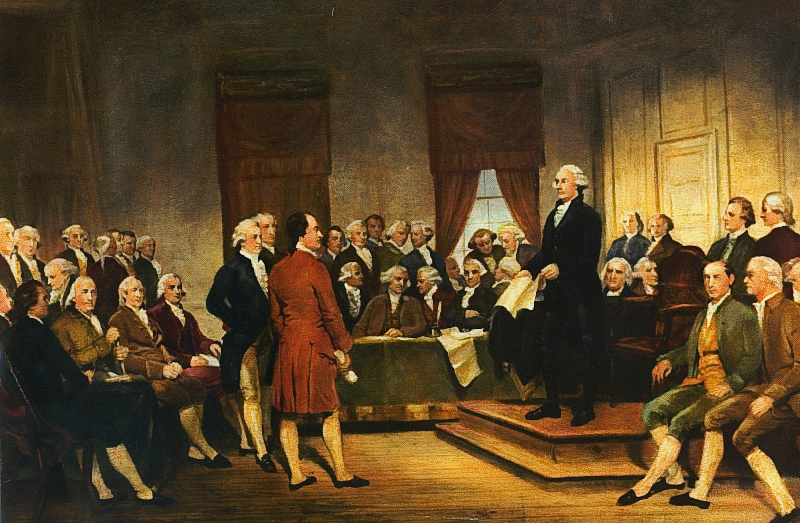
U.S. Constitutional Convention

Does use of the Word Constitution Mean this Type of a Government?

But the Party is nervous about Xi’s continued use of the word, hence the Global Times editorial which criticizes the “liberals -自由派” (likely the rights activists who have been thrown in jail) who seek to “distort” this Party-mandated perception of the rule of law and putting others on guard to avoid such “traps.”  But can the idea of constitutionalism be raised without giving life to those provisions of the document Xi and the Party would rather ignore – freedom of speech, of association, of religion?  Is Xi’s conception of the Constitution – which would limit official corruption and provide for greater economic development – enough to satisfy the masses?  Or will the Chinese people continue to demand that the Chinese dream be a Western-style constitutional one?


Panorama Theme by Themocracy