Ambassador Huntsman Discusses U.S.-China Relations – A Review

By , October 19, 2010

Steve Orlins of the National Committee on U.S. China Relations interviews Amb. Jon Huntsman

Last night’s China Town Hall, a live webcast sponsored by the National Committee on U.S.-China Relations and hosted by various educational institutions throughout the United States, fell short of expectations.   Featuring U.S. Ambassador to China Jon Huntsman, the conversation was anything but a frank discussion on the current difficulties in U.S.-China relations.  Instead, the evening had the stale air of political-speak and left one wondering, who exactly was the audience for this event?  But although Ambassador Huntsman’s comments were largely staged, a few key highlights emerged.

Interestingly, the audience was not the American public.  From Ambassador Huntsman’s answers, it appeared to be the Chinese leadership.  Many, if not most of his substantive comments responded to some of the Chinese leadership’s issues in U.S.-China relations, notably their fears on human rights and currency. Ambassador Huntsman began his comments by focusing on the importance of dialogue in the U.S.-China relation and the very real need of greater understanding of each other’s countries and their particularities.  It’s true that most Americans’ views of China are not the most informed and the culture is a bit of an enigma to many but, as the Ambassador pointed out, the same holds true for most Chinese on their views of American culture.

Ambassador Huntsman continued with his plea for greater understanding between the two nations by raising the issue of human rights.  According to Ambassador Huntsman, the Chinese need to understand that human rights is an important issue to Americans; it is a part of who we are, and that is why we always raise it in bi-lateral discussions.  This is certainly the conciliatory route to take in addressing the very prickly issue of human rights in China and it appears to be the strategy purposefully chosen by the Obama Administration.  President Obama took this approach in his Shanghai Town Hall address last November and the same rhetoric emerged after the U.S.-China Human Rights Dialogue this past spring.

But one wonders – is this effective?  Or by claiming that human rights is a part
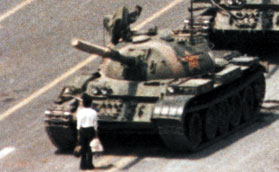
June 1989 - Tank Man

of our – e.g. the American or the Western culture – does this rhetoric cheapen the call for universal human rights?  If human rights is universal, then why must we couch the call for it in cultural terms?  And why is there never a reminder from the Obama Administration about China’s commitment, both on the government and individual levels, to human rights?  China has signed various international human rights treaties and many of her people clamor for greater human rights.  Back in June 1989, many died for it.

For now at least, this cultural contexting of human rights appears to be the strategy in dealing with the call for greater human rights in China.  So don’t expect to see any developments on this front with the current Administration; instead, expect human rights to painted as a peculiar particularity of the American culture; something the Chinese will just have to understand about us, sort of like how we like baseball while the rest of the world is crazy for soccer.

But on a more positive note, Ambassador Huntsman used the China Town Hall to signal to the Chinese leadership that it needs to do something about its currency, and quickly.  Although initially complementing the Chinese leadership on allowing the currency to float, Ambassador Huntsman continuously stressed the need for China to allow it to float more rapidly, heavily implying that retaliation from any angry Senate would be sure to follow.  While the Treasury Department has again delayed its report that determines which country is a currency manipulator, the Ambassador’s veiled comments seemed to hint that the U.S. government might be getting closer to taking action on currency.

Ambassador Huntsman shone though on the final question of the night from an audience member in China (likely at the American Chamber of Commerce which was the only organization hosting a webcast within China) about China as a hot-button campaign issue.  Instead of referring to some of the recent campaign ads as mere “anti-China rhetoric,” Ambassador Huntsman noted
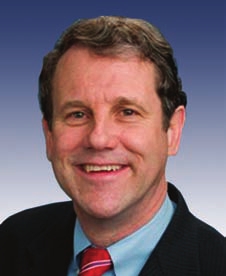
Sen. Sherrod Brown

that many of the issues raised recently during the election cycle are important issues and should be addressed.  Interestingly, the New York Times ran two op-eds on Monday intelligently discussing the issues (Paul Krugman and Sherrod Brown); each noting that what is good for American business interests in China is not necessarily what’s good for America.  But Ambassador Huntsman did note that the danger is relegating China issues to a 15 second ad and hoped that once people are elected, that Congress should have a deeper conversation about China.  Evidently Ambassador Huntsman has been out of the country too long; Congress, on both sides of the aisle, appears incapable to discuss any issues deeply, if at all.  And it doesn’t appear that the U.S. government – including Congressmembers and Senators – ever have an interest in hiring staff that actually knows anything about China.  While Ambassador Huntsman is right that these issues do need to be discussed intelligently and sincerely, good luck with resting your hope with Congress.

Although the message from the China Town Hall was less than frank, it was still good that the National Committee on U.S.-China Relations sponsored this event – it provides insight into the U.S.’ relationship with China.  Additionally, the sponsoring educational institutions each hosted a talk, either before or after the Ambassador, discussing more recent developments in China.  At Seton Hall School of Law’s China Town Hall, organized by Prof. Margaret K. Lewis, Prof. Carl Minzner gave the keynote speech.  An expert on legal and political reform in China, Prof. Minzner spoke much more frankly about China’s future course, especially as it pertains to greater rights protection of its citizens.  Prof. Minzner’s speech will be analyzed in a future blog post.  Stay tuned!

NY Event – China Town Hall – October 18

By , October 13, 2010

Ambassador Jon Huntsman

Don’t miss this year’s “China Town Hall” sponsored by the National Committee on US-China Relations on Monday, October 18 starting at 7 pm.  The China Town Hall is a night of China events, with the keynote address live from Ambassador Jon Huntsman (via webcast).  In its fourth year, this year’s event will likely prove to be the most interesting.  China has become a major campaign issue in the U.S.’ mid-term elections, the trade imbalance does not seem to be improving, currency is still pegged, and China doesn’t seem keen on allowing for greater freedom in the wake of the Nobel Peace Prize award to Liu Xiaobo.  To be sure Ambassador Huntsman will likely address some, if not all, of these issues.

While you can watch the event on your own over the web (here: http://www.ncuscr.org/programs/cth), life is always more fun when you do things with others!  The National Committee is sponsoring various educational institutions across the country to host events and this year, Prof. Maggie Lewis of Seton Hall University School of Law will be hosting a China Town Hall, with Prof. Carl Minzner of Washington University in St. Louis School of Law providing comments and context to what will sure to be an exciting night.  RSVP is required for this event: http://law.shu.edu/About/News_Events/china-town-hall-rsvp.cfm

China Town Hall
Monday, October 18, 2010
7 p.m. – Discussion with Prof. Carl Minzner
8 p.m. – Live webcast featuring Amb. Jon Huntsman
Seton Hall University School of Law
One Newark Center
Newark, NJ
(Directions: http://law.shu.edu/About/Directions.cfm – literally a hop skip & jump from midtown – 15 minutes on NJ Transit)

RSVP here: http://law.shu.edu/About/News_Events/china-town-hall-rsvp.cfm

For those not in the NYC-area, check out the listings of Town Hall events in your location: http://www.ncuscr.org/programs/cth

Imprisoned Chinese Dissident Wins Nobel Peace Prize

By , October 8, 2010

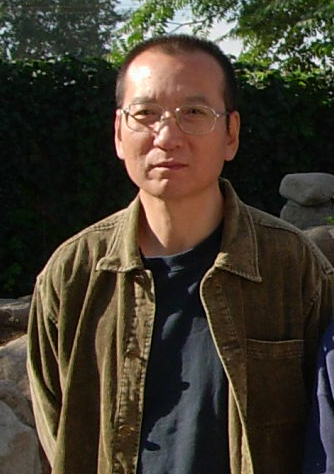
Liu Xiaobo

This morning, the Nobel Prize Committee announced the winner of its 2010 Nobel Peace Prize: Chinese human rights activist Liu Xiaobo (pronounced Leo See-ow Bwo).  But don’t expect Liu to be able to go to Norway to accept his prize; Liu is currently serving the first year of an 11-year prison term.

In all respects, Liu is perhaps the most famous of China’s human rights activists, at least internationally, and one of its longest serving.  Liu, an intellectual, literary critic, professor and writer, first emerged on the human rights scene in 1989 during the Tian’anmen student protests.  When the protests began in the Spring of 1989, Liu was at Columbia University in New York.  Immediately boarding a flight, Liu, a professor at Beijing Normal University, joined the students in hunger strikes on Tian’anmen Square.  But by June 3, sensing the danger of an impending crackdown, Liu encouraged the students to withdraw from the Square before the Chinese army was likely to violently suppress the student-led protests.  While many of the students did leave the Square, Liu’s pleas were for naught; on the streets surrounding the Square, an unknown number, likely reaching in the thousands, were killed.  After the suppression of the movement, Liu was tried for “counter-revolutionary propaganda and incitement” and convicted although ultimately exempted from criminal punishment. 

During the 1990s, Liu’s commitment to greater human rights in China did not waiver.  In the long tradition of the Chinese dissident, Liu took up the pen and during the 1990s, wrote a series of essays criticizing the Chinese government and calling for greater democracy for the Chinese people.  With his essays receiving accolades from abroad and censure from those high up in the Chinese Communist Party (CCP), the Chinese government detained him and sent him to a labor camp through China’s “Re-education Through Labor” (RETL).  RETL is an administrative punishment, not a criminal one and has become an important tool of the Chinese government to suppress dissent.  Even if China amends its criminal laws to be more in line with international standards, as long as it keeps RETL, the CCP will always have a way to suppress those individuals it deems a threat to its rule.  Individuals like Liu Xiaobo. 

But Liu’s current trouble stems from a document he helped author in late 2008 known as “Charter 08.”  Modeled after Charter 77, the document that sparked the Velvet Revolution in Czechoslovakia, Charter 08, called for greater human rights in China, the end of one-party rule and an independent legal system.  The morning that Charter 08 was to be posted to the internet, Liu was detained by police.  Liu was eventually arrested, tried and in December 2009, sentenced to a harsh term of 11 years.  In general, the average dissident sentence in China is between 3 and 5 years. 

Given Liu’s current imprisonment doe this Nobel Peace Prize even matter?  Most certainly.  First, it brings attention to the weakness of the current Chinese regime. While most news stories in the Western press discuss China’s growing economic might and its increased military muscle and portray a China that is sure to achieve global dominance, Liu represents the very real flip-side of that story – a communist party that is increasingly fearful of any threats to its authority and that in many ways is retaining one-party rule on a shoe-string.  Second, the Nobel Peace Prize was awarded to Liu after vigorous protest and threats from the Chinese government.  In fact, the Chinese government’s response has been shockingly quick – issuing a statement that Liu is a criminal and awarding him the prize is in contravention to the mission of the Nobel Committee.  Given that many governments have shirked from confronting China on its recent suppression of rights activists for fear of upsetting trade ties, the Nobel Committee’s action reflects its commitment to human rights and acknowledges the importance of human rights in Western diplomacy. 

But most importantly, the Nobel Committee’s actions will bring greater attention to Liu within China.  Although famous internationally, with media and internet censorship domestically, many Chinese are unfamiliar with Liu and his quest for greater human rights.  While censorship of the awarding of the Nobel Prize to Liu will surely exist in China, because this news is so huge, stories will slip through the Great Firewall, and those Chinese with access to the internet will learn more of Liu’s work and the push for human rights in China. 

But the award does not come lightly.  If history is a guide, the Chinese government will likely increase repression on other rights activists in China in the immediate aftermath and abuse of Liu in prison is a very real possibility. 

And from the White House and last Year’s Noble Peace Prize Winner:                                          

THE WHITE HOUSE

Office of the Press Secretary

______________________________________________________________________________

FOR IMMEDIATE RELEASE                                                                            October 8, 2010

Statement by the President on the Awarding of the Nobel Peace Prize to Liu Xiaobo 

I welcome the Nobel Committee’s decision to award the Nobel Peace Prize to Mr. Liu Xiaobo.  Last year, I noted that so many others who have received the award had sacrificed so much more than I.  That list now includes Mr. Liu, who has sacrificed his freedom for his beliefs.  By granting the prize to Mr. Liu, the Nobel Committee has chosen someone who has been an eloquent and courageous spokesman for the advance of universal values through peaceful and non-violent means, including his support for democracy, human rights, and the rule of law. 

As I said last year in Oslo, even as we respect the unique culture and traditions of different countries, America will always be a voice for those aspirations that are universal to all human beings.  Over the last 30 years, China has made dramatic progress in economic reform and improving the lives of its people, lifting hundreds of millions out of poverty.  But this award reminds us that political reform has not kept pace, and that the basic human rights of every man, woman and child must be respected.  We call on the Chinese government to release Mr. Liu as soon as possible.

What’s the Big Deal About a Pile of Rocks? The Diaoyu Island Incident

By , October 7, 2010

This past September, the world watched as the centuries-old feud between China and Japan reached epic proportions over a little-known chain of uninhabited islands in the East China Sea.  Known as the Diaoyu Islands in Chinese, the Senkaku Islands in Japanese, both China and Japan claim them as their own and each seeks control of the oil-rich seabed that potentially lies beneath. 

 As Marcy Nicks Moody writes in Foreign Policy Digest (reprinted below), at stake with these islands is more than just a pile of rocks. 

Speak Softly and Carry a Big Wallet: China Flexes Economic Muscle in Regional Disputes
By Marcy Nicks Moody
Originally Printed in Foreign Policy Digest

DEVELOPMENTS
Last month, a Chinese fishing boat collided with two Japanese coastguard patrol ships off the coast of a small chain of uninhabited islands in the East China Sea.  Japanese authorities took the boat’s crew into custody, and prosecutors debated whether to press charges against the boat’s captain for obstruction of justice.  Demanding the captain’s release, Beijing made strenuous arguments invoking Chinese sovereignty and human rights.  Chinese Premier Wen Jiabao refused to meet with Japanese Prime Minister Naoto Kan during a recent United Nations Summit meeting in New York and insisted that the conflict be resolved through diplomatic channels, while simultaneously suspending all mid- and high-level political contact between the two countries.  When the fishing boat captain was released, Beijing responded by insisting that Japan issue a formal apology and provide financial compensation.   Japan, in turn, argued that China should compensate Japan for the damage done to its naval ships.  Whether the collision was intentional is unclear, and it is unlikely that further light will be shed on the subject.

BACKGROUND

If the scale and particularly bitter nature of the diplomatic denouement following this small maritime accident strikes readers as odd, it should.   These events put into sharp relief the changing security landscape that both Asia and the United States face today in the Asian maritime.  They may also provide some insight into how China intends to conduct its increasingly forward facing maritime and energy security policy.

The islands near which the collision occurred are a matter of ongoing dispute between China and Japan that dates back for at least 40 years. Although the Senkaku Islands (called the Diaoyu Islands, in Chinese) are effectively a pile of uninhabitable rocks, it became known in the 1970s as an area potentially rich in oil and gas deposits in the surrounding waters, control of which could improve either country’s energy security dramatically. At present, the islands are controlled by Japan, but claimed by China. Although both have legitimate grounds for their claims, there is no foreseeable end to the dispute in sight. As Japanese authorities held the Chinese fishing boat captain on the basis that they might charge him with a violation of Japanese law, they were implying that these waters are, indeed, Japanese. For this reason, it is not entirely surprising that China would respond with such vociferous complaints as it did. What was surprising were the unannounced measures that China also took.

In addition to arresting four Japanese citizens in China for spying, which may have been coincidental, China appears to have suspended the export of rare earth minerals to Japan. Rare earths are elements in the Earth’s crust. Although they exist in miniscule concentrations, they are crucial to a range of modern technologies, including car batteries, wind turbines, and many other electronics. China mines approximately 97 percent of the world’s rare earths and, given the relative importance of electronics manufacturing to the Japanese economy, this move has the potential to be extremely damaging to Japan. No one from the Chinese government announced the suspension, and officials from the Chinese Ministry of Commerce (MOFCOM) have denied any sort of embargo. Chinese officials have, however, made public that they are contemplating fining Toyota Motor Company’s Chinese operations for various violations, including illegal rebates to Chinese car dealerships. While it is possible that the dispute with the trawler captain, the suspension of rare earths exports, the arrests, and the Toyota fines are all coincidental, it seems more likely that China is manipulating its economic and commercial relationship to gain leverage in its dispute with Japan over the Diaoyu/Senkaku Islands.

China has similar ongoing disputes over other chains of islands in the South China Sea with its Southeast Asian neighbors—in particular, Vietnam. Like the Senkaku/Diaoyu Islands, the waters surrounding the Spratly and Paracel Islands are believed to be rich in oil and natural gas, in addition to their valuable proximity to busy shipping lanes. The U.S. government inserted itself into the dispute in July, when Secretary of State Hillary Clinton announced that the United States would be willing to facilitate multilateral talks on the issue. She insisted upon U.S. neutrality, but argued that the United States has a strong interest in preserving free shipping in the region. Not surprisingly, a number of Southeast Asian countries welcomed the announcement, while China, caught off-guard by the announcement, maintained that the talks should be undertaken in a bilateral format.

ANALYSIS

China has not been the positive, productive, and cooperative international partner that the Obama administration seems to have been expecting two years ago. On the security side, cooperation on the North Korean question has disintegrated; Beijing has refused to move forward on sanctions against Iran; and U.S.-China military-to-military relations are increasingly strained. On the economic side, meanwhile, China has not allowed its currency to appreciate materially; it has recently placed steep tariffs on some U.S. exports, and the business environment is widely acknowledged to have become increasingly hostile to non-Chinese enterprises. If nothing else, Secretary Clinton’s July announcement is a mechanism for registering U.S. frustration with the current trajectory. Like China, Washington is also willing to play the zero-sum game.

The disputes over the Senkaku/Diaoyu, Spratly, and Paracel Islands are all based, at least in part, in China’s quest for greater energy security. At the same time, Beijing has taken an increasingly aggressive stance in a range of its foreign policy dealings, both with the United States and with its Asian partners. Given the trend of global economic interdependence that relies more and more heavily on China’s mammoth economy, Beijing’s recent behavior could forecast some serious struggles in the future, as China manipulates its growing commercial influence to leverage its position in the Asian security landscape.

Marcy Nicks Moody writes about China. In 2007-08, she was a Fulbright Scholar in China, where she was also a Research Fellow with the U.S.-Asia Law Institute. She received an M.A. in East Asian Studies from Columbia University and graduated from Brown University.

Panorama Theme by Themocracy