Parallels in Authoritarianism: Trump and the Chinese Communist Party

By , January 31, 2017

President Donald J. Trump (courtesy of whitehouse.gov)

For years, the Chinese Communist Party (CCP) was in denial about the extent of its air pollution problem, often referring to smog-infested days as perfect “blue sky” ones.  Then, in July 2008, @BeijingAir, a U.S. Embassy-created twitter account, began tweeting accurate pollution data throughout the day. Beijing was furious, claiming sole legal authority to monitor and publish air quality numbers.  But the U.S. Embassy stood its ground, and slowly, the CCP began to acknowledge that pollution levels were dangerously high. By January 2013, the Beijing government began reporting accurate, hourly data and by the end of 2013, climate change, pollution levels, and green technology had become important parts of the CCP’s platform.

Fast forward four years, and it is now the United States that is censoring tweets about climate change. Instead of the transparency that has long been a bedrock of the United States’ political system and that we encourage in other, less democratic nations, President Donald Trump appeared to take a page from the CCP’s playbook: he ordered that the Badlands National Parks remove tweets about increased CO2 omissions and climate change, statements he disagrees with.

In fact, in much of the first week of Donald Trump’s presidency, the parallels to authoritarian regimes, specifically the CCP, have become all too real.  It has become clear that Trump is not going to be the rational businessman that people had hoped for; he is not going to surround himself with advisers who temper his rash decisions. That is not how authoritarian leaders behave.

Upending Society – Trump, America’s Mao Zedong?

Chairman Mao Zedong

Mao Zedong came to power as a revolutionary, a populist and as a man intent on turning over the old world order.  Those tendencies – among other things – help to explain why China was enveloped in disarray for most of Mao’s 27-year reign. Similarly, these are the same impulses found in Trump, his campaign and thus far his presidency, as noted China scholar Orville Schell pointed out two weeks ago at an Asia Society event.  Trump’s preeminent goal is not necessarily to  advance the United States economically or even to advocate a coherent, ideological policy platform; rather his motivating impulse is to upset the current world order: “I think there is a bit of an outsider, troublemaker, turner-over of old orders, putting fingers in the eyes of the establishment in Donald Trump” Schell noted.

It is the disarray and the upending of society that appeals to Trump.  “If you don’t destroy, you can’t construct” was a favorite saying of Mao as he took China on the pointless path of a continuous revolution. Understanding that aspect of Trump is important in figuring out how to deal with his presidency.  Appealing to economic logic when he calls for a 20% tariff on Mexican goods and calling on American values when he institutes a ban on Muslim immigration is not going to resonate with Trump.

Projects That Are Ideological, Not Beneficial
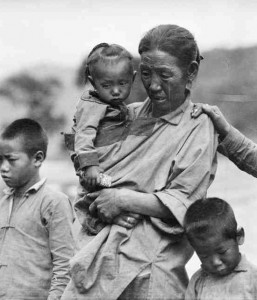
Rural residents and victims of China’s Great Leap Forward

Part of an authoritarian regime is the dedication to ideological-based projects, even at the expense of economic or social progress. For Mao, the Great Leap Forward (1958-1962) stands out.  In order to prove that China had made the “great leap” to an industrialized, rich, communist society, Mao ordered the complete collectivization of farms, factories, and most of society. Harebrained ideas of digging crops deeper, smelting steel in backyard furnaces, and building useless irrigation projects, resulted in one of the greatest man-made famines in history. Within a year, the leadership knew that the program was a failure. But the CCP ignored this fact and continued the campaign, committed to the ideological line.

In his first week, Trump has already called for an ideological project that most agree will hurt America more than it will help: building a wall between the United States and Mexico. But most undocumented immigrants over-stay their legally-obtained visa, not walk across the border. Trump ignores this fact and instead has proposed building a border wall that will cost between $10 billion (Trump’s estimate) and $38 billion (MIT’s estimate) and distract America from dealing with more compelling issues.  While he demands Mexico pay for the wall, the only proposal Trump has offered is a 20% tariff on Mexican goods, a tariff that will likely be borne by the American consumer.
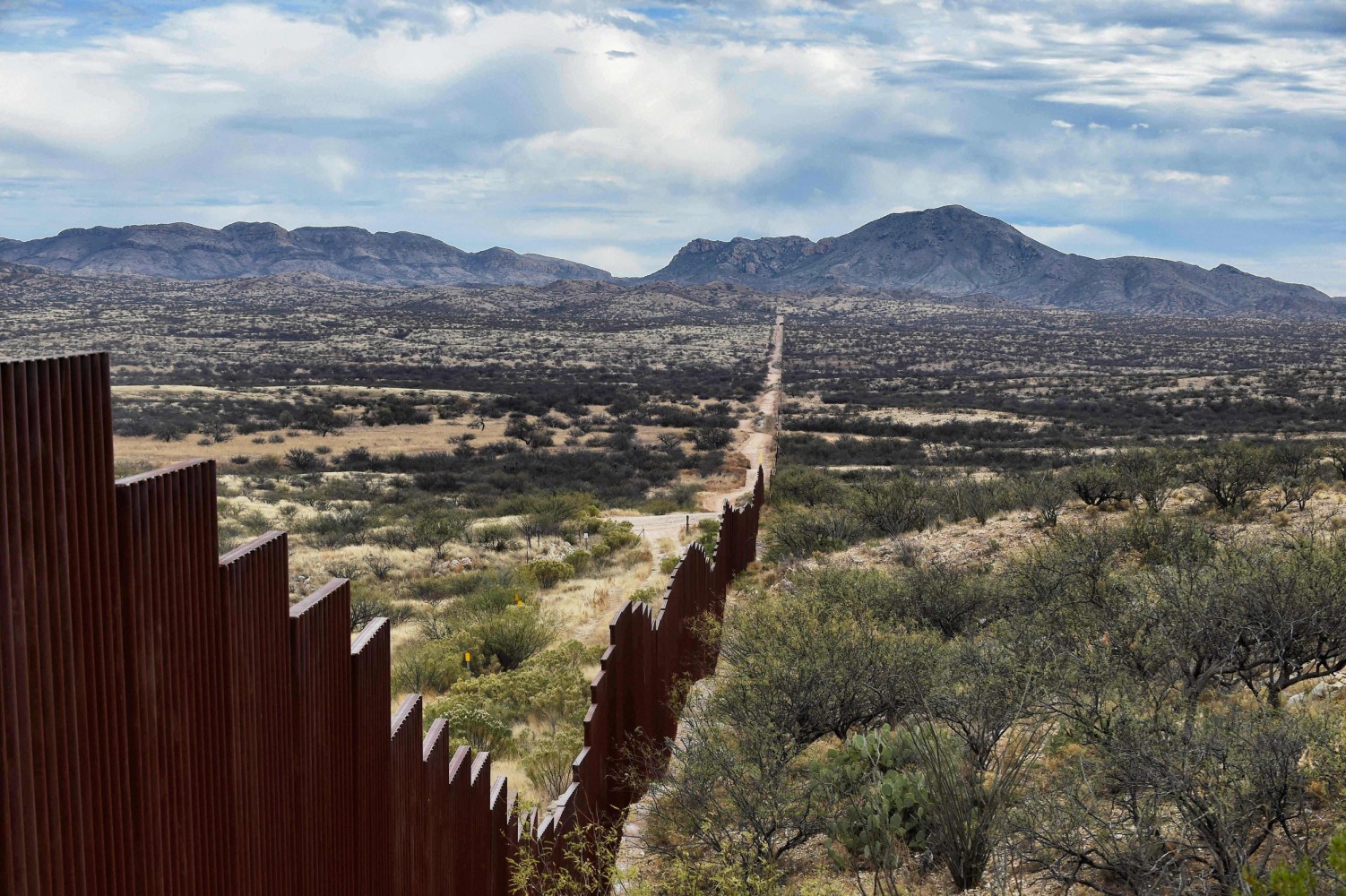
Some of the wall that already exists between Mexico and the U.S. (courtesy of NBC News)

Because the emphasis is on ideology and not practicality, ideological projects are neither particularly well-thought out nor properly executed.  During the Great Leap Forward, Mao decided that China would double its steel production.  To meet this goal, Mao instituted “backyard furnaces:” every item made of metal – doorknobs, farm tools – was smelted down. But as Mao would find out, smelted down metal produces inferior quality pig iron that cannot be used, let alone sold abroad as steel.

Similarly, Trump’s January 27, 2017 executive order, to ban immigration of Muslims from certain countries, gave no thought to its legality or to its implementation.  Signed after 4 pm on a Friday and to take immediate effect, the world was left unprepared. Immigration officials, who had no prior notice of the precise contents of the executive order, were left largely in the dark, and when refugees, green card and visa holders arrived, chaos ensued.

But logical arguments and exposing impracticalities are likely not going to cause Trump to change his mind.  His campaigns are about ideology and like Mao, expect Trump to double down when confronted with facts and the failure of their implementation. Much like he did on his twitter feed on Monday regarding Friday’s executive order.

Of Purges & Sycophants

As part of his purge, Liu Shaoqi, was often publicly criticized during the Cultural Revolution

From Mao to Xi Jinping (pronounced See Gin-ping), Chinese politics have been roiled with political purges.  It is a way for the current leader to eliminate threats to his power, maintain his authoritarian control and ensure that those remaining quickly fall in line. During the Cultural Revolution (1966-1976), Mao purged Liu Shaoqi (pronouced Leo Shao-chi) and Deng Xiaoping, two senior officials who had gained support among the Party for their economic reforms. Liu eventually died in prison but Deng was able to survive, and in the early 1990s, implemented those economic reforms that caused Liu his life.

Current President Xi Jinping has also purged those he considered a threat to his rule, using the Party-controlled legal system to do so.  In 2012, photogenic, ambitious and popular politician Bo Xilai (pronounced Bwo See-lie), long considered competition to Xi and his power base, was arrested and tried on charges of corruption, receiving a life sentence.  In 2015, Zhou Yangkang (pronounced Joe Yongkong), the former head of China’s powerful Ministry of Public Security and a supporter of Bo, received the same fate. A life sentence in a Chinese jail is a good way to eliminate perceived rivals
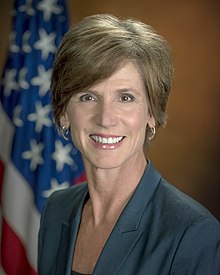
Former Acting Attorney General Sally Yates

Under Trump’s rule, New Jersey governor Chris Christie was the first to go, even before Trump officially took office.  While the reason is unclear, some saying his son-in-law didn’t get along with Christie while others maintaining that Christie’s honest advice was too much for Trump, it wasn’t the most practical move to remove the head of your transition team – and all of his staff – in the midst of executing the transition plan.

But on Monday, Trump carried out his first purge of his Administration: the firing of Acting Attorney General Sally Yates who, like the courts, questioned the legality of his executive order and called on the Justice Department staff to decline to defend it.  Reminiscent of CCP use of inflammatory rhetoric for its purges, Trump issued a similar factional statement, stating Yates’ “betrayal” of the Justice Department and that she is “weak on borders and very weak on illegal immigration.”

But these purges are not just about eliminating threats and consolidating power, it is also to ensure that those remaining toe the party line.  Before the Great Leap Forward, Premier Zhou Enlai (pronounced Joe N-lie) had fallen out of Mao’s favor.  Desperate to get back in his graces, Zhou became an ardent supporter of Mao’s Great Leap Forward even though he quickly became aware that the program was a failure with hundreds of thousands starving to death. But, fearful of a purge, Zhou never revealed the truth to Mao, afraid to challenge him. Instead, Zhou remained committed to the program and ordered that Mao’s irrational demands be fulfilled: that China immediately pay off its international debt through grain export.
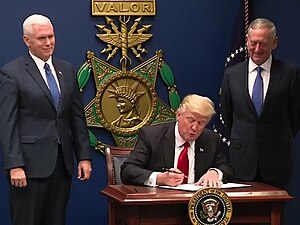
Pence and Mattis watch Trump sign Friday’s executive order.

Most Republicans did not speak out against Friday’s executive order that essentially banned Muslims from a select list of countries from legally entering the United States.  Even those who had previously condemned Trump’s call for a for a Muslim ban – Vice President Mike Pence, Speaker Paul Ryan, newly appointed Secretary of Defense James Mattis – have yet to utter a word.  But speaking up may mean falling out of Trump’s favor. And like Zhou Enlai before them, they appear to prioritize their position in Trump’s inner circle over everything else.

This is why Trump’s cabinet appointees’ statements to the Senate – that climate change is real, that water boarding is torture – cannot necessarily be relied upon.  Once in office, will they be like Pence and Mattis, willing to fall in line with Trump’s extreme views and carry out his orders?  And now that Trump has appointed Steve Bannon, his chief strategist, confidant and heretofore intelligence novice, to the National Security Council, while simultaneously downgrading the director of national intelligence and the chairman of the joint chiefs of staff to a need to know basis, is Trump messaging to his cabinet that ideology takes precedent over expertise – that in red versus expert, red wins?

Attack on the Press                                                                                                    

Press Secretary Sean Spicer on January 21, 2017 discussing the size of the crowds at Trump’s inauguration (courtesy Getty Images)

Calling the press “the opposition party,” lecturing reporters on what they “should be writing,” referring to journalists as “the most dishonest human beings on earth,” are all a part of the Trump Administration’s strategy on how to interact with the media, or more aptly, how to crush it.  Eerily, it is also the strategy of the CCP, in its efforts to ensure that freedom of the press never takes hold in China: “the ultimate goal of advocating the West’s view of the media is to hawk the principle of abstract and absolute freedom of the press, oppose the Party’s leadership in the media, and gouge an opening through which to infiltrate our ideology” (translation of the CCP’s Document No. 9 courtesy of Chinafile).

With its attacks on the media, the question remains just how far the Trump Administration will go in trying to clamp down on the press. The CCP offers a frighteningly effective alternative, with its arrest and prosecution of journalists on trumped up charges, its random detention of reporters critical of the government, its toying of the visa process – and for some outright repulsion from China – for foreign journalists when the CCP does not approve of their coverage of China.

But even in light of the Trump Administration’s censure, the U.S. press continues to try to serve its role as a watchdog of the government. But if the Trump Administration steps up its campaign against the press à la the CCP, who is going to win that battle?
(courtesy of China Digital Times)

Creating a Ministry of Truth

Throughout his campaign and now, in the first week of his Administration, Trump has been accused of telling lies and at times, trying to censor the truth.  But alternative realities are nothing new to an authoritarian regime.  The Chinese government is a master at it.  Referring to hazardous pollution as mere fog?  Trying to hide from your people and the world that SARS is spreading and hitting epidemic proportions? Blaming the recent downturn in the economy on mysterious foreign forces?  Having web pages just disappear? All alternative realities that the CCP uses to maintain its authoritarian control.

Insisting that your inauguration crowd was larger than President Barak Obama’s when the pictures clearly depict otherwise?  Pretending that your executive order is not a ban on Muslim immigration? Claiming that you lost the popular vote because millions of people voted illegally?  Having web pages just disappear? These are all alternative realities the Trump Administration has offered in just the past week alone.

Lies and alternative realities come with a real danger – that people will start to believe them or will never know the truth.  Take for example the Chinese government’s censorship of the its violent crackdown in 1989 on the students protesting in Tian’anmen Square. For the first few years after the Tiananmen massacre, the question was, how long will the Chinese government refuse to investigate the government-sponsored murder of hundreds of Chinese students. Twenty-eight years later, the question now is, will the Chinese ever know their own history?  Most below the age of 30 have never seen the photo of “tank man” let alone have any idea about what happened on that fateful night in June 1989.

Conclusion
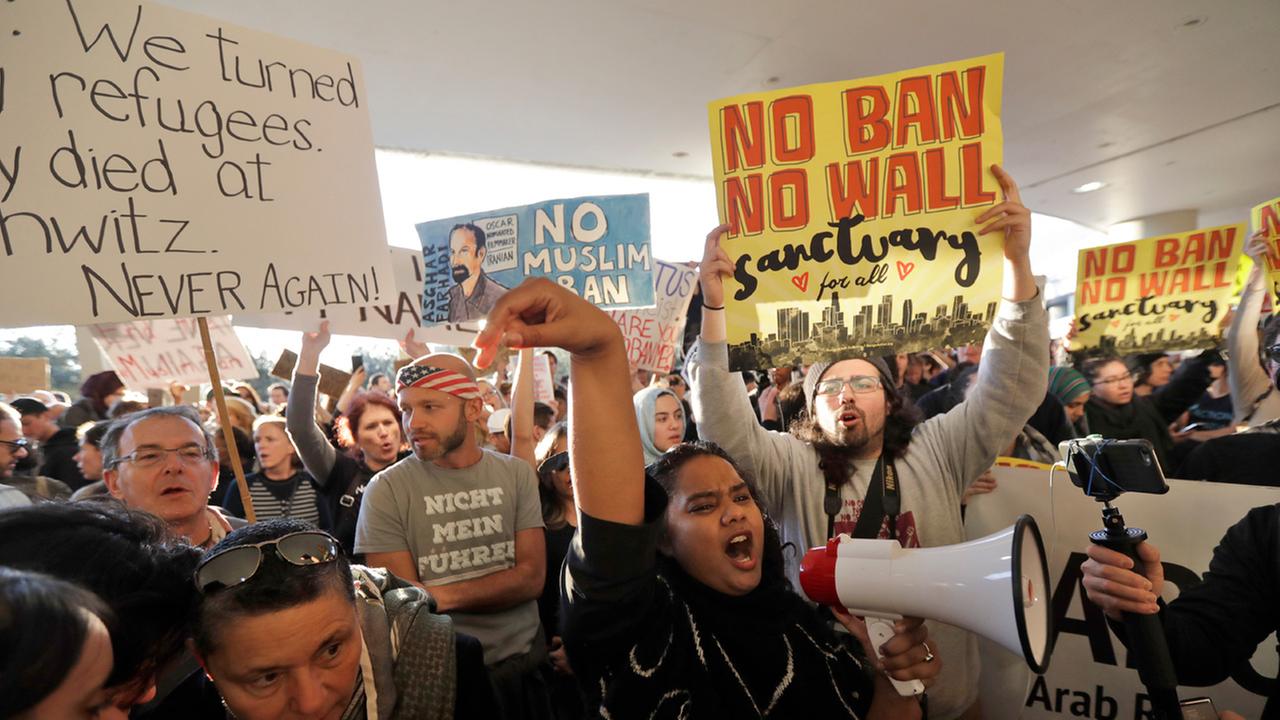
Protests erupt on Saturday at San Francisco International airport (courtesy of AP Photo/Marcio Jose Sanchez)

To be clear, America is not China.  This is not how things have to progress nor necessarily how they will. But what we see with the Trump Administration is a start.  And even a start is dangerous. But at the same time, many of America’s most revered democratic institution – the courts, its lawyers, the media, the American people – have spontaneously stood up to try to protect this country and its people.

But for the past week, Congress has been too slow to realize that the Trump government is no ordinary administration: this is a president and an administration that in its first week in power is more reminiscent of an authoritarian regime than a democratic one.  The ordinary tactics of politics – the give and take, the horse trading – are not going to suffice; bolder steps need to be taken.  Like the U.S. Embassy in Beijing, politicians need to constantly and publicly pressure and oppose the Administration if they want to ensure that America stays true to her democratic ideals.

恭喜发财!Happy Year of the Rooster!

By , January 26, 2017

On Saturday, the world will awake to the crow of the rooster as most East Asian countries mark the beginning of a new year: the year of the rooster.  But this is not just any old rooster; instead, it is the year of the fire rooster and it is that fire rooster that is causing many Chinese Feng Shui masters to predict that 2017 will be a tumultuous year.

Asian lunar new year, also known as the Spring Festival in China, doesn’t just usher in a new animal in the 12 animal zodiac, it also brings forth a new element.  In addition to being associated with an animal, each year is also associated with one of the five astrologic elements (metal, wood, water, fire and earth).  For 2017, that element is fire.  But at the same time, each zodiac animal is independently associate with one of the five elements.  And a rooster is metal.

So, you have a metal animal in a fire year.  According to Feng Shui master Raymond Lo, this just produces all sorts of ugly as fire conquers metal, making for a destructive relationship and causing disharmony in the year to come.  For Lo, “it will not be surprising that there will be serious explosions, fire disaster and war in 2017.”  Noted Feng Shui master Joey Yap is also on the same wavelength, remarking that with a metal rooster in a fire year, 2017 will be “dominated by challenges, fierce competition and scarcity of resources.”  As if on cue, the PBS Newshour just ran a story that water may soon become unaffordable for one-third of Americans.

But just because the world might be going to pot doesn’t necessarily mean that your life will.  How you fare in the fire rooster year is dependent on how your birth sign deals with the rooster. Check out your personal horoscope here (note you may have to do a Bazi test to determine the strength of your birth year element.  You can do that here – note that birth date is entered day-month-year).

But it might not all be bad.  In past fire rooster years, good things have happened. In 1897, aspirin was invented; 1957 saw the production of West Side Story as well as the formation of band the Quarryman with John Lennon and Paul McCartney, essentially the predecessor to the Beatles.

For those having a baby in year of the rooster, expect a faithful, reliable yet ambitious child, quick to speak and express his opinions. But budget a lot for clothes.  Roosters are known to dress up and be meticulous about their appearance.  Elton John, Bette Midler, Kate Middleton – all roosters

Whatever Year of the Fire Rooster may bring, may you celebrate the new year with family, friends and good food!  To all our Chinese friends who celebrate the new year, 新年快乐 (sin knee-an k-why le)!

Happy Lunar New Year! (courtesy of the Int’l Business Times)

Codifying Illegality? The Case of Jiang Tianyong

By , January 20, 2017

Jiang Tianyong

For the Chinese state, human rights lawyer Jiang Tianyong (pronounced Gee-ang Tee-an Young) never seems to learn his lesson.  In 2009, after taking on a slew of politically sensitive cases such as representing Falun Gong practitioners and ethnic Tibetans prosecuted following the 2008 Tibet riots, the Beijing Bureau of Justice declined to renew Jiang’s lawyers license.

But lack of a law license did not stop Jiang from continuing to advocate for some of China’s most vulnerable. Instead, Jiang played an active role in ensuring that blind activist Chen Guangcheng‘s cruel house arrest remained in the public eye. Again the Chinese state came for Jiang.  In February 2011, after meeting with fellow advocates to discuss Chen Guangcheng’s case, Jiang was abducted by local police, beaten, psychologically tortured and held incommunicado for two months.  (For Jiang’s own description of his two month ordeal, click here). Jiang was released, but only after he promised to give up his advocacy work, stop associating with his current friends, cut off ties with foreigners and refrain from making comments on social media disparaging the Chinese Communist Party (CCP).

Jiang, on the left, with other human rights attorneys and advocates, protesting in Heilongjiang

But even in light of these guarantees, Jiang’s advocacy did not cease. Nor did the Chinese state’s reprisals, which became increasingly violent. In May 2012, Jiang attempted to visit Chen Guangcheng in a Beijing hospital.  After Jiang was denied entry, state security officers took him away, beat him and then placed him under surveillance. In 2013, when Jiang exposed Sichuan province’s largest “black jail,” a secret and unlawful detention center, he was again beaten by local police.  When, in 2014, Jiang went to Heilongjiang province to protest the detention of Falun Gong practitioners in a “legal education base,” Jiang was administratively detained for 15 days and subject to various beatings while in police custody.

Not surprisingly, Jiang, who has yet to give up his advocacy, is back on the Chinese government’s radar, this time with much more serious charges that could land this civil rights attorney in prison for life.  But there is one thing that should make this time different from Jiang’s prior detentions: the implementation of China’s new Criminal Procedure Law (“CPL”), amended in 2012.  When these amendments passed, they were herald as more protective of criminal suspects’ rights, much needed in a system with a 99.9% conviction rate. In October 2016, the Supreme People’s Court (“SPC”), Supreme People’s Procuratorate (“SPP”), and the Ministry of Public Security (“MPS”) doubled down on the 2012 amendments, issuing a joint opinion, reaffirming each agency’s commitment to a more fair criminal justice system.

But as Jiang’s case highlights, these are just  paper promises.  For Jiang, some of the provisions of the CPL are outright ignored.  But more dangerously, the Chinese police have placed Jiang under “residential surveillance at a designated location,” a form of detention that was added to the CPL with the 2012 amendment.  In the case of Jiang, this amendment is being used to keep him away from his lawyers and, with his precise whereabouts unknown to the outside world, in a situation where torture while in custody is highly likely.  So much for better protecting criminal suspects’ rights.

Why Is Jiang Under Residential Surveillance at a Designated Place?

On November 21, 2016, Jiang went missing.  According to the Legal Daily, Jiang was picked up by the Changsha police after using someone else’s identity card to purchase a train ticket home to Beijing. After being taken into custody, Jiang is now suspected of harboring state secrets, a crime that carries a three to seven year prison sentence depending how serious (Crim. Law Art. 282) and of providing those state secrets abroad, a crime that results in a sentence anywhere between five years to life depending on the severity (Crim. Law Art. 111).

However, according to an advocate close to the investigation, the police notice eventually issued to Jiang’s family also lists suspicion of inciting subversion of state power, a national security crime that the Chinese government has increasingly used to silence its civil rights lawyers.  That charge can carry a sentence of anywhere between three years to life (Crim. Law Art. 105), and where inciting subversion involves foreign entities, the punishment shall be heavier (Crim. Law Art. 106).

Jiang Tianyong’s wife, Jin Bianling, calling on the Chinese government to inform her of her husband’s whereabouts. Photo courtesy of Hong Kong Free Press

For close to a month, Jiang’s whereabouts were unknown; unknown to his lawyers and to his family.  And while this might seem illegal, China’s amended Criminal Procedure Law (“CPL”) forgoes many of the protections intended to make the system more fair when the crime of endangering national security is potentially involved. When a suspect is taken into custody, Article 83 of the CPL requires that the police inform the suspect’s family within 24 hours except for those crimes that endanger national security or involve terrorism.  Here, Jiang is suspected of subverting state power and passing state secrets abroad, two crimes that certainly endanger national security.  And as a result, the police did not inform Jiang’s family that he had been taken into custody.

In what is increasingly necessary when a civil rights lawyer lands in the exclusive control of the police and his whereabouts are unknown, Jiang’s family and friends resorted to the one tool they had left: pressuring the foreign press to repot that Jiang had gone missing.  With the story of Jiang’s abduction splashed across the international press, on December 16, 2016, the Chinese government, through the government-controlled Legal Daily newspaper informed the world that Jiang not only had been taken into custody but that he was placed in “residential surveillance in a designated place.”

Residential Surveillance in a Designated Place – likely not here.

One of the major amendments to the CPL included what China terms  a “compulsory measure” but in reality is a new form of detention: “residential surveillance” (Articles 72 through 77 of the amended CPL).  Residential surveillance might sound like a more mellow form of detention but when applied, it provides carte blanche for police to interrogate – and usually torture – a suspect without any interference from the outside world.

For any residential surveillance that occurs outside of the suspect’s hometown, or if the suspect is being investigated for crimes of “endangering state security,” “terrorism” or “serious crimes of bribery,” residential surveillance does not occur at one’s home. (CPL, Art. 73) Instead, it occurs at an undisclosed location and while the family is required to be informed that their relative is under residential surveillance at a designated place (CPL, Art. 73), the family is not necessarily informed as to the precise location of the place.

And this is why Jiang shouldn’t be expecting any care packages in the near future from his family; they have no idea where he is.  In fact, according to a source close to the investigation, Jiang’s family first learned about his residential surveillance through the Legal Daily article on December 16, 15 days after he was placed in that form of detention.  True that the amended CPL  does a great job at severely circumscribing suspects rights once they are under residential surveillance, but the one thing that the Chinese government still gives these suspects is reuiring the  police to provide a written notice to the suspect’s family within 24 hours of placing the suspect under residential surveillance, regardless of the type of crime involved, national security or not. (CPL, Art. 73; see also Ministry of Public Security Implementing Regulations of the CPL Art. 109)  But here, according to an advocate close to Jiang’s case, Jiang’s family was not provided official notification until December 23, 2016, 22 days later.

Under the residential surveillance provisions of the amended CPL, the police are given so much power over the suspect, power that is largely illegal in other forms of detention and for other crimes. But even with this power, the police still feel the need to violate the clear language of CPL Article 73 and withhold notice to Jiang’s family.

Jiang Can Be Held for Up To Six Months and Without Access to a Lawyer

Empty chairs at empty tables – No lawyer for Jiang anytime soon

Jiang should also not be expecting any visits from a lawyer for the six months that residential surveillance at a designated place is permitted. (CPL, Art. 77)  And that’s another way that, by slapping a national security charge on a suspect, the Chinese government is able to circumscribe rights otherwise enshrined in the amended Criminal Procedure Law.

Because “residential surveillance in a designated place” usually presupposes a possible state security, terrorist, or serious bribery charge, the requirement that a meeting with the lawyer take place within 48 hours (CPL, Art. 37) is suspended for those possible charges.  (CPL, Art. 37).  Instead, any meeting must be approved by the police. (CPL, Art. 37).   Which fits with the rules that the suspect must follow when in residential surveillance: only with permission of the public security agency can the suspect meet or correspond with someone else. (CPL, Art.75(2)).  That permission must be granted unless the investigation would be obstructed or national secrets may be leaked (Ministry of Public Security Implementing Regulations of the CPL Art. 49)

Changsha police notice informing Jiang Tianyong’s lawyer that he cannot meet with Jiang due to crimes endangering national security (click for bigger image)

Although the regulations strongly favor meeting with a lawyer, in practice, civil rights attorneys held on charges that involve endangering national security are rarely given approval to meet their attorney.  Jiang is no exception.  According to an advocate with close ties to Jiang’s case, on December 27, 2016, Jiang’s lawyer requested permission to meet with his client.  On December 29, 2016, Changsha police denied this request, stating  that  “Jiang Tianyong was accused of crimes of endangering state security, and a meeting with lawyers would obstruct the investigation or possibly divulge state secrets.”

Codifying Illegality?

Jiang’s case makes clear that the 2012 CPL amendments have done little to curb the power of the police and that the Chinese government’s recent pronouncements that it needs to do better to protect suspects’ rights, is nothing more than window dressing. As long as the police unilaterally, and without due process, decide to investigate the suspect for crimes involving national security, all rights are essentially lost: the suspect can be held incommunicado for up to six months without access to a lawyer.  That kind of situation – with no one watching – all but guarantees torture and abuse.  Ironically, it is potential charges of endangering national security where these protections are needed most.

But, starting with the 2015 crackdown on lawyers and now continuing with Jiang Tianyong, the Chinese government has demonstrated that it will use the label of “endangering national security” to forgo the rights that it says it is committed to providing criminal suspects.  In late 2015 and early 2016, the Supreme People’s Procuratorate issued two sets of rules ostensibly to curb the police’s abuse of residential surveillance in a designated location.  But, as others have noted, the new rules seem to be designed more to ensure that everything looks good on paper than to guarantee criminal suspect’s rights and access to due process.  The case of Jiang Tianyong appears to prove that even those new regulations have had no effect.

As the rest of the world marks the seventh annual Day of the Endangered Lawyer next Tuesday, Jiang Tianyong, one of China’s great civil rights attorneys, languishes in an unknown place, likely subject to constant interrogation and torture, and without any access to a lawyer.  His rights deprived all because the Chinese police are able to claim that it is investigating him for endangering national security.  But the only thing that is being endangered by making a mockery of the protections of the amended Criminal Procedure Law is the actual rule of law.

*****************************************************************************

Thank you to China Law Translate for providing free of charge most of the translations of China’s laws used in this article. 

Trump’s Call with Taiwan: A Hard Rain’s A-gonna Fall?

By , January 2, 2017

U.S. President-elect Donald Trump (left) and Taiwanese President Tsai Ing-wen

Every four years, leaders from around the world call the newly-elected president of the United States, congratulating him on winning his country’s election.  Although a quaint custom, there is a lot of backroom dealing that goes on before the two leaders talk: staff has to ensure that it isn’t a prank, that translators are on hand if necessary, and that an agenda and time is appropriately set.

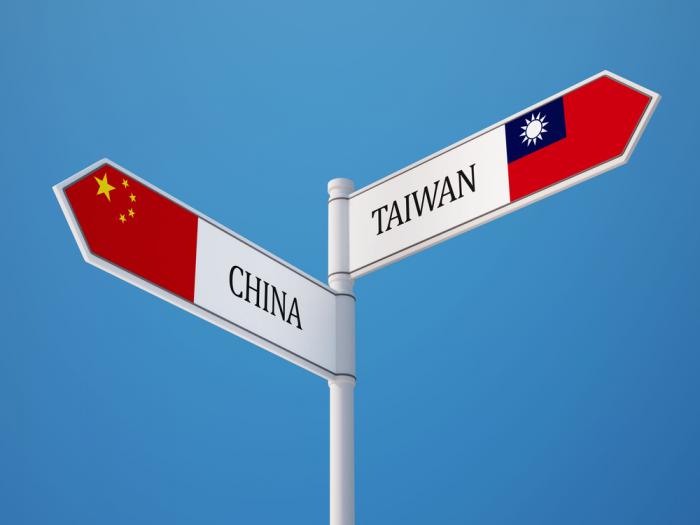
But one thing that never happens is a congratulatory phone call between a U.S. president-elect and the President of Taiwan.  That is because for the past 40 years, the U.S. has not recognized Taiwan as a separate country; to take an official phone call from the President of Taiwan signals a possible change in the United States’ “one-China policy,” potentially inciting the anger of the People’s Republic of China (“Mainland China,” “China” or “PRC”), and potentially undermining the tense status quo between Mainland China and Taiwan.

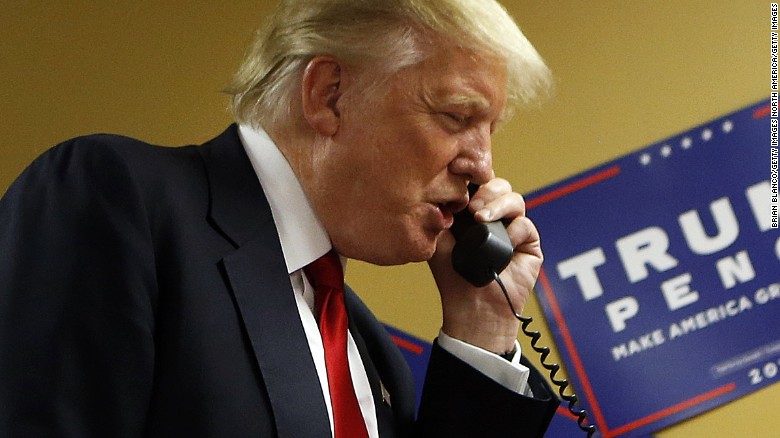
Hotline Bling! President-elect Trump on the phone (photo courtesy of CNN.com)

And that is why President-elect Donald Trump’s decision, on December 2, to accept a phone call from Tsai Ing-wen, the current president of Taiwan, was such a shock and front page news across the globe.  Although originally downplayed by his transition team, Trump doubled-down only a few days later where, in an interview with Fox News, he stated that he doesn’t “know why we have to be bound by a One-China policy unless we make a deal with China having to do with other things. . . .”

But if Trump is sincerely thinking that such a policy shift would benefit Taiwan or thinking that this is a good way to strong arm Mainland China on other issues, he will likely be proven dead wrong. Toying with China about Taiwan is not going to give the U.S. the upper hand in its relations with China. For almost 70 years, the Chinese Communist Party (CCP) has tied its legitimacy to the eventual reunification of Taiwan with the Mainland. For the U.S. to make overtures that it might abandon the one-China policy goes to the heart of the CCP’s rule.  Because of this, the CCP will not respond lightly – nor necessarily in accordance with what we think might be rational – to President-elect Trump’s public insinuations of a shift in the one-China policy.

The Creation and Evolution of the One-China Policy

1971 PRC Propaganda Poster: “We will definitely liberate Taiwan!”

The one-China policy is not the brain child of the United States.  Rather, it is a concept created in 1949, after the Chinese Civil War, by the leaderships of both Mainland China and Taiwan.  Up until 1949, Mainland China, of which Taiwan was a part, was called the Republic of China (“ROC”) and was ruled by the Kuo Mintang party (“KMT”), under the leadership of Chiang Kai-shek.  But on October 1, 1949, the CCP gained control of Mainland China, establishing the People’s Republic of China (“PRC”) and the KMT and its supporters fled to the island of Taiwan.

On Taiwan, Chiang Kai-shek and the KMT re-established the Republic of China. Both the CCP and the KMT agreed there was only one China, a China that includes the Mainland and Taiwan; both agreed that eventually the Mainland and Taiwan would be re-united. Where the two states differed was to which was the legitimate leader of this phantom one-China.  For the KMT, the ROC in Taiwan was the legitimate China with the mainland consisting of renegade provinces that would eventually be re-united under KMT rule.  For the CCP, the opposite held true: it was the PRC that was the legitimate government, Taiwan was a wayward province that would eventually be re-united with the mainland under CCP rule.

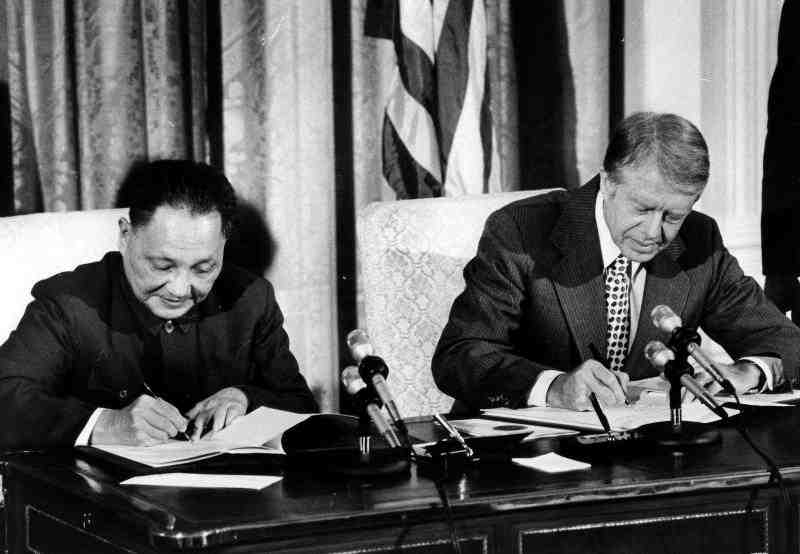
U.S. President Jimmy Carter and Chinese President Deng Xiaoping sign the accords where the US switches recognition to the PRC

Because of the CCP and KMT’s one-China concept, the rest of the world had to choose “one China” to recognize and establish diplomatic ties. Neither Taiwan nor the Mainland would allow a country to recognize both Chinas. Like most things during the Cold War, the choice was political.  Between 1949 and the early 1970s, almost all western, democratic countries recognized the ROC on Taiwan as China and most communist countries recognized the PRC on the mainland as legitimate China.

By the early 1970s, things began to change and in 1979, the United States switched its formal diplomatic recognition to the PRC.  As a result, the United States cut off all official diplomatic relations with Taiwan, closing its embassy in Taipei.

But only official diplomatic ties were severed.  The United States continued to maintain strong economic and military ties with Taiwan.  In fact, to show that the United States was not completely abandoning Taiwan, in 1979, Congress passed the Taiwan Relations Act.  The Act didn’t just create the American Institute in Taiwan (“AIT”), a non-profit organization, funded by the U.S. government and serving as a de facto embassy in Taipei, it also, by committing the U.S. to make available “defense articles and defense services,” tied U.S. military support to the island.  Since the passage of the Act, the United States has sold over $30 billion in defensive military arms to Taiwan; $14 billion of that has been under the Obama Administration.

For Mainland China, the One-China Policy Is Not A Joke

For Mainland China, the belief that Taiwan is an indispensable part of China and will eventually be re-united is sacrosanct. It is the line the CCP has been propagating to its people since 1949 and which the majority of the Chinese people believe. Enshrined in preamble to the PRC Constitution is the notion that Taiwan is an inalienable part of the PRC and will be re-united with the Mainland. Every time relations between Taiwan and another country gets too cozy, the CCP, through the state-run media, vehemently criticizes the offending nation for interfering in their internal affairs.
As China’s economy continues to lag, the CCP’s promise of constant economic property for its people is undermined, making its nationalist promises of a one-China even more necessary to fulfill. For the CCP, failure to fulfill that promise threatens its rule.  And the CCP has no interest in relinquishing its rule.

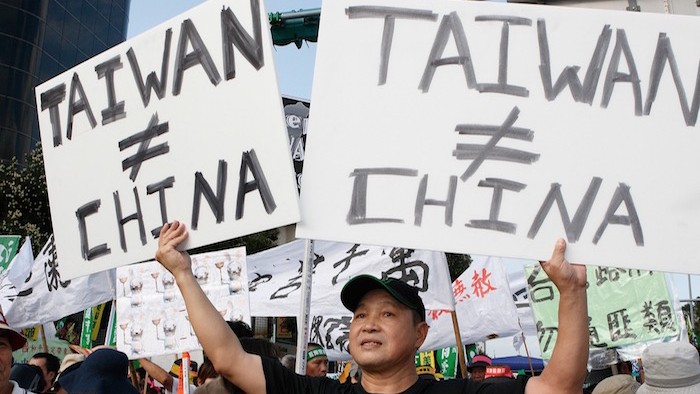
But for the Taiwanese people, the concept of one China has evolved especially as the KMT has lost its complete control of the island’s political system.  From 1949 to the early 1990s, Taiwan was a one-party country, with the KMT and its allegiance to the one-China policy, in control.  However, starting in the mid 1990s, a new political party emerged on Taiwan, the Democratic Progressive Party (“DPP”).  The DPP rejects the idea of a one-China.  It even rejects the idea of a two-China.  Instead, it maintains that Taiwan has become a separate country and culture, distinct from Mainland China.  For the DPP, there is only one China, the Mainland, and then there is Taiwan.

Taiwanese protesters who oppose the One China Policy

In 2000, when DPP candidate Chen Shui-bian won the presidency, the CCP grew fearful.  With the increased stature of the DPP in Taiwan and the fact that it can win national elections, China has built up its military to be capable of dealing with Taiwan if the country should ever publicly repudiate the one-China policy and change its laws to establish the independent country of Taiwan.  After Chen won a second term in 2004, the CCP decided to make its intentions more clear.  In 2005, the CCP passed a new law – the Anti-Secession Law – exclusively about the Taiwan situation.  While it continues to call for the peaceful reunification of the Mainland with Taiwan, Article 8 of the Anti-Secession Law makes it clear that China will use force if Taiwan declares its independence.  In 2015, the CCP passed the National Security Law, a sweeping law that seeks to expand and reinforce China’s international reach.  Article 11 mentions sovereignty over Taiwan.

While the Taiwanese people have elected a DPP president in 2000, 2004 and then again with current President Tsai in 2015, the Taiwanese repeatedly prefer to maintain the status quo in their relationship to the Mainland.

The Trump Call Is More Than A Phone Call

Taiwanese protesters supporting the One China Policy

It is within this powder keg – two entities armed to the teeth, one voting in an “independence party” and the other feeling insecure with its economic slowdown – that President-elect Trump decided to accept Taiwan President Tsai’s call, feigning ignorance that the call was somehow not monumental. Not surprisingly, China’s reaction was quick and angry.  But in ways, less so toward the U.S. than to Taiwan. In an op-ed in the state-run Global Times, the CCP reminded Taiwan that it would not hesitate to “punish” Taiwan and that Taiwan must pay the price if it breaks the status quo.

True the one-China policy is increasingly a rotten deal for Taiwan, especially as China seeks to use its might to squeeze Taiwan out of important international organizations and meetings, including meetings held recently by the U.N. and Interpol. And there might be reasons to re-calibrate some of the customs surrounding the one-China policy.  Currently, the Taiwan Travel Act, which would permit officials from the Taipei Economic and Cultural Representative Office (Taiwan’s de facto embassy in the U.S.) to conduct official business with the U.S. government, is pending before Congress. Additionally, last year Congress passed, and President Obama signed into law, a bill requiring the U.S. State Department to develop a strategy to obtain observer status for Taiwan at Interpol.  When President Tsai travels to Latin America this month, the Obama Administration has agreed, regardless of China’s protests, to grant her a “transit visa”, allowing her to meet with people while on U.S. soil. The U.S.’ continued advocacy to ensure Taiwan’s inclusion as an important international entity is not only a benefit to Taiwan but also a benefit to the rest of world as it permits an East Asian state with an democratically-elect government and vibrant civil society to serve as a counter-example to China.

But President-elect Trump’s December 2 call with President Tsai does not come off as a well thought out and effective means to bolster Taiwan’s place in the world.  Based on his follow-up interview with Fox News, the call appears to have been solely a strategy to anger Beijing in an attempt to work out a better trade deal for the U.S.  But Taiwan – and the one-China policy – is too essential of an issue for the CCP to simply bargain for as if this is a mere business deal.

If Trump continues to carelessly trifle with the one-China policy, it will be Taiwan and its people that will bear China’s initial wrath. But with the U.S.’ ostensible obligation under the Taiwan Relations Act to support Taiwan defensively, it could very well be American lives that are also at stake.

For a thoughtful rebuke of President-elect’s phone call with President Tsai, please read former American Institute in Taiwan senior official and China expert Richard Bush’s “Open Letter to Donald Trump on the One-China Policy”: https://www.brookings.edu/blog/order-from-chaos/2016/12/13/an-open-letter-to-donald-trump-on-the-one-china-policy/

Panorama Theme by Themocracy