Why Was There a Trial When Gu Kailai Confessed – China’s “Plea Bargaining”

By , August 29, 2012

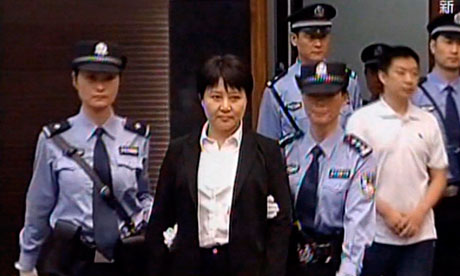
As China Law & Policy reported last week, the guilty verdict issued against Gu Kailai for the murder of Neil Heywood came as no surprise, even with the slim evidence – much of it hearsay – presented at the August 9th trial.

One central piece of evidence at the eight hour trial was Gu’s own confession.  According to the Chinese state-run media, Gu openly confessed to intentionally killing Heywood.  But for some, this raises the question – do you need to have a trial at all if the defendant confesses?  Can’t she just plea to the murder and avoid the trial?

But does China even have plea bargaining?

China’s Summary Procedure – Not Exactly Plea Bargaining

Even in the United States, plea bargaining was not a welcomed occurrence.  Plea bargaining emerged as a grass-roots response by the actors in the criminal justice system – the judges, prosecutors, and defense attorneys – to the rapidly growing criminal docket.  Although first documented as widespread as early as the 1920s, it wasn’t until 1970, when the Supreme Court declared plea bargaining constitutional, that it became embraced, even if awkwardly.  Today, over 95% of all felony convictions in the United States result from plea bargaining.

In the adversarial system – where the prosecution and the defense battle it out to ultimately determine the truth and the judge plays a more passive role – plea bargaining has its place.  But in an the inquisitorial system – where the judge plays an active role in determining the facts – plea bargaining is not as openly accepted.  But criminal justice systems in civil law countries suffer from the same demands – too many case, too few lawyers and too little time.  As a result, even countries like Germany have developed a type of plea bargaining.  In Germany today, a remarkably high average of 20% to 30% of all convictions are the result of a confession.

In China, the story of plea bargaining has taken a similar path.  Innovation has come from the bottom up and its increasing use is a response to

Bargaining in the market - same as bargaining justice?

the exploding criminal caseload in most courts.   Beginning in 1996, with the first amended Criminal Procedure Law, China first introduced Summary Procedure – a form of plea bargaining where the trial is reduced in cases where the defendant confesses and agrees to summary procedure.  Under the 1996 CPL Summary Procedure could only be used in “minor” criminal cases, where the sentence was limited to three years or less.

But as China instituted another “strike hard campaign” and criminal dockets further ballooned, local courts began experimenting with Summary Procedure in major criminal cases (sentence of more than three years).  Eventually, most courts began issuing extending the use of Summary Procedure to major criminal cases, and most criminal cases, regardless of the sentence, were subject to Summary Procedure (these regulations referred to the use of plea bargaining-like procedures in major criminal cases as “Simplified Procedure“).  For further analysis of the development of Summary and Simplified Procedure, see “Maybe a Plea But is It a Bargain: An Initial Study of the Use of Simplified Procedure in China.”

In amending the CPL in 2012, the Chinese government officially sponsored the use of Summary Procedure by extending the use of Summary Procedure to almost all criminal cases.  See Articles 208 to 214.

Summary Procedure is Not Allowed in Death Penalty Cases

Gu Kailai could not avail herself of Summary Procedure because the CPL does not permit the use of such procedures in capital cases.  The 2012 CPL Amendments don’t specifically spell this out.  Instead, Article 208 limits the use of summary procedure to those cases within the jurisdiction of the basic-level people’s court (基层人民法院).  However, under Article 20 of the CPL, the intermediate people’s court (中级人民法院) has jurisdiction in the first instance of all cases punishable by life in prison or death.

As a result of these two provisions, Gu Kailai, even if she wanted to use Summary Procedure, could not as her case was heard in an intermediate level court, and not a basic level court.

Summary Procedure Does Not Eliminate the Trial

But even if a crime is eligible for Summary Procedure, there is still a lot more judicial oversight than what you would see in the U.S.  This is a remnant of China’s civil law system where, due to the central role of the judge, the defendant cannot avoid a trial just by admitting guilt.

Under Summary Procedure, the “trial” is not eliminated, just shortened.  The judge will still review the prosecution’s file, call the parties to court, allow the parties to argue certain points and provide the defendant with the last word prior to judgment.  Under the current amendments, someone from the prosecutor’s office should attend the Summary Procedure trial.  This is an important change from the prior CPL which permitted the absence of the prosecutor, demonstrating that Summary Procedure is not just some rubber stamp of the defendant’s confession.  Cf. 1996 CPL Article 175 with 2012 CPL Article 210.

Thus, even if Gu’s trial was not a capital trial and she was able to avail herself of Summary Procedure, much of what was seen in court – the presentation of some evidence, her confession as the last word – would still have occurred.

Summary Procedure – Interesting Developments in the 2012 CPL Amendments

In addition to death penalty cases, the 2012 CPL Amendments list other situations where Summary Procedure is not prohibit.  Not surprisingly, in cases with a vulnerable defendant (blind, mute, deaf, or mentally ill) or in cases where there are multiple defendants and not all defendants have confessed.  See CPL Article 209(1) & (3).

But the 2012 CPL Amendments limits the use of Summary Procedure in one additional instance: where the case has a strong societal impact.  See Article 209(2).  This exception did not exist in the 1996 CPL articles governing Summary Procedure.  In adding this exception, it appears that the Chinese government acknowledges the potential political use of certain criminal trials.  Not surprisingly, that appears to be what happened in the case of Gu Kailai.

The Trial of Gu Kailai – Did the CCP Bite Itself in the Butt?

By , August 19, 2012

Happy times - Gu Kailai, Bo Xilai & son Bo Guagua

On Monday morning (Beijing time) the Hefei Intermediate Court will announce its verdict in the murder trial of Gu Kailai (pronounced Goo Kai-lie), wife of Chongqing’s purged Party Secretary and former rising star, Bo Xilai (pronounced Bwo See-lie).   The world will be waiting but not because the verdict is uncertain (Gu will be found guilty) or because she will receive the death penalty (likely her sentences will be commuted to death penalty with 2 year reprieve, a.k.a. life sentence); the world will be watching more because this absurd tale of kangaroo justice mixed with seemingly bizarre and inconsistent facts will finally come to an end.

August 9, 2012: The Eight Hour Murder Trial

Gu is accused of murdering one-time family friend and British businessman Neil Heywood in order to protect her son, Bo Guagua (pronounced Bwo Gwa-gwa).  While the eight-hour trial was publicized in the Chinese press, the evidence against Gu is flimsy at best.  Even the prosecutor’s arguments seemingly contradict the facts and common sense.  At the trial, prosecutors argued that Gu was motivated by a motherly (and as presented to the court mentally unstable) need to protect her adult son.

Allegedly, Heywood kidnapped Bo Guagua, kept him in his basement in England, and threatened his safety after a business deal went bust.  To

Neil Heywood, allegedly murdered by Gu Kailai

protect her son, in November 2011, Gu allegedly hatched a Tudor-esqe plan to convince Heywood to come to Chongqing where she met him at his hotel room, had him drink copious amounts of wine and tea, watched him vomit and then gave him a glass of water mixed with cyanide.  When Heywood’s dead body was discovered two days later, on November 16, 2011, by hotel staff, Gu allegedly convinced his wife in Beijing to cremate the body.

None of this makes sense, at least in terms of justice and accountability.  Since 2010, Gu’s son has lived in the United States, attending Harvard’s John F. Kennedy School of Government and Politics (he graduated May 2012).  At the very latest, Bo Guagua’s “kidnapping” would have occurred in early 2010, when he was a student at Oxford.  But wouldn’t Oxford have been aware of a missing student?  Wouldn’t a protective mother call the British police at the time to alert them of the kidnapping of her son?  Other than Gu’s “confession” and other witnesses’ statements read into the record by prosecutors, no tangible evidence was presented.

Gu Kailai – A Pawn in Her Husband’s Purge?

But this trial is not about sense, justice or accountability.  Instead, with its lack of evidence and with its fantastical soap-opera explanations, it is a song-and-dance number put on by the Chinese Communist Party (“CCP”) to explain the downfall of Gu’s husband, Bo Xilai.

Since 2007, Bo has had a successful run as Chongqing Party Secretary.  Starting in 2009, Bo lead a popular crack-down on corruption, prosecuting thousands of black market operatives.  Under Bo’s leadership, no one was safe; even corrupt politicians were prosecuted.   Chongqing, once the bastion of organized crime, had been cleaned up under Bo and its people were very happy.

As Chongqing Party Secretary, Bo also began efforts to revitalize Maoism.  Calling on the people to sing “red songs” and for the young to go to the countryside, Bo harkened back to the days of the Cultural Revolution.  Bo’s neo-Maoism was criticized in the Western press but was not opposed by all in Chongqing.  Namely, the “losers” of China’s economic development benefitted from Bo’s focus on public work projects and subsidized housing for the poor.

In Chongqing, Bo was becoming a powerful politician with an already regal pedigree (Bo is known as a “princeling,” the son of one of Communist China’s founding leaders).  By the middle of 2011, Bo had positioned himself perfectly for a powerful, national position with China’s change in leadership set for October 2012.  A position on the all-powerful Politburo Standing Committee was not out of reach.

But Bo’s downfall began, not with the November 14, 2011 death of Neil Heywood, but with Wang Lijun’s – Chongqing’s police chief and long-time Bo ally –  alleged attempted asylum at the U.S. Consulate in Chengdu.  On February 6, 2012, Wang fled to the U.S. Consulate, allegedly fearing for his life and confessing to U.S. Consulate staff the secrets of Bo Xilai’s reign.  The U.S. did not provide Wang with asylum; once he left the consulate, Chinese officials boarded Wang on a flight to Beijing to be disciplined by the Party.

On March 15, 2012, Bo was dismissed as Chongqing Party Secretary although retained his position on the Politburo (but not yet the Standing Committee).  On April 10, 2012, the Chinese government announced its investigation of Gu Kailai for the November 14, 2011 murder of Neil Heywood and dismissed Bo from his remaining Party positions, effectively purging him.

Gu at her murder trial.

But did Gu actually kill Neil Heywood?  With the minimal “evidence” presented at trial, it’s unclear.  It could be that Heywood unexpectedly died while in Chongqing or that someone else killed Heywood and that pinning the murder of Gu is a more pleasant way for the Party to explain Bo’s purge than the actual truth.

Does a One-Party Authoritarian Dictatorship Need to Explain Its Purge?

In the past, the CCP has purged Party leaders without any explanation.  But in the case of Bo – with his international stature, relative popularity among the people, good looks, and money – purging him without any explanation would raise eyebrows to say the least.  One thing the CCP cannot have as it jockeys its leadership transition, is a public who questions its legitimacy.

The internet, fervent micro-blogging and greater access to information (even if it is government-censored), leaves the CCP susceptible to rumors (or in some cases, to uncovering the truth).  Some Party-approved narrative is necessary to explain a popular politician’s purge.  Here, Bo’s downfall is his wife’s alleged murder of Neil Heywood.   The criminal trial – held in a Hefei, not Chongqing court – adds further legitimacy to the Party’s narrative.

But even more importantly, the trial serves as an important signaling device for China’s internet users.  By leaking some information to the government-controlled press from the trial regarding the Party-approved narrative, the Party puts Chinese society on notice as to the acceptable dialogue surrounding Bo’s purge.

But Will the Trial of Gu Kailai Ultimately Bite the CCP in the Butt? 

It could be that Gu killed Heywood.  It could also be that she didn’t and that her trial is being used to mask the real reasons for Bo’s purge.  But

Yes, some more so than others.

regardless, the flimsy manner in which Gu will likely be convicted gives the appearance of her innocence.  The facts just don’t make sense and not just to the Western audience.  Likely many in the Chinese audience see this as well (they just know that they can’t talk about it).

The Party put on this show trial to bolster its legitimacy.  But ultimately it’s this trial that will undermine the Party’s legitimacy.  The CCP has a serious trust problem with its people – its people know that food safety is flouted with abandon, that government officials’ children get away with murder, that government statistics on air pollution are a lie, and now that something weird is going on within the Party over Bo Xilai.  But a people’s trust of its own government is necessary to its ultimate success.  Yes, in every country, people question some aspect of their government or their history, but not to the extent that happens in China.  Without trust, at some point the government won’t be able to function. So the question emerges, how many lies can the CCP continue to tell before its house of cards comes tumbling down?

Panorama Theme by Themocracy