
 On Facebook
 By Email

Movie Review – Ai Weiwei: Never Sorry
 Comments (3)

Ai Weiwei with his Tate Modern art installation “Sunflower Seeds”
For the past few years, Ai Weiwei (pronounced “I Wayway”) – Chinese artist turned dissident turned heavy metal singer – has occupied the Western consciousness as the voice of China’s activist community. A larger than life personality and an adept producer and user of social media, Ai is well known to the pages of the New York Times, Time Magazine, and other Western media outlets.
But is he truly the voice of the Chinese dissident community? Or just branding himself for success? Is he even an artist?
Alison Klayman’s provocative documentary, Ai Weiwei: Never Sorry, doesn’t precisely answer those questions. Instead the movie displays the humanity of the man behind the brand and perfectly captures the oppressiveness and absurdity of the Chinese government’s clamp down on any form of effective dissent. That approach provides for a compelling documentary that both attempts to explain a complicated man and an even more complicated country.
When Klayman first began filming Ai Weiwei, she did not intend to create a film that adeptly portrays China’s fear of any form of dissent. Instead, she was filming a Chinese artist whose star was on the rise after assisting with the design of Beijing’s iconic Olympic stadium, the Bird’s Nest.
But soon after she began filming, a monumental earthquake hit Sichuan, China, killing over 70,000, many whom were children attending classes

Parents at the Mianzhu School, with children’s backpacks still sprawled on the ground
at schools that it turns out were shoddily built. The unnecessary deaths of these children and the fact that the Chinese government failed to investigate the causes or even reveal the exact number of children killed, was a life-changing moment for Ai, which Klayman skillfully portrays in the documentary.
In December 2008, Ai begins his single-minded quest to provide transparency to this tragedy. Through a series of trips to Sichuan, Ai interviews various families to learn the names of the children killed. In the process he creates a network of volunteers who assist him in this endeavor. Ai’s work culminates in a moving documentary of his own “So Sorry” which exposes the shoddy construction of school buildings and the subsequent government cover up.
On the first anniversary of the Sichuan earthquake, Ai goes online, publishing the names of these children. Eventually, he organizes an online campaign where individuals across China can call in and recite one of the children’s names. The ultimate product is perhaps the most subversive of Ai’s art – it is not just a tribute to the children lost; it is a wake-up call to the Chinese government that it is more than just Ai that wants greater transparency about the Sichuan earthquake; there is a whole bunch of people dissatisfied.
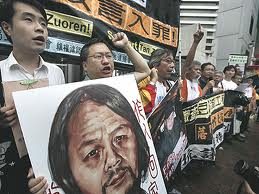
Activists protest the 5 year sentence for Sichuan earthquake activist, Tan Zuoren
Not surprisingly, the Chinese government does not take kindly to Ai’s investigation and call to arms. He has done the two things that scare the Chinese Communist Party the most – he has been able to effectively galvanize and organize a large swath of the Chinese public nationally and he has been able to subvert the firewalls and use social media to its most. When he is in Sichuan, he is beaten and prevented from testifying at the trial of earthquake activist, Tan Zuoren; he is followed by local police who create more a scene in trying to “disperse” Ai than if they had left him alone; the Shanghai government – without any trial or hearing – tears down his studio (which they had invited him to build only two years previously); and he is eventually arrested by the Beijing police, kept in an unknown place without access to family, for over 60 days.
All of these actions demonstrate the absurdity by which the Chinese government deals with its people, especially those who seek to hold the government accountable. Some might refer to this as dissent, but as Ai’s Sichuan earthquake online campaign demonstrates, and later on the “demolition party” he has at his Shanghai studio, it isn’t really dissent when so many ordinary Chinese people are in agreement with him and support him.
Klayman also spends time interviewing Ai about his childhood which, although Ai shortchanges its influence, must have had some impact on his current world view. Fortunately, Klayman spends some time developing this part of Ai’s story. Ai’s father – Ai Qing – was a famous revolutionary poet and early communist supporter, joining the Chinese Communist Party and partaking in its historic “Long March.”
But like many intellectuals in the late 1950s, Ai Qing soon felt the weight of the Chinese Communist Party’s Anti-Rightist Campaign (1957). With his new “dissident” label, Ai Qing and his family – including the one-year old Ai Weiwei – were banished to China’s far western province of Xinjiang. There the Ai family would remain for 19 years. As Ai Weiwei recounts in his interview, his once illustrious, revolutionary father was forced to clean toilets. During China’s Cultural Revolution, Ai Qing became his city’s enemy number one and subject to repeated abuse at the hands of the Red Guards.
You can’t help but draw conclusions that Ai Weiwei’s current questioning of authority is a result of what must have been horrible childhood experiences. Which makes you wonder – what about all the other children of victims of the Cultural Revolution? Ai is public in his dissatisfaction but you can’t help but think that his emotions must be shared by a large number of China’s “Lost Generation.”
Klayman’s Ai Weiwei: Never Sorry is amazing precisely because it never does answer the questions which started this post – does Ai speak for

Guess what Ai Weiwei is telling the Chinese government?
the Chinese people or is he merely a brand. The movie leaves you confident with the fact that it doesn’t matter. That this man, and only this man, should be judged on his actions alone, and his actions thus far are sincere and heroic. By the end of the film, you can’t help but like the guy and cheer him on as he single-handily antagonize the Chinese state in order to have some accountability of the Chinese government.
Ai Weiwei: Never Sorry is both uplifting and scary as Klayman perfectly captures a slice of contemporary China that at times is too quickly described: the cat-and-mouse game between the activists and the Chinese government, that often has serious and dangerous repercussions for the former. As Ai continues to needle the Chinese government, adeptly using social media to galvanize more ordinary Chinese, what will the Chinese government’s reaction be? He’s already been detained once. What else can they do? Ai Weiwei: Never Sorry doesn’t answer those questions because it can’t; only the Chinese government can provide the answer.
Rating: 
Director Alison Klayman is currently touring the U.S. with Ai Weiwei: Never Sorry. Check out her website to see if she will be showing the film near you. You can also request a screening by emailing screenings@aiweiweineversorry.com or purchase the movie on Amazon: Ai Weiwei: Never Sorry



 Themocracy