Just for Fun: Movie Review – Ghina

By , July 29, 2014
GHINA!

GHINA!

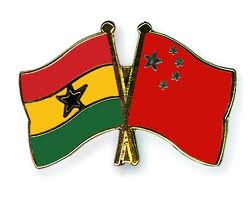
Every year, over 10,000 Chinese immigrants arrive in the oil- and gold-rich West African nation of Ghana, all with the aspiration to hit it rich. But what does such a huge wave of immigration followed up by the Chinese government’s low-cost loans and aid mean for Ghana? In Ghina (pronounced Gee-na), director Christine Choy attempts to answer that question by looking at the inter-personal relationships between a few Ghanaians and their Chinese bosses. But by focusing only on these select impressions and not examining the bigger macro issues at play, Choy fails to achieve her goal and instead, the movie is a disjointed, hodge-podge of interviews and scenes that merely perpetuates stereotypes of the Ghanaians rather than enlighten the viewer to any cohesive point.

Ghina opens with the Chinese construction of a hospital in the capital. As we learn from the English-speaking Chinese boss, this hospital is a donation to the Ghanaian people.   While the undercurrent is clear – that China is likely getting something in exchange for this “donation” – the movie fails to ever explain what that exchange is. There is vague reference to “Chinese illegal mining” but the movie never explains just how illegal and damaging to the environment that mining is to a country that still largely relies on agriculture and thus is sensitive to environmental pollution.

And that is the major problem with Ghina. It barely scratches the surface and as a result, fails to explain, either on the micro or the macro level the complexities of China’s investment in Ghana. It is not all bad. As Ghina points out, roads are being paved, hospitals are being built and ambitious Ghanaians are learning new skills and technology. But at what cost? And ultimately, at what benefit? Is China just another colonial-like power in Ghana, intent to strip it of its resources and go, leaving Ghana worse off than before? Or is it committed to the development of Ghana, where the country and its people can share in the prosperity?

Ghina also fails to adequately address the fact that many of these new Chinese construction projects aren’t job-creators for Ghana.  Instead,
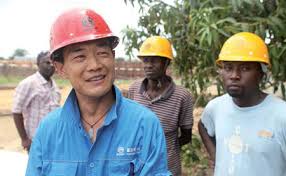
Chinese boss leading a work group in Ghana

Chinese boss leading a work group in Ghana

the Chinese company often imports the Chinese labor with the construction materials, giving only a few jobs to the locals.

Only in one scene – where what appears to be an NYU professor traveling with the film crew interacts with one of the Ghanaian professors (who judging from his wardrobe is doing quite well) – do we see the kernel of the greatness that Ghina could have become. In that exchange, the Ghanaian professor defends the Chinese actions, acknowledging that the Chinese are only taking advantage of loopholes that the Ghana government allows. And on some level that is true. However, in the case of Chinese mining in Ghana, these aren’t loopholes. These are largely illegal actions that since the summer of 2013, the Ghanaian government has begun to crackdown on, deporting thousands of Chinese immigrants.  The movie fails to point that these referenced loopholes are actual illegalities.

Unfortunately, with an issue like Chinese investment in Africa, it is difficult to tell a coherent story just by looking at a few vignettes of individual people’s lives. While Ghina attempts to do that, it largely demonstrates that this type of storytelling ends up telling little to no story at all. Instead, check out the Guardian’s 15 minute video on illegal mining in Ghana for a more nuanced understanding of the Chinese in Ghana.

Rating: ★★☆☆☆

Book Review: Leftover Women – The Resurgence of Gender Inequality in China

By , July 18, 2014

For over 60 years, the Chinese Communist Party (CCP) has promoted itself as a champion of women’s rights. It was Mao Zedong who famously proclaimed “women hold up half the sky.” In making such proclamations, the CCP has crafted the story that in Asia, an otherwise bastion of patriarchal societies, China is an oasis of women equality.

But Leta Hong Fincher, in her new book Leftover Women: The Resurgence of Gender Inequality in China, unmasks that myth and exposes a disturbing, shocking and ultimately depressing development: China likely has one of the fastest-growing gender wealth gaps in the world. And the culprit of that increasing inequality? The Chinese government itself.

As Fincher convincingly demonstrates, it all starts with the concept of a “leftover woman,” a recently-developed ideology splashed not just all over the government-run newspapers but promoted

CCP Propaganda: Women Hold Up Half the Sky

CCP Propaganda: Women Hold Up Half the Sky

by government agencies like the All-China Women’s Federation, an organization ostensibly designed to encourage female empowerment. Basically, if a woman is not married by 27, she is labeled a “leftover woman.” The older one gets, the worse the mind games become, mind games that are played out in the press and on TV on an almost daily basis. As a result, women, especially educated women who are mocked even more vigorously, feel societal pressure to marry at a young age; if you are leftover, no one will want you. But, as Fincher shows, this fear is utterly illogical. Due to the preference for boys in what has been one-child country for the past 30 years, China has a shortage of marriageable women. Not to mention, if you can only have one child, what is the rush in getting married? But in perhaps one of the most shocking parts of the book, doctors – licensed medical professionals – lie to their female patients, instilling fear in them that babies will be born with birth defects if conceived after the age of 30.

In Leftover Women, Fincher shows that this fear of being leftover has resulted in women being left out; left out of one of the largest gains in individual wealth in Chinese history: property accumulation. To understand better the connection between the two, Fincher set up a Weibo (Chinese version of Twitter) account to survey hundreds of young Chinese women. Through revealing snippets of interviews with these 20-somethings, it becomes clear that this fear of being leftover by the age of 27 has taken hold in the women themselves. This fear causes women not just to rush into a marriage but act against their own economic self-interest. Many of these well-educated, well-employed women will provide cash toward the down payment on a marital home without putting their name on the deed. Instead, as Fincher documents, in the vast majority of apartments occupied by married couples, only the man’s name is on the deed due to the resurgence of traditional gender roles. Shockingly many of the women interviewed accept these roles, acknowledging that they are effectively being swindled, but hint that it is all worth it so that they are not “leftover.”

Leftover Woman?

Leftover Woman?

Changes to the Marriage Law in 2011 only further perpetuated these non-progressive gender norms. In 2011, the Supreme People’s Court issued an interpretation of the Marriage Law finding that in the case of the divorce, the property goes only to those whose names are on the deed unless the other party can clearly show their monetary contribution. But because down payments are in cash, receipts are often not kept. Further, China does not allow joint bank accounts and it is usually the husband who writes the monthly mortgage check, even if the wife is providing cash contribution or providing for other household needs such as food and childcare. But under the new interpretation, these contributions are not considered. So, yes the interpretation is neutral on its face, but its disparate impact it clear. This is an interpretation that is going to screw women.

Rushing into marriage and losing their economic independence leaves these women vulnerable to another increasing and alarming practice in China: domestic violence. Through the interviews that Fisher conducted, a general trend emerges: these women will often stay in an abusive marriage because otherwise they will lose everything. Not to mention that the Chinese government, even after years of lobbying, has yet to adopt a Domestic Violence law. As a result, the police’s treatment of domestic violence is anything less than sensitive and is usually just seen a family matter for the wife and her abuser to handle on their own.

The Most Powerful "Leftover Woman": Epress Dowager Cixi

The Most Powerful “Leftover Woman”: Empress Dowager Cixi

Leftover Women is a chilling portrayal – often told through the voices of the women themselves – of the rapid deterioration of women’s equality in China. If you think you know China, you don’t until you have read this book. It exposes an ugly development where, through pressure to marry young, the resurgence of traditional gender norms and laws that promote male property ownership, the Chinese government is keeping women out of the property market and thus out of an important segment of societal wealth.

Unfortunately, China is not alone in keeping a group of people out of property ownership and thus wealth accumulation. In an essay that was published in June in the Atlantic, Ta-Nahesi Coates illustrates the racist policies of home ownership in the United States that has largely kept communities of color out of one of America’s most important sources of family wealth. The initial culprit? The U.S. government itself. Reading these two pieces together will make you doubly angry, but also more reflective on how wealth is accumulated in any society and the desires to keep certain groups of people out.

Rating: ★★★★½

Leftover Women: The Resurgence of Gender Inequality in China, by Leta Hong Fincher (Zed Books 2014), 192 pages.

Happy 5th Birthday China Law & Policy!

By , July 14, 2014
Happy 5th Birthday China Law & Policy!

Happy 5th Birthday China Law & Policy!

Five years ago today, China Law & Policy was born. I had just finished my fellowship at NYU Law School’s U.S.-Asia Law Institute and wasn’t 100% clear on what I was going to do next. Why not a blog. I didn’t know much about blogging but what I did know was that China was – and still is – too important a country not to be understood by the general public. But all too often people’s opinions on China are informed more by stereotypes and sound bites.

China Law & Policy was created to overcome that simplistic view and to explain in easy to understand terms, why non-China people should care about some of the underlying issues about China’s rule of law development.  We strive to ensure that our analysis is always well-documented and informed. Our secondary goal has also been to provide a platform for more diverse voices to opine about China and to this day, 50% of our podcast interviews have been conducted with women, a fact that we are very proud of.

So five years in, it’s time to take stock. Every year, China Law & Policy continues to grow. We know have over 3,500 followers to our website via various outlets (twitter, facebook, email, RSS feed) and every year we publish an article that gets a lot of attention. This past year, our series on foreign journalist visas and media censorship in China has become the most popular of posts. But in a close second is a piece that took me a long time to come to terms with and write: Chen Guangcheng and the Commandeering of Our China Human Rights Policy.

But as China Law & Policy continues to grow, the same cannot necessarily be said about China. Our inaugural post, on July 15, 2009, concerned the riots that had engulfed Xinjiang Province, the Uigher area in China’s northwest. A month later, we were writing about the detention of public interest lawyer, Xu Zhiyong (pronouced Sue Zhi-young). Fast forward five years and Xinjiang is again seeing a sharp increase in violence followed by a strong government crackdown; Xu Zhiyong is once again in prison, serving a four year term.

I hope that China Law & Policy continues to be a useful blog for both China-watchers and ordinary people. I have a lot of fun with the blog

It's my birthday, get me some cake!

It’s my birthday, get me some cake!

and will continue with it in between my day job. But as always, I welcome feedback and ideas. Have an idea for a blog post? Want to write that post yourself? Just email me – elynch@chinalawandpolicy.com.

In celebrating our 5th anniversary, I again want to thank everyone who reads this blog and who has given me much needed comments, edits and information. But in particular, I want to thank a few individuals who were there at the founding of this blog and who provided support, encouragement, and ideas: Tom Cantwell, Andrea Worden, Robert Burnett, Michael Standaert, Jeremy Daum, Susan Tice, Eva Pils, Nicky Moody, Don Clarke, Madhuri Kommareddi, Susan Fishman Orlins and Jerome Lynch.

Finally, China Law & Policy could not exist if WordPress – the software that powers the blog – was not offered free to the public. Thank you Matt Mullenweg, the founder of WordPress, for creating an easy-to-use, open-source software that has been an important democratizing tool.

Here is to another 5 years!

birthday chinese

Just for Fun: Movie Review – Lou Ye’s Blind Massage

Lou Ye's Blind Massage

Lou Ye’s Blind Massage


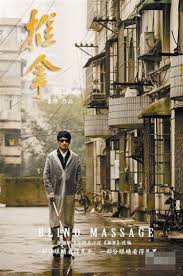
Blind Massage, Chinese director Lou Ye‘s (pronounced Low Yeah) new film, should never be introduced as “heartwarming” as it mistakenly was at last week’s New York Asian Film Festival.   “Absolutely fearless” is much more apt. This is a movie that attempts to capture the experience of blindness in the least blind-friendly of mediums – film – and it largely succeeds. For that reason alone, this brave, beautiful movie is a must see. But it’s also a movie that, by following the employees of a blind massage parlor in Nanjing, China,that diverges from the usual narrative and refuses to allow the audience to simply view these characters as saints merely because of their disabilities. Instead, the audience is challenged to view the blind and near-blind masseuses as who they really are: ordinary people just trying to make their way in the rough and tumble world that is China.

The opening scene itself – where the audience is left unable to focus on the key object that resulted in one of the main character’s loss of sight – lets you know that this is no ordinary movie. For many of the scenes throughout Blind Massage, the geography keeps changing and the audience cannot just orient itself by viewing the scene alone. Slowly you come to realize that what you see is no longer reliable. Instead, the audience is required to rely on other senses, in particular the sense of sound – the pouring of the rain, the ringing of bells – to comprehend what is happening; much like the blind must do on a daily basis. Lou perfectly captures this visceral feeling in a scene toward the end of the movie, where one of the blind masseuses – in a delicately, intimate scene – confesses her love to another. But at the end of the scene, you are shocked by the sound of a third person in the room. The audience is just as disoriented, surprised and deprived as the two characters who thought they were having a moment alone.

Lou also dispenses with any sentimentality toward the blind. The blind masseuses – played by both sighted professional actors as well as

Chinese film director Lou Ye

Chinese film director Lou Ye

non-sighted amateurs (who do a great job) – are not the usual wise blind sages often portrayed in Hollywood flicks. Instead, Lou develops the complexity of each character, portraying their foibles as well as their strengths; some you like and some you don’t. Most notably, Lou shows the sexual side of the blind, with awkward and honest sex scenes between some of the characters. But through the stories of each character, the emotional impact of discrimination and the invisibility each must feel in the world of the sighted is evident. It is particularly acute in a bloody, hara-kari-like scene where one character’s self-inflicted wounds symbolize the anguish of his injured pride.

Although there has been much criticism recently regarding the traditional and wholesale compartmentalization of the blind as masseuses in China, Lou Ye does not delve into that discussion. Nor does he have to. Lou’s goal is not to make a political point, but rather a human one: to show what it is like to be blind and to force the sighted to see. And he does so deftly. Even in America, where visual aids are prevalent, the blind and the sighted still do not exist as one; their worlds are largely divided. And while yes, China probably has a worse track record in mainstreaming the blind (only recently has it allowed the blind to take the same college entrance exam as the sighted), it should be remember that it is a Chinese film director that had the courage and sensitivity to attempt to honestly portray the lives of the blind on film.

There are aspects of the script that veer toward the melodramatic, but ultimately Blind Massage is a powerful movie that makes you feel the world of the blind instead of just trying to see it.

Rating: ★★★★½

********************************************************************************************************************************
As of the date of this post, Blind Massage has only shown at the Berlin Film Festival (where it won the Silver Bear for Outstanding Artistic Contribution) and the New York Asian Film Festival.  It is unclear if Blind Massage will be shown more widely in the United States or Europe. 

A scene from Lou Ye's Blind Massage

A scene from Lou Ye’s Blind Massage

Just For Fun: Art Review – Ai Weiwei’s “According to What?”

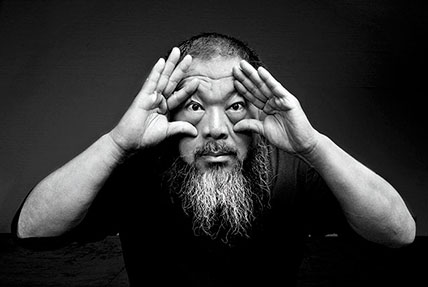
Artist & Activist Ai Weiwei

Artist & Activist Ai Weiwei

For sure the best part of the Brooklyn Museum’s current exhibition of Ai Weiwei‘s (pronounced Eye Way-Way) retrospective – “According to What?” – is that it was able to obtain the six dioramas Ai made of his 81-day detention by Chinese authorities. The dioramas visually demonstrates the utter absurdity of the Chinese police state. This alone mandates that this exhibit not be missed.

But the second best part? That the Brooklyn Museum did not place Ai’s works in a vacuum. Instead, Ai’s exhibit is one of four fascinating exhibits concerning art and social activism. Any visit to Ai’s exhibit should be accompanied by a viewing of at least one of these other shows. If you get there before July 13, definitely check out “Witness: Art and Civil Rights in the Sixties” as a contrasting exhibit to Ai’s and as a powerful reminder of America’s own checkered past and unclear future concerning civil and human rights.

“According to What?” is not just a retrospective of Ai’s art but also an explanation of

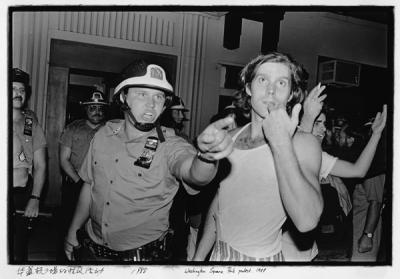
Ai Photo of Police & Protestors at Washington Square Park, 1988

Ai Photo of Police & Protestors at Washington Square Park, 1988

his activism. One of the most revealing parts of the exhibition is Ai’s photographs from 1980s New York City, covering the decade when Ai lived in the city. Through Ai’s photographs, we see what he saw: constant protests in various city parks, face-to-face confrontation with the police, the beginnings of the AIDs crisis and its activism, the grit of 1980s New York City. When later on in the exhibit you watch a video of Ai challenging the Chinese police and demanding accountability, you can’t help but think back to the photos of bloody protesters in Tompkins Square Park and wonder if this is what influences Ai to be the agitator that he has become.

But Ai wasn’t always such an agitator. Unfortunately the exhibition gives only short shrift to his prior – and government-accepted – work. In overlooking this aspect of Ai’s career, the exhibit also fails to fully explain the spark that radicalized his art – the Sichuan earthquake. After an 8.0 magnitude earthquake rocked Sichuan province, Ai traveled to the region and saw the hundreds of shoddily-built schoolhouses that completely fell, killing the children in them. All the while surrounding government buildings remained standing. Seeing the thousands of children’s backpacks lying in the rubble and the fact that the government-controlled press was not acknowledging the “tofu-dreg construction,” Ai took matters into his own hands, undertaking a “Citizen’s Investigation” and uncovering the names of the 5,196 children killed.

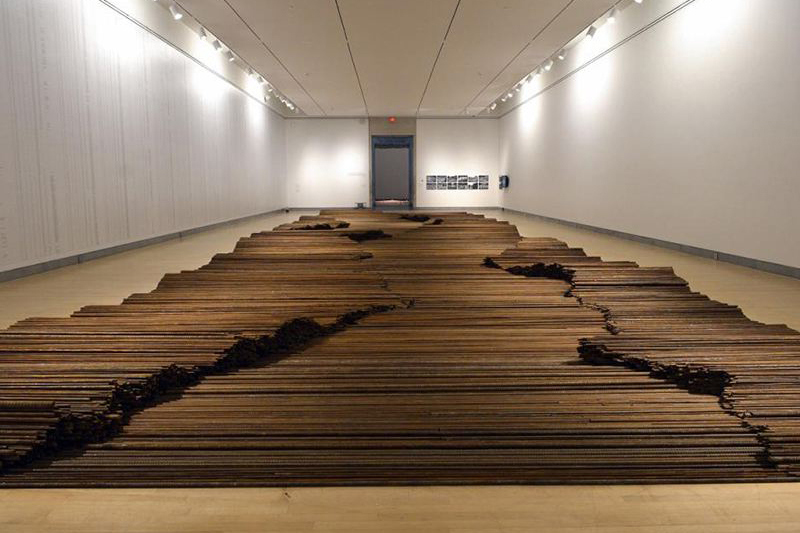
The gallery with Ai's Sichuan earthqake remembrance art, including "Straight"

The gallery with Ai’s Sichuan earthqake remembrance art, including “Straight”

In “Sichuan Name List,” Ai lists the name, age, school and address of every single child killed.   It is the layout of this work – the 5,196 names line an entire wall of the gallery, from top of the ten foot wall to bottom – that forms the art work. Only in seeing this can one even begin to attempt to understand the enormity of the loss. The work is accompanied by “Remembrance” a three-and-a-half audio recording of strangers from around the world speaking the name of every single child that perished. Lying in the center of the gallery are the steel rebar from the shoddy construction – all of which have been straightened back to their original form.

Ai’s homage to the victims of the Sichuan earthquake is powerful. It is also the reason why Ai is so dangerous to the Chinese Communist Party (“CCP”).   To maintain its power, the CCP needs to retain its monopoly on Chinese history. Since the founding of the People’s Republic, it is the CCP that writes the country’s history; not its people. Tiananmen? Never happened. Mao Zedong? Only 10% wrong. The Cultural Revolution? Not a descent into madness, just a little blip on the radar screen. Here, Ai – who is an influential figure since his father, Ai Qing, was a well-known and respected poet – is attempting to write the people’s history. It’s that attempt that the CCP sees as an assault on its rule.

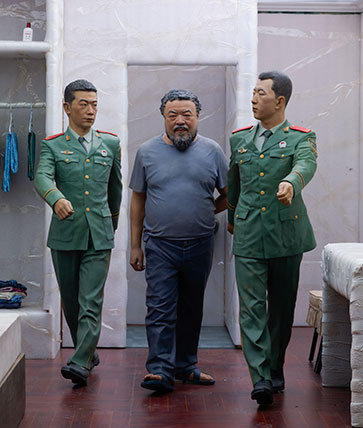
Never Lonely! Friendly little guards are there and everywhere!

Never Lonely! Friendly little guards are there and everywhere!

But if you think that is overreacting, then check out the six half-life size dioramas that Ai made of his 81 day detention. In 2011, Ai was detained by the public security bureau allegedly on tax fraud charges although the general consensus is that it was the government’s failed attempt to silence his activism. Ai designed each five-foot tall diorama with a window where the viewer can look in and see Ai in his room. In the first room, things don’t look so bad. It looks more like a hotel room than a jail cell. But as you progress and look into each scene, you begin to realize the absurdity of what is going on here. Two guards are with Ai at every moment, watching him. As he eats, as he sleeps, even when he showers. The guards are there, standing over him, watching his every move. Is this jolly, chubby man really that dangerous?

With so much of Ai’s art involving his interaction with the authorities, “According to What?” raises the question – has social activism become Ai’s art? And is this good for either: should activism merely be theater; should art be so much protest? By situating “According to What?” with other activist art, the Brooklyn Museum has largely answered those questions – art does not exist in a vacuum nor should we want it to.

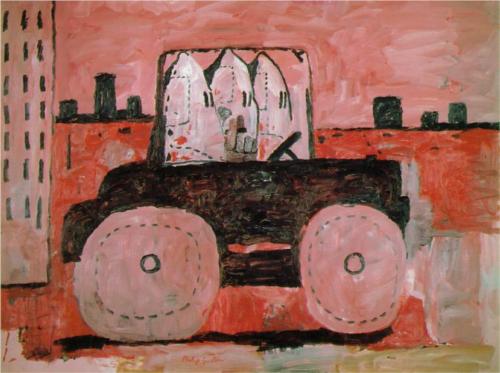
Philip Guston's City Limits (1969), part of BK Museum's Witness Exhibit

Philip Guston’s City Limits (1969), part of BK Museum’s Witness Exhibit

For Americans, viewing “Witness: Art and Civil Rights in the Sixties” will demonstrate that art and activism go hand-and-hand and that we can and should respect the artist for both. It will also serve as an emotional reminder of our own dirty little past. But in the end, it will make you wonder – while these tactics worked in 1960s America, a largely democratic society, will they also work in Ai’s authoritarian China? One hopes that Ai’s art is not in vain, but, as China’s new regime even more violently cracks down on any purported challenge to its rule, only the future can tell.

*************************************************************************************

“Witness: Art and Civil Rights in the Sixties” is only on view at the Brooklyn Museum until July 13, 2014. “According to What?” is on view until August 10, 2014. This will be the exhibit’s final stop on its international tour. While entrance to the Brooklyn Museum is a suggested donation of $12, “According to What?” is a required $15 ticket (which includes price of general admission). Note that the dioramas of Ai’s detention are on the first floor before purchasing tickets and thus can be viewed for free.

Panorama Theme by Themocracy