
 On Facebook
 By Email

Book Review – Peking Diary: A Year of Revolution
 Comments (0)
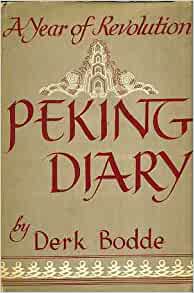
Reading Derk Bodde’s memoir, Peking Diary: A Year of Revolution, is like watching season four of The Crown. Sure we know what is going to happen to Prince Charles and Princess Diana, but it’s watching the details develop that is fascinating. The same with Peking Diary, Bodde’s account of his year in Beijing in 1948, when China was in the midst of a civil war. We know that the Chinese Communists will eventually defeat the Nationalist government, but seeing precisely how that happens, and the changes it brings to everyday life in Beijing, is fascinating. Anyone who wants to understand better how the Communists were able to defeat the U.S.-backed Nationalists, Peking Diary is a must read.
Peking Diary opens with Bodde, fluent in Mandarin and a professor of Chinese studies, returning to Beijing in August 1948 as a Fulbright fellow. It’s been eleven years since he was last in China and Beijing is a shell of its former self. Bodde sees a city, weighed down both economically and psychologically by a corrupt Nationalist ruling party that largely ignores the Chinese people’s hardships. Through conversations with various Chinese people – both the elite and the average individual – Bodde conveys the Chinese people’s frustrations. Much of the first half of Peking Diary is a recounting of the exploding inflation under the Nationalists, a fact that makes living in Beijing, especially for the Chinese, extremely difficult. Bodde himself becomes obsessed with it as he sees his Fulbright stipend able to buy less and less each day. But instead of trying to get the inflation under control, the Nationalists try to pass it off as fake news. Bodde never expresses support for the Communists but, as living conditions worsen and the Nationalists continue flounder in response, a sense of eagerness for the Communist invasion of Beijing permeates his entries. For the Chinese people Bodde talks to, they seem to feel the same.
On January 23, 1949, after two weeks of air raids and the sounds of constant gunfire just outside Beijing’s city walls, the Communist finally take Beijing. Within a few diary entries of that conquest, the city seems to come back alive. Most people are excited about the Communists, or at the very least that Nationalist rule is over. It is Bodde’s description of this ground level reaction to the Communists that makes Peking Diary a compelling read. So few histories from that time cover what people on the ground were thinking and how they were reacting to the fall of the Nationalists.
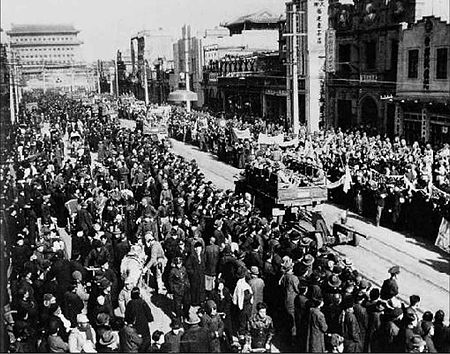
But what comes as a shock is how quickly the Communists were able to get control of the Beijing and effectively run the day-to-day affairs of the city. Blackouts quickly ceased, running water returned, homeless students were sent back to their schools, and, to limit inflation, the Communists adopted plans that the Nationalists ignored.
Peking Diary generally portrays the Chinese Communist Party in a positive light, but there are moments when Bodde is rather prescient about the hidden dangers of the Party. Almost immediately the Party shuts down the foreign press and, through control of the Chinese press, Bodde sees how the Party seeks to limit the Chinese people’s independent knowledge of affairs outside the city’s borders. The Communists fondness for thought control also unnerves Bodde. And Bodde also sees the beginning of a police state, with anonymous “investigation boxes” set up in Tianjin so anyone can secretly denounce another.
But there are also things that Bodde gets terribly wrong. In particular, his assessment of the Communists’ land reform policy. Throughout the book, Bodde describes the new policy as relatively benign, nothing more than the reallocation of land from the rich and well-off medium farmers to everyone else in the village. But outside the walls of Beijing, the mass murder of landlords in the countryside is occurring as part of the land reform policy. Between 1949 and 1953, the Chinese government estimates that anywhere between 830,000 (as estimated by Zhou Enlai) and 2 to 5 million landlords (as estimated by Mao Zedong) were killed. Under Communist control, Bodde is not permitted to leave Beijing to see for himself the effects of what he thinks is a harmless land reform policy.
But Peking Diary is a must read not just because it is one of the few books from that time period that captures the ground-level impact of Communist rule, but also because some of Bodde’s warnings to U.S. policymakers still resonate. In the Epilogue, Bodde cautions policymakers from seeing China’s Communist revolution as a mere extension of Soviet influence or that somehow the Chinese people have been “enslaved” by an illegitimate Communist party. Bodde makes clear that the reality on the ground is much different – with Chinese people, even critiques of communism, welcoming the Chinese Communists.
Unfortunately, this idea – that the Party is illegitimate – has re-emerged in today’s Washington. In July 2020, Secretary of State Mike Pompeo distinguished the Chinese people and its government: “We must also engage and empower the Chinese people – a dynamic, freedom-loving people who are completely distinct from the Chinese Communist Party.” But the Chinese people’s relationship with the Communist Party is not that simple. It is much more nuanced, just like any citizenries’ relationship with its government. This isn’t to say that there isn’t a large number of dissatisfied Chinese citizens, demanding greater reform, freedom and human rights. And there are some who also seek the downfall of the Communist Party. But there are many who are at the very least agnostic toward the current Chinese government if not supportive of it. To fail to recognize these distinctions will only lead to an uninformed China policy, much like it did in 1949. It’s disappointing that 70 years on, the lessons of Peking Diary still need to be learned.
Rating: 

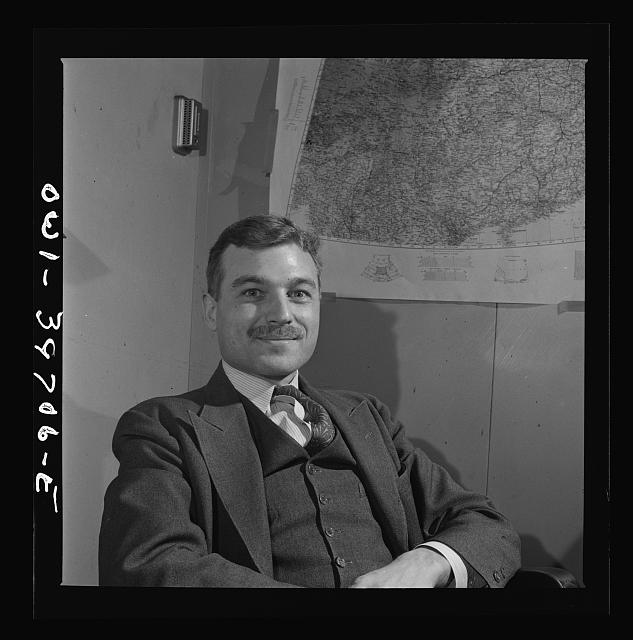
Peking Diary: A Year of Revolution (Henry Schuman, Inc. 1950), 274 pages.
Peking Diary is currently out of print but appears to be available for free in it entirety at Internet Archive here. Used physical copies are available on Amazon.





 Themocracy