Just for Fun: Uptown & Downtown – Different Perspectives on the Chinese in America

By , October 30, 2014
At the NY Historical Society - Photo from American actress Anna May Wong's identity card that she had to carry with her at all times

At the NY Historical Society – Photo from American actress Anna May Wong’s identity card that she had to carry with her at all times

It is rare to see an exhibit exclusively on the Chinese experience in America.  Rarer still to have two shown simultaneously in the same city.  But that is precisely what is happening in New York this fall with the New York Historical Society’s Chinese America: Exclusion/Inclusion and the Museum of Chinese in America’s (“MOCA”) 35th anniversary show, Waves of Identity: 35 Years of Archiving.

Located on the Upper West Side, the Historical Society is removed from any of the city’s Chinatowns and unfortunately, that removal is felt throughout the show.  The exhibition centers on the passage of the Chinese Exclusion Act, a 1882 act of Congress that essentially barred all but the few Chinese from entering the United States and prevented the naturalization of Chinese immigrants for the next 60-plus years.

Exclusion/Inclusion does a great job of presenting the history of Chinese immigration in America, American’s backlash with the passage of the Exclusion Act, and the Act’s eventual repeal in 1943 (although a  quota remained for Chinese immigration until 1965 when the passage of the Immigration and Naturalization Act eliminated quotas).  In particular, the show makes clear that “exclusion” in the title of the Act was a misnomer.  With the stated goal to keep out Chinese laborers, the Act permitted other classes of Chinese citizens to immigrate: officials, teachers, students, merchants (although not laundry or restaurant owners), and their immediate families (wives and children).  As a result, an industry falsifying documents began and the modern U.S. immigration bureaucracy – needed to verify the accuracy of the immigrants’ documents and keep as many Chinese out – was born.

But throughout the show, the history feels whitewashed.  While the exhibit is about Chinese and Chinese Americans, little of their voices come

MOCA's New Show -Waves of Identity: 35 Years of Archiving

MOCA’s New Show -Waves of Identity: 35 Years of Archiving

through.  Sure the show uses the usual method of quotes and diary passages from Chinese men and women held for years in Angel Island, but it is more didactic than it is inspiring.  It isn’t until the end, with a blown up graphic novel of Bronx-born Amy Chin describing  the continued impact of the Exclusion Act on her family that the exhibition takes on an emotional gravitas.

The Chinese voice is particularly absent in expressing the community’s role in actually changing the law that impacted it or in shaping its own future.  Scant attention is paid to the Chinese-American community’s continued activism in agitating for acceptance as Americans.  Instead, the show ends with a feeling that “inclusion” has already happened.  There is no mention of the 2011 suicide of Private Danny Chen who, prior to his death, was tormented daily because of his Chinese heritage.  No mention is made of the 1982 hate-motivated murder of Vincent Chin whose murderers received a mere three years of probation.   These incidents and many others show that full inclusion has yet to occur.

But what Exclusion/Inclusion lacks can be found in MOCA’s Waves of Identity: 35 Years of Archiving.  Commemorating the museum’s 35th anniversary, Waves is a modest but compelling show.  MOCA, located in Chinatown itself, was very much a community-created institution and it is that sense of community that is felt throughout the exhibit.

Waves is not a lineal procession through history like Exclusion/Inclusion; instead, it is much more innovative.  MOCA’s impressive collection of community artifacts, photos and oral histories are laid out by answering a series of questions:  “who founded MOCA and why?”; “what does it mean to be Chinese?”; “how do you become American?”; “how does memory become history?”; “where does Chinatown end?”  None of these questions are directly answered by the artifacts and multimedia that accompany the section.  Instead the viewer is forced to engage with the objects and draw their own conclusions.  The McDonald’s Shanghai McNuggets promotion that you might fondly remember from the late 1980s, how do we – and should we – place this in our, shared American history?

Shop in Chinatown days after Sept. 11, 2001 (c) Corkey Lee - http://911chinatown.mocanyc.org/album/CorkyLee.html

Shop in Chinatown days after Sept. 11, 2001
(c) Corkey Lee – http://911chinatown.mocanyc.org/album/CorkyLee.html

And that is perhaps the biggest difference between Waves and Exclusion/Inclusion.  The latter, by its very title, presupposes a separate society that Chinese Americans are either kept from or allowed to enter.  Waves on the other hand demonstrates that Chinese American history is – and has always been – as much a part of the greater American history as the American Revolution or the Southern Civil Rights Movement.  Perhaps the portion of the exhibit that demonstrates our shared history the most is the section on the impact of the September 11th attacks not just on Chinatown itself which sat in the shadows of the Towers, but also on its people who, like all New Yorkers, saw those anchors of their lives fall before their eyes.

Chinese America: Exclusion/Inclusion, with ads plastered on almost every subway station, is getting the most attention.  But if you go see that show, be sure to follow up with Waves of Identity: 35 Years of Archiving for carefully curated exhibit by the community itself that will engage the viewer.


Chinese America: Exclusion/Inclusion
Now through April 19, 2015
Rating: ★★½☆☆New York Historical Society
170 Central Park West
New York, NY
Admission: $19; FREE Fridays 6 pm – 8 pm
Waves of Identity: 35 Years of Archiving
Now through March 1, 2015
Rating: ★★★½☆Museum of Chinese in America
215 Centre Street
New York, NY
Admission: $ 10; FREE Thursdays All Day

Xie Jin’s “Two Stage Sisters” & Xi Jinping’s Recent Thoughts on the Arts

By , October 26, 2014
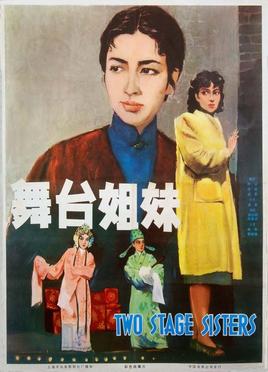
Movie Poster for Xie Jin's Two Stage Sisters

Movie Poster for Xie Jin’s Two Stage Sisters

The China Institute‘s Cultural Revolution film series kicked off with a bang the other week with a rarely-viewed Xie Jin (pronounced Sye Gin) film, Two Stage Sisters (舞台姐妹).  All of the films being shown  makes this little series a gem.  But it is the series’ fortuitous timing – with President Xi Jinping’s (pronounced See Gin-ping) recent speech on the arts – that makes it a must see for anyone trying to understand the possible direction China’s arts may take in the future.

Two Stage Sisters, filmed in 1964 during a more open time before the onset of the Cultural Revolution, breaks down any notion that  propaganda films from this time period could not also be art.  The film follows the lives of two Shaoxing opera actresses – Yuehong and Chunhua – as they travel through a turbulent time in China’s history.  The film opens in 1935’s rural China.  Chunhua, who has run away from her in-laws who had plans to sell her, finds herself hiding in the store room of a local opera troupe.  The troupe – run by Yuehong’s father – adopts her and discovering that she has a natural talent for Shaoxing opera, makes her the star of the show along with Yuehong.  Showing the abusive practices of pre-revolution China, after the father dies, the two stage sisters are sold to a Shanghai opera troupe to pay off their father’s debts.

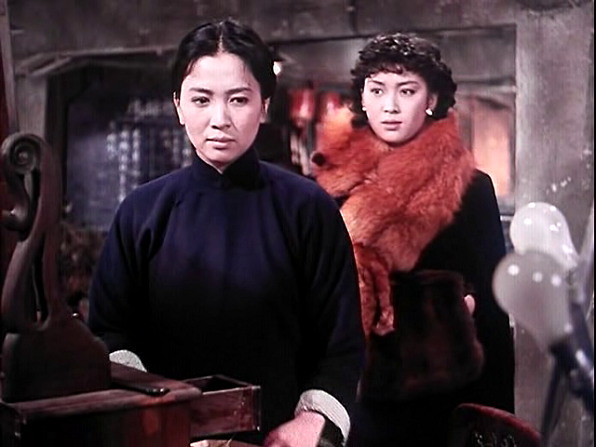
In early 1940s Shanghai, Yuehong and Chunhua become stars.  But slowly, as China begins to change, so does the relationship between the two women.  Chunhua remains the virtuous peasant.  Even when a wealthy patron wants to adopt her as her daughter, Chunhua, ever pure to the art, rejects the patron’s advances.  Yuehong questions Chunhua’s decision and is slowly seduced by the opera troupe’s manager as well as the Guomingdang, bourgeois lifestyle that he offers.  While Chunhua, inspired by Lu Xun’s work, begins to write revolutionary operas, Yuehong retires and fills her life with pearls, furs and diamonds.

Two Stage Sisters is marked by amazingly intense melodrama with the growing tension between the two sisters and the impending revolution

Chunhua (left) and Yuehong begin to lead different lives

Chunhua (left) and Yuehong begin to lead different lives

building in every scene.  It is in that melodrama that director Xie Jin excels and makes this film into a masterpiece.   The drama crescendos in an artfully shot courtroom scene that demonstrates that if history did not get in the way, Xie Jin could have been China’s Kurosawa.

But like most things in China, history and politics did get in the way, essentially putting Xie Jin’s career on hold for the next twenty years.  Two Stage Sisters, filmed with the approval of Xia Yan (pronounced Syia Yen), China’s Vice Minister of Culture, was produced at time when Mao Zedong’s power was at its lowest due to the tragic debacle of the Great Leap Forward.  But that period would not last and it is the Cultural Revolution itself that becomes Mao’s plan to regain complete power.

With the start of the Cultural Revolution in 1966, Xie’s film was condemned precisely because it had not been hard enough on Yuehong, the sister that succumbs to materialism.  Xie Jin’s art of portraying even the “villain” in a nuanced and sympathetic manner did not fly during the Cultural Revolution.  For the Red Guards who would begin to rule society for the next few years, Chunhua’s forgiveness of Yuehong came too easy.  For them, Yuehong – an enemy of the socialist state – should have been punished more for her capitalist ways.

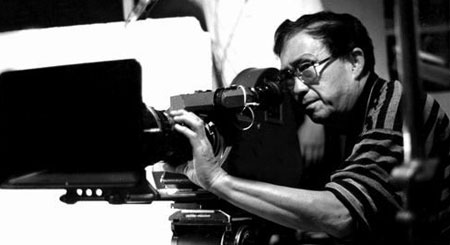
Director Xie Jin at work.

Director Xie Jin at work.

Additionally, produced with the assistance of Xia Yan, a vocal critic of Mao’s Great Leap Forward and a target of Mao’s wife and former actress Jiang Qing, Two Stage Sisters’ condemnation was inevitable.  Soon after the start of the Cultural Revolution, Xia was purged and jailed for the eight years.  Xie Jin would spend much of the Cultural Revolution and what should have been the prime of his career in a labor camp.

Two Stage Sisters, and the history that surrounds it, shows that art in the People’s Republic of China, while ostensibly required to “serve the people” in fact serves the political whims of its leaders.  Given this history, Xi Jinping’s recent October 15, 2014 meeting with China’s artists might be a bellwether for his attempts to tie art not just more to the Chinese Communist Party but more to his rule.  The Cultural Revolution found its origin in Mao’s 1943 speech at the Yenan Talks on Literature and Art.  For Mao, the revolution had two fronts – the arts and the military; there was no such thing as art for art’s sake.  Art and literature were essential for a successful revolution and the Yenan Talks made clear that art and literature needed to extol the masses and propel them forward for greater revolution.  At a point though, Mao noted that with the masses’ rising cultural levels, art standards would have to rise as well.  But the art would still need to serve the people.

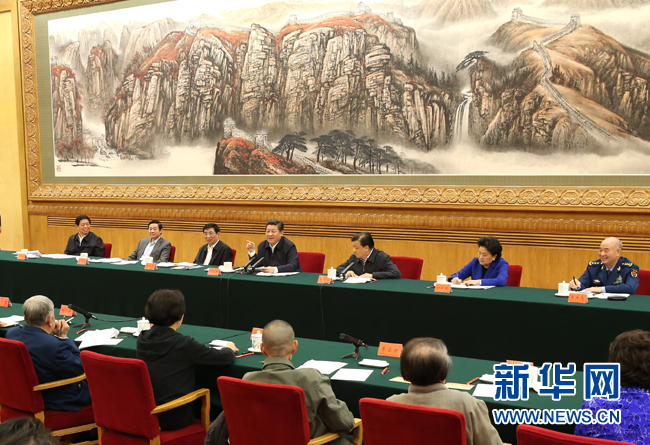
Xi’s October 15 speech, while not as obvious, has aspects that are eerily similar to Mao’s 1943 Talks.  According to Xinhua News agency, which summarized Xi’s remarks rather than print them, Xi called on artists and authors to be one with the people and to use their art to promote the Party: “Literature and art must reflect well the people’s wishes; it must persist in the fundamental orientation of serving the people and serving Socialism” (translation courtesy of Rogier Creemers).  Xi also digressed on the need to produce quality works for the masses’ increased cultural awareness.

Will Xi try to dominate the arts the way Mao did during the Cultural Revolution?  Or was this just a roundabout way to state the obvious: even

Xi Jinping speaking on arts in literature in today's China

Xi Jinping speaking on arts in literature in today’s China

Chinese people don’t really want to watch Chinese movies and there is a genuine need to improve quality?  Or is it something else?  For sure we won’t be seeing a Cultural Revolution anytime soon.  But if I was an artist, author or director in China right now, with a speech that makes reference to “a hundred flowers bloom and a hundred schools of thought contend (百花齐放、百家争鸣的方针),” I would certainly sit this round of art-making out.  That unfortunately means the arts in China – at least those sanctioned by the state – will continue to stay at its current level.

Two Stage Sisters
Director: Xie Jin
1964
Rating: ★★★★½

**********************************************************************************
The China Institute’s Cultural Revolution Film Series runs now through November 19, 2014 with a movie shown every Wednesday night.  Tickets are $15 and each movie is followed by a Q&A session with either the director or someone expert in the movie.  The China Institute is located at 125 E 65th Street in New York City. 

Troublesome China – New Human Rights Report Confirms a Decline

By , October 10, 2014

Seal of the CECC“Human rights and rule of law conditions in China overall did not improve this past year, and declined in some of the areas covered by this report.” And so begins the Congressional-Executive Commission on China‘s (CECC) 2014 Annual Report, a non-sugarcoated analysis of the dilapidated state of human rights and rule of law in China these days.

Required by regulation, the CECC publishes an annual report analyzing these issues and this year’s report demonstrates that President Xi Jinping continues to consolidate his power through political purges and other methods not seen since the end of the Cultural Revolution.  But, as the this year’s report shows, the periphery – both from a geographic as well as a societal perspective – continues to buck the central government’s control and as a result, continues to experience a harsh crackdown.

The Chinese government’s reaction to the Hong Kong protests earlier this month – calling the peaceful protesters “extreme” and threatening “unimaginable consequences” – pale in comparison to its suppression of any attempts in Tibet or Xinjiang to give life to the term “autonomous” in the title Autonomous Region which both nominally are.  In the past year alone, of the 141 Chinese political prisoners that China has arrested or detained (see CECC list here), 101 are Tibetan or Uigher (the ethnic group that populates Xinjiang province in western China).

The recent sentencing of Uigher professor, Ilham Tohti, reflects the Chinese government’s inability to comprehend a notion of autonomy that

Ilham Tohti and his wife before he was sentenced to life imprisonment

Ilham Tohto and his wife before he was sentenced to life imprisonment

could mean anything other than complete tethering of the region to the Chinese Communist Party and its policies.  Tohti was not a Uigher radical and never called for separatism from China in contrast to the charges against him.  Rather, his writings questioned the efficacy of the government’s harsh policies like forbidding traditional Muslim practices of fasting for Ramadan, wearing of head scarves, or even public prayer.  Tohti called for the Uighers to have more of a say in the governing of their daily lives, breathing life into the term autonomous, much like the students protested for last week in Hong Kong.  But instead of listening to Tohti that greater independence in these ostensibly autonomous regions could lead to great stability, a Chinese court sentence Tohti to life imprisonment.

But, as the CECC’s Annual Report illustrates, controlling the periphery increasingly means controlling entities ostensibly outside of its borders.  The Chinese government’s continued use of the journalist visa process in an attempt to censor foreign coverage of China is one such example.  The other, is the lopsided use of its laws to benefit domestic businesses over foreign ones, in particular the anti-monopoly law. As Sophie Richardson, Human Rights Watch’s China Director points out, rule of law issues in China are no longer a fringe human rights issue; instead, the same arbitrary legal system that puts dissidents in jail for life is now beginning to negatively impact foreign business interests in China.  But will this Annual Report will be the wake-up call to business and the U.S. government that it needs to actually start  considering attention these issues?  That it needs to actually read the CECC’s Annual Report, not just mandate that it be created?

Panorama Theme by Themocracy