Happy Year of the Metal Rat!

By , January 23, 2020

Are you ready for Year of the Rat?

For the Western world, a rat is not a good thing.  “Rat race,” “I smell a rat,” “pack rat,” “who gives a rat’s ***,” usually do not connote positive vibes. But in Asia, the rat is more respected.  For the rat isn’t just any animal on the lunar year zodiac, it’s the first of the 12-year cycle.  So on Saturday, when the world welcomes the Year of the Metal Rat, it will also be celebrating the start of a new lunar cycle!

It was the rat’s ingenuity and quick-thinking that caused it to be first among all twelve of the animals in the zodiac.  According to legend, the Jade Emperor called all the animals of the world together and announced that he was going to choose 12 to be part of the zodiac.  How would those 12 be chosen?  Through a race, and the order of the animals in the zodiac would be determined by the order in which they finished the race.  The rat, realizing it was one of the smallest animals, knew it didn’t stand a chance to be first let alone one of the 12.  So he asked his friend the ox if he could bum a ride on his back to get to the finish line.  The ox, being an honest, dependable soul and a good friend, agreed.  But just as the ox was about to cross the finish line first, the rat hopped off of his back and beat him to it, making the rat the first among the 12 animals.

With the rat year the first in the zodiac cycle, some feng shui experts say that 2020 will be a year of new beginnings, a perfect time to finish long-term projects and to make some money.  But some note a more ominous future.  Previous rat years have brought on wars and other calamities: 1840, a rat year, saw the start of the Opium Wars in China; and 1960, the start of the Vietnam War.  For those who remember the last rat year – 2008 – will also remember the worst financial crisis since the Great Depression.

What does the rat year mean for you?  All of that depends on how your sign interacts with the rat sign (to figure out your sign, click here).  For more details on what is in store for you, check out feng shui expert Theirry Chow’s predictions here.

But regardless of what 2020 may hold for you, the Lunar New Year – which lasts 15 days until the Lantern Festival on February 8 – is an important time to celebrate with cherished family and friends.  And to all our readers who celebrate the Lunar New Year, we wish you a healthy and prosperous Year of the Metal Rat!

Book Review – Betraying Big Brother: The Feminist Awakening in China

By , January 19, 2020

Freelance Journalist, Huang Xueqin

Huang Xueqin, a 30-something freelance journalist in the southern Chinese city of Guangdong, doesn’t look like a hardened criminal.  With a playful smile and wearing an Annie Hall-style hat, Huang seems like a friendly sort, with maybe a mischievous side.  But make no mistake, Huang is a fierce advocate for women’s rights, being one of the public figures behind China’s nascent #MeToo movement after coming out in 2017 about her own workplace sexual assault.  She’s written extensively on other women who have been sexually harassed and assaulted and, in 2018, conducted an online survey of female Chinese journalists finding that almost 85% had experienced sexual harassment on the job, with almost 60% of those remaining silent.

It was that activism that landed Huang in a Chinese detention center.  And on Friday, after holding her for three months under suspicion of “picking quarrels and provoking troubles,” a crime under China’s criminal law that has been used almost exclusively to silence peaceful critics of the Chinese government, Guangdong police finally freed Huang.  In a country where its founding leader once said that “women hold up half the sky,” it seems odd that a women’s rights activist would be considered a pariah, someone that the Chinese government has to deal with criminally.

But Leta Hong Fincher,[1] in her recent book, Title: Betraying Big Brother: The Feminist Awakening in China, explains precisely why the Chinese leadership trembles at the idea of women calling for their rights. Identifying China’s current leadership as “patriarchal authoritarianism,” Fincher, in her well-researched and insightful book, shows that unlike other social movements in China, these feminist activists are not just seeking a more open society or looking to fulfill the promises of equality under Chinese law.  As Fincher shows, if you take this feminist movement to its logical conclusion, only by overturning the current political and cultural order can these women achieve equality in China.

Fincher comes to this damning, powerful conclusion largely through the stories of five feminist activists who were detained for 37 days in 2015 and became known as the Feminist Five.  This choice – to tell the history of China’s feminist movement and forecast where it is headed through these women’s personal narratives – is what makes this read an engaging page-turner.  Not surprisingly, Fincher was previously a  China-based journalist and she brings that reporter’s eye for detail and desire to understand the characters behind the story.  And this is necessary because what caused the Feminist Five to end up in detention – also on suspicion of “picking quarrels and provoking troubles” – seems completely ordinary, and defies logic that this would be something that would scare any government, let alone China’s: they were just going to give out leaflets and stickers on public buses calling for the end of groping and provide women with information on how to report such an incident.

But for the Chinese government, this was a serious offense and the women needed to be broken.  Through in-depth interviews, Fincher retells, for the first time, these Feminist Five’s harrowing experiences during 37 days of detention.  They were subjected to physical and psychological torture: the police took away the women’s glasses, making them unable to see; interrogation was constant to the point that one woman needed medical attention; intense light, only a few inches from their faces, shown brightly in their eyes; medications were denied; and each was told about the threats made against their parents or children.  These women talk about the emotional toll that these interrogations had on them, making each question whether it was worth it.  But in the end, each remains committed to the cause, finding strength in the support of other Chinese feminists and inspiration from women activists abroad.

While the Feminist Five, and other Chinese Feminists’ stories makes the book a lively read, Fincher doesn’t shy away from more academic arguments to further support her argument of the Chinese government’s “patriarchal authoritarianism.”  She examines societal institutions: the lack of any women in positions of power in government; the prevalence of domestic violence in China; the failure to enforce the Domestic Violence Law; the pressure on women to marry and the shaming of single women (this was the focus of Fincher’s ground-breaking book, Leftover Women); the lack of career options for most women; nationalist rhetoric filled with misogyny; and seeing women solely as reproductive vessels.


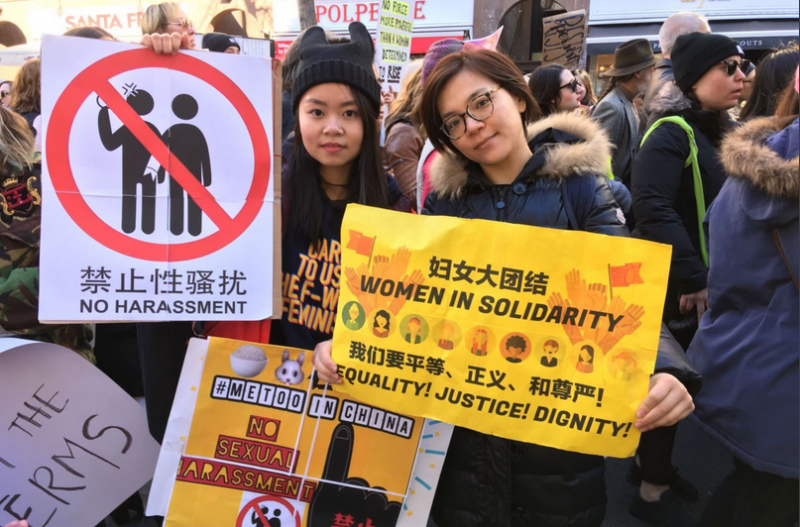
Chinese feminists march at NYC’s Women’s March

Betraying Big Brother is a necessary read to understand the role of women in Chinese society and why the feminist movement may be one of the few social movements to overcome the Chinese government’s persecution.  Make no mistake, Fincher is not a neutral observer; she admits as much in the Introduction stating that she is a convert to the cause and friends with many of the women she writes about.  But this doesn’t hinder her scholarship; she finds sufficient evidence to support her arguments.  Fincher believes that China’s feminist movement will achieve its goals: there is broad discontent among women in China that crosses class lines and the creativity of these activists give them the uncanny ability to constantly influence public opinion even in light of the government’s crackdown.  But while Betraying Big Brother is full of hope, Fincher is not naïve.  She knows that the Chinese government will not give up without a fight and that things are going to get a lot worse for these activists before they get better.  Huang Xueqin is a recent case in point.

Rating: ★★★★½

Betraying Big Brother: The Feminist Awakening in China, by Leta Hong Fincher (Verso 2018), 205 pages

***************************************************************************************************************************

[1] In the interest of full disclosure, Fincher is a colleague and friend .

When Journalism Is not Journalism: The Grayzone’s Faulty Analysis of What is Happening in Xinjiang

By , January 5, 2020

When I started seeing the Grayzone, a website that describes itself as “dedicated to original investigative journalism,” touted in various Chinese media reports (see here and here) for a study that allegedly debunked the estimate of one million Uighurs detained in internment camps in Xinjiang, I felt like I had to read it. But to call the Grayzone piece an analysis – or even objective journalism – would be a serious overstatement.  Instead, Ajit Singh and Max Blumenthal, the authors of “China detaining millions of Uyghurs?  Serious problems with claims by US-backed NGO and far-right researcher ‘led by God’ against Beijing,” largely dedicate their piece to the character assassination of the two organizations/people who first estimated the one million figure: the Network of Chinese Human Rights Defenders (CHRD) and Adrian Zenz, a social scientist at the European School of Culture & Theology and now a senior fellow at the Victims of Communism Memorial Foundation.

By focusing almost exclusively on ad hominem attacks, Singh and Blumenthal conveniently ignore that subsequent data sources have confirmed a one million number as credible.  And most absurdly, after portraying the CHRD and Zenz’s admissions that their numbers are merely estimates as a fatal flaw, Singh and Blumenthal completely fail to acknowledge why we can only estimate the number detained.  The keeper of the exact numbers – the Chinese government – refuses to publish any numbers let alone permit international monitors to enter Xinjiang and conduct their own, independent, on-the-ground analysis.

Protest to free one million Uighurs, held in Geneva in 2018

But regardless of the uselessness of the Grayzone article, it is good to periodically question our assumptions and re-review where exactly the the one million number comes from.  About a year ago, Jessica Batke, a senior editor at Asia Society’s ChinaFile and a former intelligence analyst at the U.S. Department of State, did just that, meticulously explaining why the one million estimate is likely not off the mark.  This post largely summarizes Batke’s piece in the context of the Grayzone article.

Singh and Blumethal begin their piece by questioning the CHRD study which was based upon interviews with eight ethnic Uighurs in Xinjiang.  For Singh and Blumethal, drawing a conclusion of one million detained from just talking to eight people is preposterous.   But the two choose to ignore the reasons why CHRD extrapolated one million detainees from its eight interviews.  As Batke points out in her analysis, each of these eight Uighurs were from a different village in southern Xinjiang.  Each person gave their estimate of the number of people who have gone missing in their village.  Based upon that number, CHRD formulated a detention rate for each village which ranged between 8% and 20%.  From those rates, CHRD chose a rather conservative estimate of a 10% Uighur detention rate province-wide, or, given that there are approximately 10 million Uighurs in Xinjiang, a one million detention number.
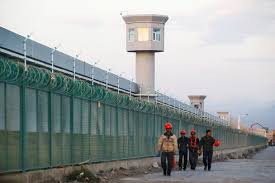
A prison camp in Xinjiang

Certainly there are things to question on CHRD’s numbers: how did each of these eight people know the number of people missing? Are they interned or did they just move?  But Singh and Blumenthal do not ask these questions.  Instead, for them, the death knell for the reliability of the CHRD estimate is the fact that CHRD receives funding from the National Endowment for Democracy (NED). But they never explain why this link matters or provide any evidence that this funding somehow undermines the reliability of CHRD’s estimate.

Similarly, Singh and Blumenthal’s review of Adrian Zenz’s study is more focused on his religious and political viewpoints, and his current source of funding, rather than on the data itself.  In the little attention the two give to Zenz’s data, they completely mischaracterize it.  Singh and Blumenthal state that Zenz’s one million estimate was based upon numbers reported by Istiqlal TV, a Uigher television station based in Turkey that often features interviews with suspected terrorists, which Singh and Blumethal believe reflect Istiqlal’s inherent unreliability.  But they conveniently leave out the fact that it was a Chinese public security official that leaked this data to Istiqlal TV, a fact later reported in Newsweek Japan.  Batke also noted this fact in her careful analysis of Zenz’s one million estimate, highlighting that the Chinese-leaked data listed around 892,000 individuals in 68 different counties in Xinjiang as detained.  However, as Zenz pointed out, the data was missing key population centers.  But instead of simply assuming that the same detention rate applies to the missing population centers, a method that would produce much more than one million detained, Zenz did a deep dive on the missing population centers, taking into account important difference, and according to Batke, comes up with a conservative – and plausible – estimate of one million detained.

Satellite images show the rapid construction of camps in Xinjiang

Batke also highlights corroborating evidence: the satellite images and Chinese government documents that also point to an equally large number of Uighurs being detained.  In October 2018, the BBC had experts review satellite images of the camps.  That group of experts concluded that 44 of the camps had a high or very high likelihood of being security facilities and a separate team architects determined that in examining one of these facilities, it could hold anywhere from 11,000 people, if each inmate has his or her own room, to 130,000 people, assuming these are dormitories.  Camp survivors have stated that they lived in cells with as many as 40 people.  Batke noted that if we took the higher number of people detained – which seems to be credible given survivors’ accounts – there would only need to be 10 similarly-sized camps to get to the one million mark.  Finally, as Batke points out, the Chinese government’s own documents – both its procurement documents and budget and spending reports –suggest that a very large number of people are being detained.

The one million estimate as the number of Uighurs detained is Xinjiang is not coming out of thin air.  Four different sources – CHRD, Zenz, satellite images, government documents – all come to the same conclusion.  Media outlets like ChinaFile and Quartz have also re-reviewed the data and found the one million estimate credible.  These outlets actively engage the data, unlike But Singh and Blumenthal whose focus is more character assassination.  Ultimately the only purpose that Singh and Blumenthal’s article serves is as a perfect example of the logical fallacy of argumentum ad hominem.

Panorama Theme by Themocracy