Paul French describes his gripping new book,Midnight in Peking: How the Murder of a Young Englishwoman Haunted the Last Days of Old China, as a belated quest to bring justice to a young woman, brutally murdered 75 years ago in Beijing. But the story is equally as applicable to the present, highlighting that our criminal justice system — and with the case of Bo Xilai, China’s criminal justice system — can easily fall victim to political agendas, singularly-focused investigations, and prejudices about who can and cannot commit a crime.
Midnight in Peking opens on a dark, cold morning in January 1937, in the dying days of old Beijing. A young white woman’s mutilated body is found near the haunted fox tower by an old Chinese man who is up early walking his caged bird. The body turns out to be that of 19 year old Pamela Werner, daughter of E.T.C. Werner, a former high-ranking British diplomat, China scholar, and single father who raised his daughter outside of the gated-off, foreign Legation Quarter of Beijing.
On the eve of the Japanese invasion, it was a murder that distracted Beijing as much as it obsessed it. And rightfully so. For the murder, and French’s amazingly detailed account of it, uncovers the debaucheries of some of foreign Beijing’s most elite, a young girl experimenting as a woman, and the official cover up that followed. On the eve of World War II, there was no way that British officials would allow the Empire and its respectability to lose face, even if it meant short-changing a police investigation and letting a diabolic murderer to go free.
Pamela Werner becoming a woman - taken a few days before her murder.
French’s talent lies in his ability to transport the reader back to 1937 Beijing, back to the Grand Hotel des Wagons Lits, back to the Badlands where seedy expat Beijing lead much of its life but rarely talked about it within the Legation Quarter. French also makes the characters come alive – with his seven years of painstaking research into the official criminal investigation and Pamela’s father’s own inquiry, French knows what each of the characters were doing, writing and saying at the time.
Midnight in Peking is known as a work of “literary non-fiction,” presenting the facts almost as a novel but unable to take any of the liberties that a work of fiction could permit. In reality though, the work has more of the drama of a good closing argument – a winning closing argument – presenting the facts,debunking the police’s simplistic conclusions (including that it was a Chinese who did it; who else would kill and mutilate a body), and thoroughly presenting a stronger theory of who did it, a theory that the reader eventually adopts.
Midnight in Peking is a remarkable read, a page turner that kept me in one Friday night just to find out who did it. But it is not just a story about the past. Sitting there, reading about a British murder investigation in China and seeing the prejudices that the police held about certain incidents, particular people and specific facts, made me think of the recent re-examination of the 1979 Etan Patz kidnapping case that is currently transfixing New York City. In that case, it appears that the police misjudged suspects and had a singular focus on a specific interpretation of the facts, even with little facts to back that up. Some 50 years after the Pamela Werner murder, police in New York City were making the same mistakes. Fast forward 33 years to today and most likely these same types of mistakes are still being made.
But more than anything, the book also demonstrates the susceptibility of any criminal justice system to power and politics. E.T.C. Werner was an outsider to British expat society of 1937, and not just because he chose to live outside of the Legation Quarter. That pissed people off and when it came time to investigate the murder of his daughter, Werner, as an outsider, became a suspect. The murderers that French eventually uncover were not just accepted in British society but considered the elites of Beijing. That acceptance – and the fact that the British diplomats didn’t want a scandal on their hands – allowed them to live their lives as free men. Ultimately politics – both individual as well as national – proved more important than justice. Even when Werner conducted his own investigation and uncovered many of the lies of key suspects, British diplomats continued to ignore his pleas for justice for his daughter.
Not surprisingly, when reading French’s book, the Bo Xilai case – where Bo’s wife is accused of murdering a British national – was not far from
An old ETC Werner, around the time of his daughter's murder
my mind. Given the politics involved in that case and the fact that perhaps Bo became an outsider to the Party system, it makes one wonder about the accuracy of the story that the Chinese government is currently presenting to the press. If it could happen in British Peking in 1937, it can certainly happen in Chinese Beijing in 2012. Likely, no criminal justice system is immune to political pressure. It would be foolish – and dangerous – to think that any system is impervious.
Midnight in Peking is a remarkable story, wonderfully written and with characters that just come to life – some you love, some you hate and some you just despise. For those who want to be transported to the past, Midnight in Peking is your ticket there; but for those who want to understand the present, more precisely the mistakes inherent in any criminal justice system, Midnight in Peking will take you there. Whichever trip you decide to make, French will take you on a fun ride.
French also has a great website about the book, including his own explanation as to what propelled him to write the book and a walking tour of Pamela’s Beijing (with downloadable podcasts). For anyone who does the walking tour, I would be interested in you take of it. Please comment below!
Chen Guangcheng, entering a Beijing Hospital with US Ambassaor Gary Locke and State Dep't Legal Advisor Harold Koh
More often than not, I am my friends’ go-to China person; something in the news pops up with China, I get the questions. So I wasn’t surprised on Saturday when over some carrot cake at the Chelsea Market a friend of mine had questions about Chen Guangcheng: if he cared so much about human rights in China, why would he leave? What is up with the Chinese government, keeping a blind man trapped in his own home? How did things get so messy between the U.S. government and Chen?
It’s been almost a month since Chen fled the home that illegally became his prison. So what exactly is up with Chen’s escape and to answer some questions – what does it all mean?
Chen’s Escape Has Propelled Human Rights to the Top of the US-China Agenda
My friend’s question on Saturday caught me off guard – does Chen really care about human rights in China if he fled to the protection of the U.S. Embassy, ostensibly to seek asylum and leave China.
To ask a man with a wife and two children to be a martyr for his cause is asking too much. As this blog has recounted previously, since Chen’s release from prison (oddly convicted of a traffic disturbance) did not result in freedom. Instead, for the past year and a half, Chen and his family have been subjected to illegal house arrest and at times, physical torture by his captures.
It is true that by departing China, Chen’s ability to change China’s current system will be much reduced if not extinguished. But his heroic flight has perhaps done more to highlight the Chinese government’s recent illegal oppression of dissent than anything else. Over the past year and a half, this blog has increasingly written about the Chinese government’s crackdown on China’s nascent rights defending (weiquan) lawyers. Aside from people already interested in the issues, these posts – and the acts of repression which they have focused on – have received little attention.
Chen’s escape and his subsequent stay at the U.S. Embassy altered this focus. With Hillary Clinton arriving for the Strategic and Economic
Inspiring Architecture? The US Embassy in Beijing
Dialogue (S&ED), the focus of U.S.-China relations shifted to human rights. For one week, as the world watched, the U.S. and China’s relationship was thrown back to a 1980s-Cold War paradigm, when ideology played a more governing role. For one week, the Western media’s attention finally focused on the repression of rights defending lawyers, and the lip service the Chinese government gives “rule of law” when it comes to civil rights and civil liberties.
It is amazing that a single man’s act, that one blind man’s heroic act, can still change the dialogue in U.S.-China relations. It is a hopeful reminder that in this globalized world, individuals still matter; that one man’s quest for freedom is still “news.” And don’t think Chen’s act was not a heroic one. Not only was a blind man able to find his way to Beijing, but imagine if he wasn’t; imagine if he was caught. Likely his fate would match that of Gao Zhisheng, a rights defending lawyer who, while in government custody, remains missing.
The U.S. Government’s Actions Supported Human Rights
Some have criticized the U.S. government – or more aptly, the Obama Administration – for its dealings with the Chinese government over Chen. Initially, the U.S. Embassy worked out a deal with the Chinese government whereby Chen would stay in China, study law at a university in a coastal city away from the thugs of his hometown, and be left alone with his family. This was what Chen initially wanted.
But once he left the safety of the embassy for a Beijing hospital, Chen began to reconsider his options. As Prof. Jerome A. Cohen recounted to CNN, the promised U.S. Embassy official was unable to stay with Chen at the hospital and once he began speaking other rights defending lawyers – friends he hadn’t been able to speak to for a year – he began to more clearly understand the increased oppression of rights defending lawyers in China. Chen was scared; Chen realized that without full information, he misjudged the situation. That’s when he vocally requested that he be able to leave China for the United States.
Were some in the U.S. Embassy a touch too naive to rely on the Chinese government’s promises? Most likely. But being naive is not the same as turning one’s back to human rights. It was Secretary of State Hillary Clinton’s decision to allow Chen into the U.S. Embassy in the first place. Chinese citizens cannot just willy-nilly enter the U.S. Embassy; even American citizens are allowed limited access to their embassy (which resembles a high-security prison). As the N.Y. Times has recounted, embassy officials were notified of Chen’s flight to Beijing and on April 25, Secretary Clinton gave the authorization to sneak Chen into the embassy compound. Secretary Clinton knew full well that by providing that approval, a throw-down with the Chinese government on the issue of human rights was certain and the ultimate outcome unclear. It is unfortunate – although not all together shocking given the current acrimonious status of politics – that Washington D.C. cannot view this moment as a proud one for America and its ideals; that the web of support that both parties have built for a human rights network in China over the years enabled Chen to come to our door. Instead, it appears that what could otherwise be a proud moment for Americans, is becoming a political tug-of-war.
Who is Driving the Bus? The Chinese Central Government’s Lack of Control
Beep Beep! Who drives this bus??
What is perhaps the most shocking of all from this whole situation is the Chinese central government’s lack of control of local governments. Chen’s persecution has largely been conducted by the local government in his hometown, with local government officials still seething after his attempt to bring a lawsuit against them for forced abortions. But even when Chen fled to Beijing, his safety could not be guaranteed, hence his changed desire to leave for the United States. Many of his relatives left in their villages are being persecuted by local officials. It makes one wonder – who really drives the bus in China?
Imagine a United States where Governor George Wallace could ignore federal law, have his way and continue segregation in his home state of Alabama. Likely you can’t. It’s unfathomable to think that a national government is unable to enforce its own laws, and in the case of China, that a supposed authoritarian dictatorship cannot control lower level party members.
Chen’s case reflects a center weaker than anyone previously thought. And that is what is most frightening and should give people pause. Does China really have the power to become a rising superpower or will it revert to its warlord past, where each city is governed by its own power broker and the central government remains impotent?
While China’s weakness appears to manifest itself often in human rights issues, it should not be just a concern for human rights advocates. Anyone working in or with China – business people, government officials – should be troubled. A weak center, especially as China undergoes an important leadership transition this year, does not bode well for China.
Prof. Jerome Cohen – The Fixer
On a final note, I want to focus on Prof. Jerome Cohen and his role in all of this. As a research fellow for two years, I had the privilege of working
Prof. Jerome A. Cohen
with Prof. Cohen at NYU’s U.S.-Asia Law Institute. In that time, I got to know a kind, brilliant man who never ceased to amaze me. It was Prof. Cohen who first identified the ingenuity and necessity of Chen’s unschooled, “barefoot lawyer” approach in 2003 and deservedly catapulted him to the world stage.
While my two years with Prof. Cohen were filled with inspiring moments, I have never been more proud of him than I was with his handling of the Chen Guangcheng situation. While this is all purely based on hearsay, it appears that it was Prof. Cohen who got the U.S. and China out of what was becoming a crisis situation. Prof. Cohen’s lifetime of experience with China, including high-level delegations soon after Nixon’s visit to China in 1972, allowed him to realize that all that was needed was a practical solution where everyone could save face: a scholarship for Chen to study law at NYU’s U.S.-Asia Law Institute and invitation for his wife and children to join him.
Now we wait and see. The United States has approved Chen’s visa application and just yesterday he applied for his Chinese passport. Although the Chinese government could renege on the deal, that looks increasingly less likely and ultimately not in their best interest. It’s never a satisfying moment when one of your citizens essentially seeks protection from a foreign government for human rights abuses, but on some level, the Chinese government is likely happy that Chen, who has long been a rabble rouser and a cause célèbre for other Chinese rights defenders and foreign friends, is leaving the country. Unfortunately for Chen and his family, he will likely never be able to return to his home country.
The Chinese Government stated today that Mr. Chen Guangcheng has the same right to travel abroad as any other citizen of China. Mr. Chen has been offered a fellowship from an American university, where he can be accompanied by his wife and two children.
The Chinese Government has indicated that it will accept Mr. Chen’s applications for appropriate travel documents. The United States Government expects that the Chinese Government will expeditiously process his applications for these documents and make accommodations for his current medical condition. The United States Government would then give visa requests for him and his immediate family priority attention.
This matter has been handled in the spirit of a cooperative U.S.-China partnership.

 On Facebook
 By Email

 Comments (6)
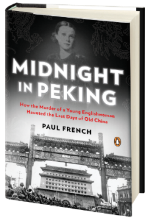 Paul French describes his gripping new book, Midnight in Peking: How the Murder of a Young Englishwoman Haunted the Last Days of Old China



 Themocracy