Huntsman Arrives in China; Xu Zhiyong, Zhang Lu & Ilham Tohti are Released

By , August 25, 2009

A day after Ambassador Huntsman’s arrival in Beijing, Chinese authorities released three prominent activists on

Ambassador to China Jon Huntsman

Ambassador to China Jon Huntsman

Sunday: Xu Zhiyong, founder of Gongmeng, a public interest law organization, Xu’s assistant Zhang Lu, and economics professor and Uighur Online founder, Ilham Tohti.

Both Xu and Zhang were released on bail, a very rare occurrence under Chinese law, signifying that higher authorities likely gave approval to release the two.  Although bail is theoretically available, in the vast majority of criminal cases, the suspect remains in custody until trial.

The circumstances surrounding Tohti’s release are much less clear, but it appears that charges against him are no longer pending.

Was it U.S. pressure on the Chinese government that secured the release of these three activists?  While it likely played a role, there are other important factors that influenced the Chinese government.  First, there was significant domestic pressure, especially for the release of Xu and Zhang.  Through small donations, some as little as five or one yuan, Gongmeng was able to raise over 800,000 yuan (over $115,000) to pay the fine imposed by the tax courts.   Additionally, a group of well-regarded academics and professionals issued an open letter to the Chinese government requesting the release of Xu and Zhang.

In addition to the domestic support for Xu and Zhang’s release, a second factor that likely played a part is that their actions are viewed as less threatening to the Chinese government.  Xu’s organization, Gongmeng, worked within the

Activist, Gao Zhisheng

Activist, Gao Zhisheng

legal system, using the very laws passed by the National People’s Congress to protect the rights of vulnerable individuals.  Other activists who have taken a more strident approach to the Chinese government have not been released.  Gao Zhisheng, an attorney who has ardently represented members of the religious organization Falun Gong and who also openly called on western nations to boycott the 2008 Beijing Olympics, was taken into custody in February 2009 and has not been heard from since.

Although Gao Zhisheng and Liu Xiaobo and many others remain in Chinese police custody, the release of Xu, Zhang and Tohti should still be viewed with guarded optimism.  Evidently, for those activists who do not go too far, the Chinese government does respond to domestic and international pressure.  However, what it means to “go too far” is still unclear and detention of activist attorneys will likely continue.

But Ambassador Huntsman and President Obama should see the release of these three activists as a positive sign, and should continue with the dialogue they have evidently already started with the Chinese government.

Public Trials Announced in Xinjiang Riot Cases

By , August 25, 2009

China Continues to Blame Outside Forces for Riots

This morning, the China Daily reported that over 200 people will go on trial, likely this week, for various crimes

Photo of Chinese protestors in Urumqi, Xinjiang on July 5, 2009

Photo of Chinese protestors in Urumqi, Xinjiang on July 5, 2009

relating to the July 5 riots in Xinjiang.  Surprisingly, the China Daily also reported that all trials will be public aside from those involving charges of “splitting the State” and “instigating to split the State.”  Because the number of cases involving these charges has not been announced, it is unclear how many of the trials will in fact be public.

Additionally, officials have yet to announce how many of the defendants are Han Chinese and how many are Uighur; at least some will be Han since the China Daily last week reported that trials of the Han defendants will occur before the Uighur defendants’ trials.

The announcement that over 200 people were arrested and face trial in the coming week was a departure from the “small number” originally anticipated.  At the beginning of August, the Chinese police stated that out of the 1,600 people detained, only 83 had been arrested.  Under the Chinese Criminal Procedure Law, a suspect can be detained for days, and in politically sensitive cases for a good month, without being formally arrested.

As with most of the articles concerning the Xinjiang riots, China Daily’s recent report again blamed foreign forces for instigating the riots.  Both the Chinese press and Chinese officials have repeatedly assigned blame for the riots to Rebiya Kadeer, a Uighur woman who was granted political asylum in the United States in 2005.  Once viewed as a model minority by the Chinese government because of her successful businesses in Xinjiang, Ms. Kadeer soon fell out of favor when she began to support Uighur causes.   Jailed in 1999 for allegedly passing state secrets, Ms. Kadeer was freed to U.S. custody in 2005.  Since then, she has become president of the Uighur American Association and the World Uighur Congress.

Because the Chinese government is intent on presenting an appearance of a “harmonious society,” it is essential that it seeks to blame outside forces when discontent is presented by some of its minority groups, regardless of the claim’s validity.  After the March 2008 protests and riots in Tibetan areas of China, the Chinese government vilified the Dalai Lama, accusing him of being the mastermind behind the riots.  However, the government never provided any evidence to support the claim that the Dalai Lama was involved (see Premier Wen Jiabao’s statements here).

Similarly, with Ms. Kadeer, the Chinese government has accused her of organizing the riots from her home in Washington, DC (for a scathing critique of Ms. Kadeer in the Chinese press, click here).  While the Chinese government claims to have a recording of a phone call to her brother allegedly evidencing her role, this recording has never been made public.

Interestingly though, China’s denunciation of the Ms. Kadeer might have the unintended consequences of designating a leader of a movement that up to this point was without one.  Tibetans easily rally around the Dalai Lama since he is their spiritual leader.  But for Uighurs, there have been few that have reached the level of the Dalai Lama and symbolize their culture and religion quite the same way.  However, by continuously pointing to Ms. Kadeer and accusing her of masterminding the riots, the Chinese government may have inevitably provided the Uighur people and the Uighur movement with a much needed leader.

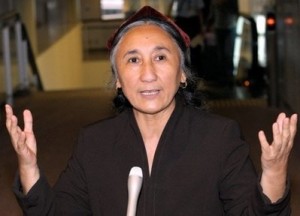
Rebiya Kadeer, President of the Uighur American Association

Rebiya Kadeer, President of the Uighur American Association

Panorama Theme by Themocracy